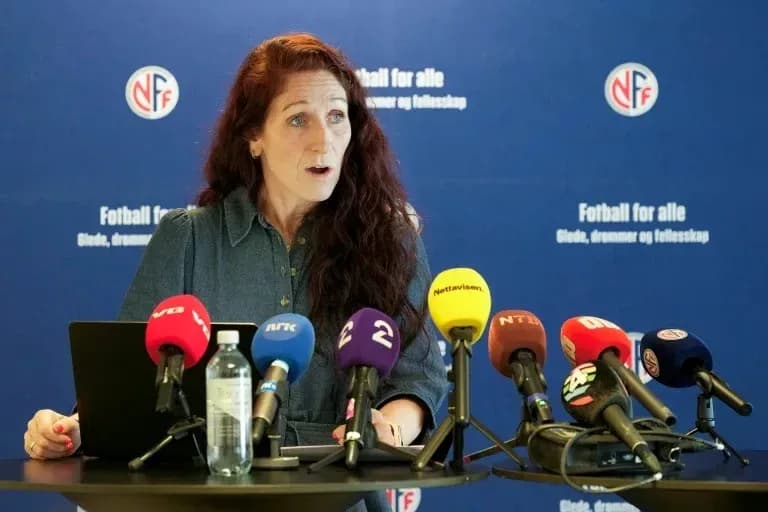
Lise Klaveness: The Rebel Challenging FIFA's Leadership
Lise Klaveness has spent the past few years doing what so few inside football’s inner sanctum dare to do: saying out loud what many whisper in the corridors.
Now, some in the game want her to go one step further and take Gianni Infantino’s job.
From Reformer’s Hope to Chief Critic
When Infantino swept into power in 2016, he did so on a reform ticket. Transparency. Good governance. A cleaner FIFA after the Blatter era. Klaveness, a 45-year-old lawyer and former Norway international with 73 caps, remembers that promise well.
“He was a candidate who had been elected on a reform programme focused on good governance,” she told AFP.
Then, in her view, the project collapsed.
“Things quickly deteriorated: from keeping a distance, we moved to giving up, and even backtracking,” she said, pointing to what she sees as FIFA’s growing dependence on heads of state and powerful figures, particularly from World Cup host nations.
The break with Infantino did not come quietly.
In 2022, shortly after taking over as president of the Norwegian federation, she flew into the heart of the storm: Doha. On the eve of the World Cup in Qatar, with FIFA desperate to keep politics at arm’s length, Klaveness walked straight into the spotlight and attacked the very foundations of the tournament’s award.
From the stage, she condemned the decision-making that had put Qatar on the global stage, arguing that “human rights, equality, democracy, the core interests of football, were not in the starting 11.”
It was a line that cut through the noise. And it marked her out as a problem for FIFA’s leadership.
Norway followed words with action. In 2023, the federation refused to back Infantino’s re-election, a symbolic but pointed rejection from a member association rarely seen as a power-broker.
“She was in a way the first standard-bearer for much of this criticism that many others now share when it comes to the way Infantino runs FIFA,” said Mina Finsted Berg, sports commentator for Norwegian broadcaster TV2.
Klaveness, Berg added, “is very committed to ensuring that rules and decisions are respected.”
Trump, Balogun and the Breaking Point
If there was tension before, the last few months have turned it into open conflict.
Three flashpoints, in particular, have pushed Klaveness and the Norwegian federation into direct confrontation with FIFA.
- First, the decision to award a FIFA “Peace Prize” to US President Donald Trump, a man with whom Infantino has maintained an unusually close public relationship.
- Then came the lifting of US forward Folarin Balogun’s suspension for the 2026 World Cup after an intervention by Trump. The optics were stark: a disciplinary matter apparently swayed by political influence.
- Finally, the plan that shook the game’s foundations: opening FIFA competitions, including the World Cup, to private investors. That project was shot down last week, but the mere attempt has deepened mistrust among critics who fear the commercialisation of football’s crown jewels.
For Klaveness, those three cases formed a pattern. The Norwegian federation has now decided to take all of them to FIFA’s Ethics Committee.
On Friday, she went a step further and called for Infantino to resign.
Her voice carries more weight these days. Norway, long absent from the latter stages of major tournaments, produced a strong run at this year’s World Cup before falling to England in the quarter-finals. The team’s resurgence has only sharpened the sense that the country’s federation is punching above its weight off the pitch as well.
Internationally, Klaveness is now routinely described as having a “strong moral compass.” Within that growing chorus, a question keeps surfacing: if Infantino falls, could she be the one to replace him?
A Woman in a Man’s Game
Inside FIFA’s glass towers, that idea still feels radical. Outside, it is gaining traction.
“She was the only one who always took a clear stand and did not go along with the mainstream. And at FIFA, the time is right for a woman to take the lead,” wrote former FIFA president Sepp Blatter on X.
The endorsement is striking, not least because Blatter himself left office disgraced in a corruption scandal. Yet his words underline how unusual Klaveness is in the upper reaches of the game.
She is one of the very few women operating at that level of football politics. And for many, that alone is a barrier.
“In addition to being seen as extremely radical in many places, especially outside Europe, she is a woman. That is also likely to count against her in many regions of the world,” warned TV2’s Mina Finsted Berg.
Even in Europe, where one might expect greater support, the path has been bumpy. In 2023, Klaveness failed to win election to UEFA’s Executive Committee. She only made it onto the body in 2025, and then only because she was the sole candidate for the seat reserved for women.
That struggle has not gone unnoticed at home.
“If she already has such a hard time getting elected in Europe, how could she convince Africans and South Americans?” asked former Norway goalkeeper and now commentator Erik Thorstvedt.
Not a ‘Game of Thrones’ – But a Power Battle All the Same
Klaveness has tried to push back against the idea that this is just a personal duel with Infantino, or a drama scripted for global television.
She insists the crisis inside world football cannot be reduced to a “Game of Thrones” storyline. For her, the issue is structural, not personal.
“For us, it has never been a personal issue against Gianni Infantino,” she told AFP. “The problems go beyond the person of the president.”
Still, politics is politics. Her name now circulates in conversations about the future of FIFA, whether she likes it or not. She admits she has “registered” that her candidacy is being floated, but refuses to be drawn on whether she will run. “We’re not there yet,” she said.
Infantino, for his part, is not behaving like a man preparing to step aside. He is standing for a fourth and final term next March and, as things stand, is the only declared candidate.
That leaves world football at a crossroads. On one side, an entrenched president, still powerful, still largely unchallenged at the ballot box. On the other, a federation chief from a relatively small football nation, armed with a legal background, a playing career, and a refusal to look the other way.
The question now is not whether Lise Klaveness will keep speaking. She has shown she will. It is whether the rest of the football world is ready to follow her into a fight that could reshape who really runs the global game.