
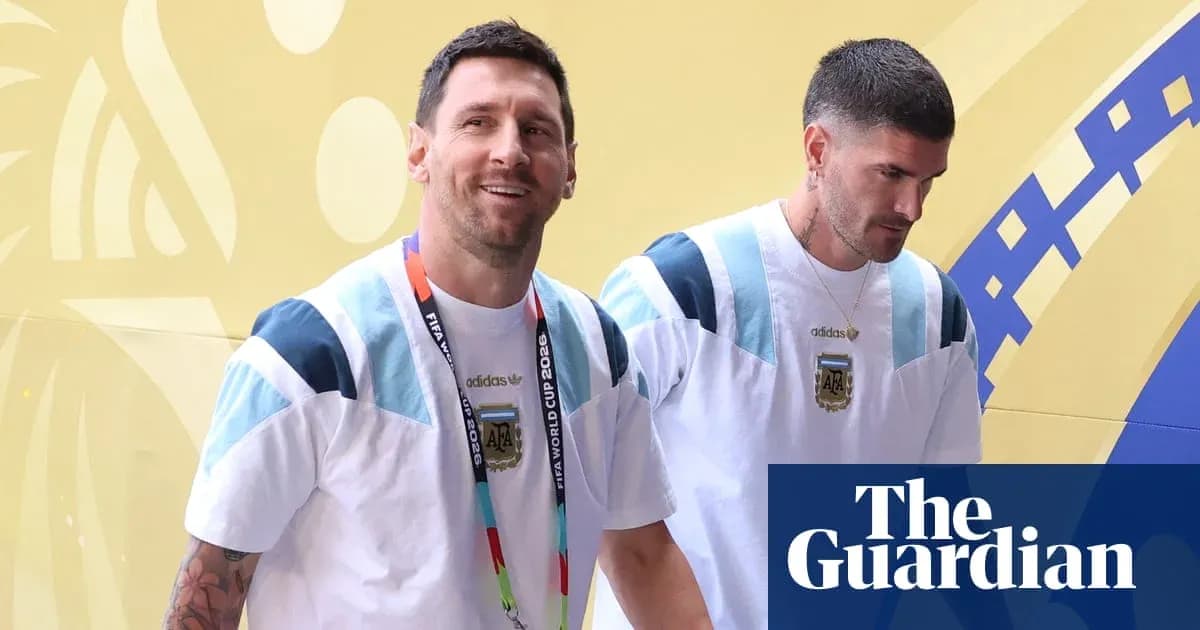
Lionel Messi's World Cup Journey: A Last Orbit
Lionel Messi’s last World Cup? It felt like it, looked like it, and for long stretches, it played like one of his great epilogues.
He left without a trophy, without a Golden Ball, without a Golden Boot. He left with something else: another month where the game revolved around him.
Messi, one last orbit
Messi was always going to be No 1. Argentina built the tournament around him and then stepped out of the way. No pressing burden, no defensive graft. Just the ball, the space and his 39-year-old imagination.
Eight goals. Four assists. The most progressive passes of any player, per Futi. The numbers only sketch the outline.
He dragged Argentina through the group and into the knockouts almost by force of will. A 3-2 win over Cape Verde? He decided it. The game against Egypt? He assisted, then equalised. England, late on and hanging on? He created both of Argentina’s late goals, the kind of cold-blooded interventions that have defined his international career.
Then came the final, and the silence.
Across 139 minutes including stoppage time, Messi completed just 28 of 39 passes, took a single shot and rarely shaped the game. The stage was there, the script was waiting, but the old magic flickered instead of burning. No medals, no awards – a rarity in his career – yet another layer to a World Cup legacy that sits on a different shelf from almost everyone else.
Argentina’s lieutenants: De Paul does the dirty work
Behind Messi’s roaming genius, Rodrigo De Paul did what he always does: run, bite, recycle, repeat.
The Inter Miami midfielder started all but two of Argentina’s games on the way to the final and logged 70 minutes against Spain. He was aggressive without being reckless, tidy on the ball without trying to be the hero. De Paul was never going to dominate the headlines, but he helped Argentina reach a second straight World Cup final by keeping the midfield stitched together while Messi floated free.
Canada’s heartbeat: Eustáquio and a nation’s first
Canada arrived with ambition. Stephen Eustáquio made sure they left with history.
One of Canada’s primary creators, the Porto midfielder kept swinging crosses into dangerous areas and threading passes through lines. He averaged 2.76 chances created and 0.36 expected assists per 90 minutes, and his 46 progressive passes were the sixth-most of any player at the tournament.
His defining moment came late, with the clock draining in the last-32 tie against South Africa. A clearance dropped, he stepped in, chested it down and lashed a half-volley into the bottom corner. First World Cup knockout victory for Canada, sealed by their metronome in midfield. After four months on loan at Los Angeles FC before the tournament, he returned to Porto with his reputation enhanced and his place in Canadian football history secure.
Richie Laryea, another long-time Canada stalwart, had a more uneven ride. He offered 0.26 xA per 90 and helped progress the ball on the left, but defensive lapses cost Canada. He lost his man on Bosnia and Herzegovina’s opener from a corner, and against Switzerland he was repeatedly out of position or slow to track back. For a player who has been a fixture in this team, the World Cup passed without the spark that has often defined his international performances.
Maxime Crépeau endured a difficult tournament in goal. Six goals conceded, six saves in five games for the Orlando City keeper. Jacob Shaffelburg came off the bench in all five matches for LAFC but couldn’t bend a game to his will. Mathieu Choinière started once, in the 2-1 defeat to Switzerland, and Jonathan Osorio was limited to late cameos, entering in the 87th minute or later twice. Jayden Nelson’s World Cup boiled down to a brief appearance in the 87th minute of a 3-0 knockout loss to Morocco. Canada’s supporting cast flickered, but never truly caught fire.
South Africa’s new star: Mbokazi grows up on the world stage
Mbekezeli Mbokazi arrived as South Africa’s youngest call-up at just 20. He played like one of Bafana Bafana’s elder statesmen.
The Chicago Fire defender, once captain of Orlando Pirates, looked composed, assured and strangely seasoned on the biggest stage. His performances didn’t just stabilise South Africa’s back line; they shifted his market value. Transfermarkt had him at $4m before the tournament. By the end, that number had more than doubled to over $9m. A World Cup as a launchpad, not a learning experience.
Paraguay’s grinders: Galarza and Cubas in the trenches
Paraguay spent the tournament without the ball and somehow still made a dent.
Their average possession across all matches was 29%, the lowest of any team. That put a ceiling on what Matías Galarza could do in attack, yet he still started every game after the opener, scored the lone goal against Turkey and set up Julio Enciso’s strike against Germany in the knockouts. Within a counter-punching system, he showed he could still make his touches count. After a loan spell at Atlanta United, he returned to River Plate with proof that he can function in a low-possession, high-stress environment.
Alongside him, Andrés Cubas did the dirty work. The Vancouver Whitecaps midfielder played every minute of Paraguay’s five matches as the team’s destroyer. His work without the ball allowed Paraguay to drag Germany to penalties and restrict France to a single goal. In the quarter-final, he won seven of 12 duels, piled up seven tackles and three interceptions, and even found time to tangle with Kylian Mbappé. It was the kind of tournament that doesn’t make highlight reels but wins the respect of coaches everywhere.
Braian Ojeda had to settle for a 21-minute cameo against Germany in the last 32, touching the ball only nine times. Miguel Almirón’s campaign never caught light: four shots, 0.11 xG across four starts for the Atlanta attacker, and a red card against Turkey after covering his mouth during an “altercation” – the first high-profile enforcement of the new IFAB mouth-covering ban. Paraguay’s World Cup will be remembered as much for that flashpoint as for their stubborn resistance.
New Zealand’s mixed bag: Surman shines, Boxall struggles
For New Zealand, the World Cup offered a glimpse of the future and a painful reminder of the present.
Finn Surman, at 22, produced a breakout pair of performances. The Portland Timbers centre-back threw himself into last-ditch tackles, cleared danger with conviction and looked like one of the All Whites’ standout players. He even chipped in at the other end, scoring their only goal in a 3-1 defeat to Egypt.
At the other end of the age spectrum, Michael Boxall fought the clock. One of the oldest players at the tournament, the veteran Minnesota defender looked half a step off the pace, often a stride behind as New Zealand conceded. For a player who has carried the back line for years, it was a harsh reflection of how quickly the international game can move past you.
USA: a tale of goalkeepers, trust and a Belgian storm
The United States’ World Cup was shaped as much by who didn’t convince as by who did.
Sebastian Berhalter became one of Mauricio Pochettino’s go-to substitutes, appearing in every match. When he finally started, it was as a No 6 – a role that exposed the squad’s lack of specialist defensive midfielders more than any personal flaw. Even so, the Vancouver Whitecaps man, reportedly on his way to Middlesbrough, still found a way to leave a mark with a goal and an assist.
In goal, Matt Freese and Matt Turner lived opposite versions of the same story. Freese, NYC FC’s 27-year-old keeper, was solid across four games: accurate distribution, nine saves, and a sense of calm – until one poor game, and within it, one poor moment, came to define his tournament. Turner, the former US No 1 now back as New England Revolution’s first-choice, started against Turkey and had a nightmare: three goals conceded, not a single save.
At centre-back, trust was in short supply. Miles Robinson, of FC Cincinnati, barely figured, with his only minutes arriving in a dead-rubber group game. Tim Ream, the capital-V Veteran now at Charlotte, saw his World Cup reduced to a brutal 4-1 defeat to Belgium. On the opener, he lost track of an in-form Charles De Ketelaere, who poached from close range with Ream nowhere in the frame. Moments after the US equalised, De Ketelaere climbed above the 38-year-old at the back post and headed in again. One night, two moments, and a distinguished international career suddenly looked mortal.
Max Arfsten’s tournament was over almost before it began: a 90th-minute introduction in that same 4-1 loss to Belgium, no touches, just the final whistle.
Australia: quiet operators and a teenager steps in
Australia’s campaign was defined by industry rather than spectacle.
Aiden O’Neill, so often a quiet conductor for New York City FC, replicated that role for his country. A possession-oriented central midfielder, he knitted play together, rarely wasting a touch. He took home the Superior Player of the Match award against Paraguay, then backed it up with another strong showing against Egypt.
At the back, Lucas Herrington announced himself. Just 18 and the youngest player in Australia’s squad, the Colorado Rapids centre-back forced his way into the XI and started the final two matches. Kai Trewin, another NYC FC defender, stepped in at half-time of the knockout tie against Egypt after Jordan Bos’s injury and helped Australia drag the contest to penalties.
Colombia and the end of an era: James fades out
Twelve years after he lit up Brazil, James Rodríguez arrived in the United States looking like a man chasing echoes.
On loan at Minnesota United, the Colombian playmaker still had flashes of the old artistry. Two years earlier at Copa América, he had delivered a legacy run: one goal, six assists in six matches, and a heartbreaking second-place finish behind Argentina. This time, the end product deserted him. Colombia exited in the last 16 to Switzerland, and James’s final World Cup outing – like his club career in recent years – drifted to a drawn-out, empty close. The technique was still there. The cutting edge wasn’t.
Uruguay’s stopper, South Korea’s silence
Juan Manuel Sanabria drew one of the toughest assignments of the tournament: keep Lamine Yamal quiet. The Real Salt Lake man started Uruguay’s final group game against Spain and largely did just that. Yamal finished with only 0.03 xG and 0.10 xA, completing five of 12 attempted dribbles. Sanabria’s performance didn’t grab headlines, but it put a lid on one of the game’s brightest young attackers for 90 minutes.
For Son Heung-min, the World Cup was a study in frustration. The 34-year-old LAFC forward started twice, failed to score, and then watched from the bench in South Korea’s must-win final group match. For a player who has carried his national team for a decade, the tournament offered no redemption arc, just a blunt full stop.
Croatia’s nearly men
Croatia’s attack never quite clicked.
Petar Musa, the FC Dallas striker, managed only one shot across two starts and 110 minutes – though he did at least convert it. Marco Pasalic, Orlando City’s 25-year-old winger, had a promising start in Croatia’s third group game but squandered his one clear chance to score. In a team that has so often thrived on clinical moments, the margins went the other way.
Haiti and Panama: uphill all the way
Haiti arrived as the lowest-ranked team in the tournament and played like a side permanently under siege.
Danley Jean Jacques, of Philadelphia, shared a double pivot with Jean-Ricner Bellegarde and spent most of his minutes firefighting. Louicius Deedson, FC Dallas’s winger, featured in all three group defeats, logging 112 minutes and just 13 completed passes – a number that said as much about the pressure Haiti faced as it did about his influence. Derrick Etienne Jr saw only nine minutes, coming on against Brazil and completing four passes.
Panama’s Carlos Harvey started all three group games. The 6ft 1in Minnesota midfielder threatened occasionally from set pieces with a couple of dangerous headers but otherwise had a muted tournament. Aníbal Godoy’s entire World Cup boiled down to a single minute plus stoppage time against Ghana. He completed eight of eight passes, but could not stop a last-gasp winner in the dying seconds.
Iraq’s fine margins
Ahmed Qasem played in every match for Iraq and lasted the full 90 against France, a rare feat against that level of opposition. The Nashville forward started the final group game too, only to be sacrificed early after Rebin Sulaka’s 13th-minute red card forced a tactical reshuffle. His tournament became a reminder of how quickly plans can unravel when you are clinging to parity against giants.
Cape Verde’s steel, Uruguay’s grit, and the rest
Steven Moreira may not have matched the spotlight enjoyed by his fellow Cape Verde full-back Sidny Lopes Cabral, but the Columbus defender anchored a back line that pushed Spain, Uruguay and Argentina to the edge. Cape Verde’s “near-glory” owed plenty to his steady presence.
For the USA-based fringe players, the World Cup flashed by in snapshots. Carlos Harvey’s headers, Braian Ojeda’s brief German cameo, Louicius Deedson’s 13 passes, Derrick Etienne Jr’s nine minutes, Max Arfsten’s touchless appearance. Moments, not arcs.
And that, in many ways, is the story of this World Cup from an MLS and US-based perspective: a tournament of roles big and small, of legacies extended and careers questioned. Messi walked away without a medal. James Rodríguez walked away without a spark. Young defenders like Mbokazi, Surman and Herrington walked into a different future.
Whose next four years will those few weeks define the most?



