
Lionel Messi: The Uncertain Future of a Football Legend
Lionel Messi is 39 years old, a World Cup runner-up again, and still carrying a nation on his back. No one in Argentina is pushing him toward the exit. Least of all the man who runs the game there.
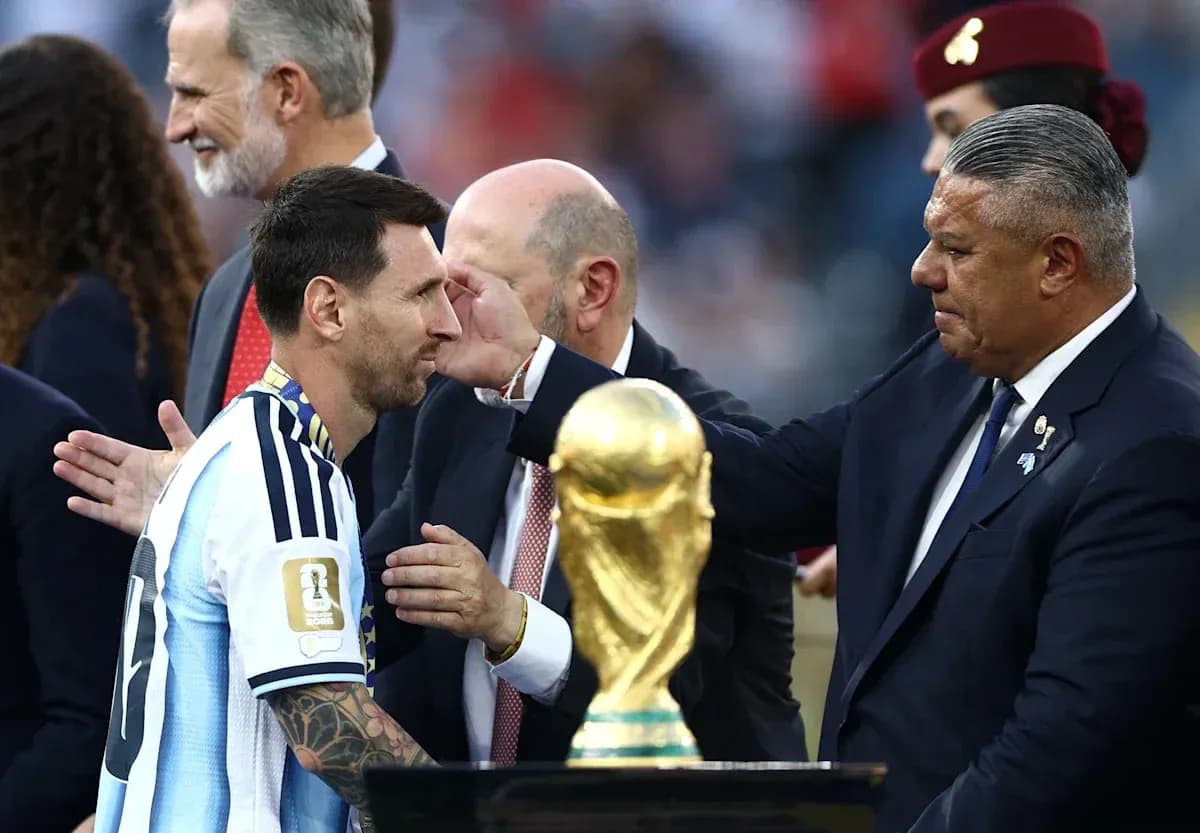
For Claudio “Chiqui” Tapia, president of the Argentine Football Association, the future of the greatest player in the country’s history comes down to one person.
Messi.
“It’s a decision that is purely and personally his,” Tapia said in an interview on Argentine television, making it clear there will be no pressure from above, no gentle nudges toward a farewell tour. “You have to let him relax.”
A World Cup that was never guaranteed
Two years ago, in Qatar, the conversation was already swirling. Would Messi even make it to 2026? He had finally delivered the World Cup, beaten France in a final for the ages, and many assumed that was the perfect curtain call.
Messi refused to script it that neatly. He spoke of taking it “game by game,” and then, this past summer, he did something even more improbable: he raised his level again on the biggest stage.
In the United States, at a World Cup that was never a certainty for him, Messi produced eight goals and four assists for La Albiceleste, driving Argentina all the way back to another final. At 39, he was still dictating matches, still bending tournaments to his will.
Argentina fell 1-0 to Spain in extra time last month, the title slipping away in a narrow, suffocating defeat. The trophy stayed out of reach, but the debate over his status did not.
“If you analyse the World Cup he had, for me he was the best player,” Tapia said. “We enjoyed it a lot, and we’ve got to feel proud. I enjoyed every moment. Without a doubt, he was the standard-bearer of this group in the World Cup. He was break records match after match.”
The grammar may have slipped. The message did not.
Chasing and breaking records
Messi’s tournament was historic even by his standards. He became the first player to surpass Miroslav Klose’s long-standing record of 16 World Cup goals, climbing past the German’s mark as he kept dragging Argentina forward.
Then the narrative twisted again.
French star Kylian Mbappé, already a World Cup icon in his own right, finished the tournament with 22 goals, overtaking Messi by one and setting a new benchmark. In the space of a few weeks, two men had rewritten the scoring record that once looked untouchable.
Messi’s numbers, though, were about more than milestones. They were a response to the doubts that had circled after 2022, proof that age had not stripped him of his vision, his timing, or his knack for rising when it matters most.
No retirement date, no clear finish line
For now, Messi has given no hint of when he will step away from the national team, or how long he intends to keep playing for Inter Miami in MLS. The speculation is constant; the player remains silent.
“You have to let him keep enjoying playing football,” Tapia said. “And after that he’ll make the decision he feels is the right one.”
Around him, the calendar keeps moving. The 2026 World Cup is set. The 2030 edition, to be staged in Spain, Portugal and Morocco, with Argentina, Uruguay and Paraguay each hosting a match in a centennial nod to history, already looms on the horizon.
Messi would be 43 by then.
The oldest outfield player to appear at a World Cup remains Cameroonian forward Roger Milla, who played at 42 years and 39 days, according to FIFA. This summer, Cristiano Ronaldo pulled on a Portugal shirt at 41, stretching the limits of what an elite forward can do in the modern era.
Messi is edging into that territory now. But no one around him is drawing a line in the sand.
The next window, and a whisper of farewell
Argentina’s next international dates fall between September 21 and 29, with two friendlies expected but no opponents yet confirmed. Those fixtures, routine on paper, carry a different weight this time.
There has been growing speculation that the next home match could be Messi’s last in front of an Argentine crowd in national-team colours. No announcement, no statement. Just a possibility that hangs over every conversation about tickets, venues, and opponents.
As Copa America champions, Argentina will also defend their 2024 title in 2028, though the host nation has yet to be named. That tournament sits as another marker on the horizon, another point at which the country will wonder if Messi will still be there, still orchestrating, still deciding games.
He has already stepped beyond what was expected after Qatar. He has already shown that timelines and age charts don’t quite apply to him.
The decision, as Tapia keeps repeating, belongs to Messi alone. The rest of the world will simply wait to see how long he chooses to keep bending football’s rules.



