Lionel Messi Scores 20th World Cup Goal Against Cape Verde
Lionel Messi scored again.
Three against Algeria, two against Austria, one against Jordan. Now Cape Verde. Another night, another World Cup knockout tie bent to his will, as Argentina edged a wild, breathless 3-2 win in Miami to reach the last 32.
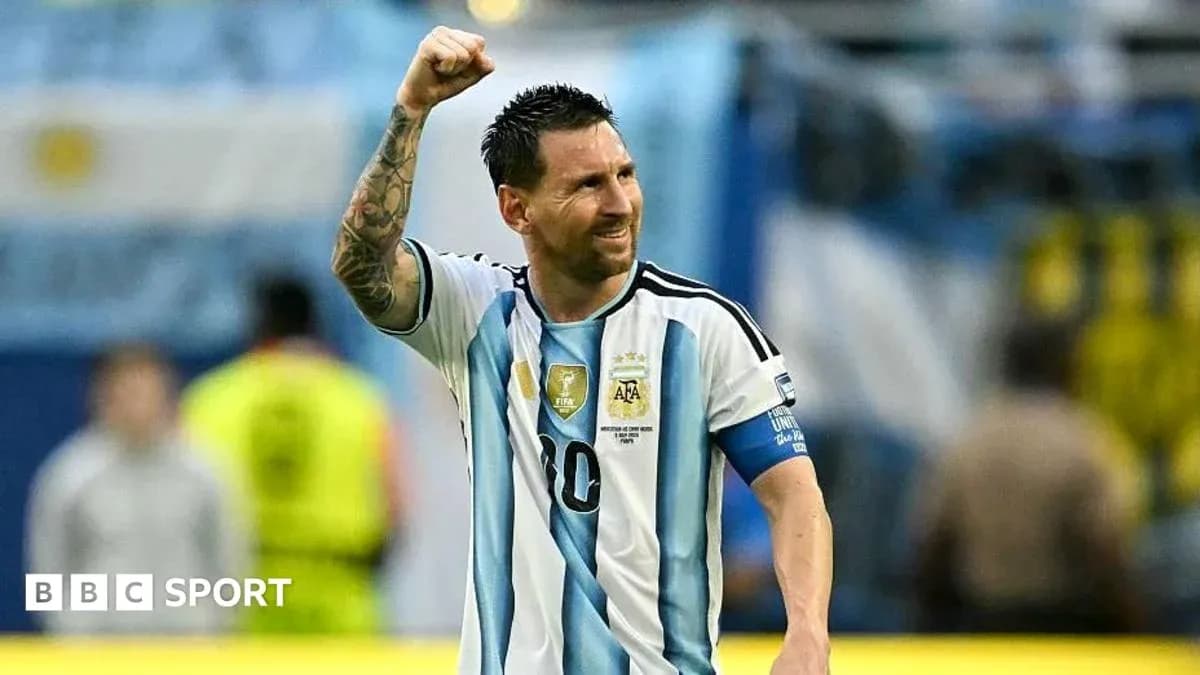
His opener, the first crack in Cape Verde’s resistance, carried more than just the weight of the occasion. It was his 20th goal at World Cup finals, extending the record he had already ripped from history during the group stage in the United States. His seventh of this tournament alone.
The numbers feel almost routine now. The setting did not.
Outside the stadium, Miami turned into a slice of Buenos Aires. Streets were washed in sky blue and white, drums thudded in the humid air, and songs rolled out from early afternoon. Supporters posed beneath enormous Argentina flags, the kind that need half a dozen people just to keep them off the pavement.
Inside, the stands were a sea of blue and white shirts, the number 10 stitched on what felt like every other back. Flags hung from railings. One banner caught the eye: Messi and Diego Maradona side by side, rendered as saints, an image that said more about Argentina’s footballing faith than any chant ever could.
“He’s our hero. He’s like our God,” said one fan before kick-off, speaking for thousands.
“He has aged like fine wine,” another added. “The older he gets, the better he gets.”
The talk, as always, drifted quickly to records and awards. Could he take the Golden Boot? The answer from the stands was simple: if Argentina reach the final, he will be there or thereabouts. Yet there was also a shrug of contentment. For many, he has already given enough.
“We’ve already had so much from him,” said one supporter. “If he wins it, fantastic, but everything he’s already done for Argentina is enough. He is incredible.”
On the pitch, this was not Messi at his most dominant. By his own impossible standards, he drifted in and out. Cape Verde refused to play the role of overawed underdog, pressing with belief, snapping into tackles and attacking with a freedom that belied the gulf in the rankings – Argentina second in the world, Cape Verde outside the top 60.
They disrupted Argentina’s rhythm, forced errors, made the world champions think.
But Messi only ever needs a single opening.
The breakthrough came with the kind of simplicity that belongs only to geniuses. He ghosted off the shoulder of the last defender, timing his run perfectly to meet Lisandro Martínez’s pass. One touch to gather in stride, a second to lift the ball over the advancing goalkeeper. Calm, precise, inevitable.
In that instant, the noise inside the stadium shifted from tension to release. The pressure that had been building finally found its outlet in a familiar left foot.
On BBC Radio 5 Live, former Scotland forward James McFadden could only marvel.
“The run he makes is beyond the backline and the timing is excellent,” he said. “The weight of the pass into him is outstanding and his first touch is exquisite.”
ITV’s Ally McCoist reached for the only phrase that really fits: “genius at work”. Then came the line that has followed Messi for years: “It’s just one record after another. It’s amazing.”
The facts back him up. No player, male or female, has ever scored 20 World Cup goals before. No one else has scored in eight consecutive World Cup appearances. No one else has managed seven or more goals at two separate World Cups, as Messi has now done in 2022 and again here.
Seven goals would have been enough to win the Golden Boot in five of the past six World Cups. Since 1978, there have been 13 tournaments; his current tally would have topped the scoring charts in all but two.
What separates him now is not speed or relentless pressing. It is his reading of the game. While others sprint, Messi studies. He walks, scans, waits. He conserves energy until the picture in front of him looks exactly as he wants it.
At 39, that economy of movement has become his superpower. He checks over both shoulders before the ball even comes near, senses where the space will open, then arrives just as defenders realise they are too late.
Yet this World Cup has shown another layer. The veteran conductor has been willing to get his hands dirty.
“Throughout the years, Messi has walked at times in games to assess what is happening,” McFadden noted. “But here he is getting back to try and win the ball and is leading the press. It’s not a full, high-energy press, but he is leading it.”
So the mind remains sharp, the feet still decisive, and the work-rate – in bursts – very much present.
If there is a place on earth built for Messi’s late-career chapter, it might be Miami. The city’s large Argentine community has wrapped itself around him since his move to Inter Miami in 2023. His influence now stretches far beyond the stadiums.
His face is painted on walls across the city. Murals, flags, shop windows – all carry his image. Children in Argentina’s number 10 shirt play barefoot on the sand, trying to curl a ball into an invisible top corner. His name is sung long before kick-off, a chorus that starts in the streets and rolls into the stands.
Even the food tells the story. Argentine restaurants proudly push the milanesa – breaded beef or chicken, one of Messi’s favourites – and some have gone further, naming dishes after him. You don’t just watch Messi in Miami. You eat like him.
Around him, the media circus has grown into its own ecosystem. In the mixed zone after games, normal rules of access seem to collapse. Journalists pack themselves into every available inch of space, microphones jabbed forward, cameras raised high in the hope of catching a glimpse, a word, a nod.
Conversations die mid-sentence when he appears. Television crews jostle, lenses tilt, bodies lean. Then, as quickly as he arrives, he vanishes down the corridor, leaving behind a trail of unanswered questions and half-finished soundbites.
Entire digital platforms exist simply to track his every move, breaking down training clips, tunnel shots and warm-up routines with forensic obsession. Every new record, every new milestone, is clipped, shared and replayed across the world within minutes.
This World Cup, then, is not just about Argentina’s attempt to add another star above the crest. It has become another chapter in a career that refuses to slow down, a rolling global event built around one man’s relationship with a football.
He has already rewritten what longevity at the highest level looks like. The only real question left is how much more history he plans to make before he finally walks away.