Levski Sofia vs AEK Athens: Tactically Rich Goalless Draw
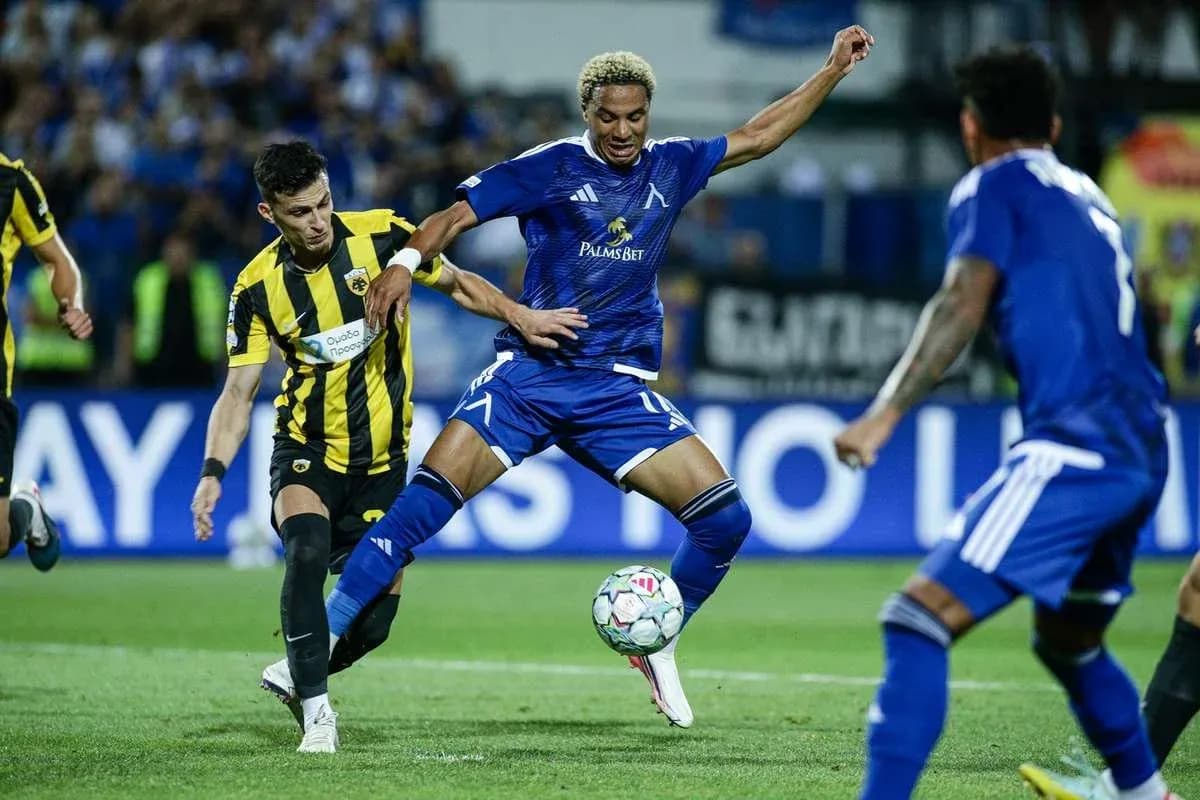
Levski Sofia and AEK Athens FC played out a goalless but tactically rich draw at Georgi Asparuhov Stadium, a match defined more by structure and control than by chaos in either box. Over 90 minutes, the game evolved into a duel between Levski’s 4-2-3-1 positional possession and AEK’s compact 4-4-2, with both sides largely neutralising each other’s strengths and finishing with a 0-0 scoreline that accurately reflected the balance of risk.
Levski’s 4-2-3-1 under Julio Velazquez was clearly built to dominate the ball and progress through midfield. The double pivot of M. Moubarik and Maicon provided the base: Moubarik often held his position in front of the centre-backs K. Dimitrov and N. Serafimov, while Maicon stepped higher to connect with the line of three – A. Oko-Flex, Serginho and Everton Bala – behind lone forward Reinaldo. This structure helped Levski edge possession 52%–48% and complete 485 passes with 428 accurate (88%), underlining a controlled, circulation-heavy approach.
In build-up, full-backs A. Neves and A. Centelles gave width, allowing the wide midfielders to drift into half-spaces. Levski’s shot profile – 15 total shots, with 6 inside the box and 9 from outside – shows a team that frequently reached the final third but often had to settle for efforts from distance. The 4 blocked shots for Levski indicate AEK’s back line, led by H. Moukoudi and F. Relvas, was consistently in position to step out and smother attempts before they truly tested T. Strakosha.
AEK’s 4-4-2 under Marko Nikolic was more direct and vertical, with Zini and L. Jovic starting up front. The midfield quartet of L. Majer, R. Marin, K. Kairinen and A. Koita was tasked with compressing central spaces and springing transitions. AEK generated 12 total shots (5 inside the box, 7 from outside) but managed only 1 shot on goal, a sign that their attacking moves often broke down at the edge of the area or were forced into low-quality attempts.
The defensive structures were the real story. Levski committed only 8 fouls to AEK’s 17, suggesting Velazquez’s side defended more through positioning and counter-pressing than through physical duels. Their back four stayed relatively narrow, trusting the wide midfielders to track AEK’s full-backs. This compactness limited clean central entries for AEK’s forwards and forced them to shoot from poorer angles.
Conversely, AEK’s higher foul count pointed to a more disruptive plan: break Levski’s rhythm early, especially as the hosts tried to play through the thirds. With 17 fouls and only 2 corner kicks conceded, AEK were effective in preventing Levski from turning possession dominance into sustained set-piece pressure. Their 2 blocked shots also reflect timely interventions on the edge of the box.
The goalkeepers had relatively quiet but efficient evenings. S. Vutsov (Levski Sofia) faced little direct threat, needing just 1 save behind a back line that largely controlled AEK’s attempts before they hit the target. On the other side, T. Strakosha (AEK Athens FC) made 3 saves from Levski’s 3 shots on goal, underpinning the clean sheet with reliable handling whenever Levski did break through.
The substitution pattern in the second half underlined the tactical chess. At 57', Nikolic moved first, reshaping his attacking and midfield dynamics: L. Majer (OUT) made way for P. Mantalos (IN), adding more creativity and control in the right half-space, while L. Jovic (OUT) was replaced by B. Varga (IN), a change that freshened the front line and offered different movement against Levski’s centre-backs. This hinted at AEK seeking more ball retention and smarter occupation of pockets rather than pure penalty-box presence.
Velazquez responded on 67' with a like-for-like attacking refresh: A. Oko-Flex (OUT) was replaced by J. Perea (IN), injecting new energy and potentially more direct running from the right. Late in the game, Levski pushed for a winner with a triple wave of changes. At 79', Everton Bala (OUT) was replaced by M. Soula (IN), and Reinaldo (OUT) made way for A. Mitkov (IN), suggesting a tweak in the front structure and fresh legs to press AEK’s build-up. On 88', A. Neves (OUT) was substituted by S. Hevertton (IN), followed at 89' by Maicon (OUT) for S. Stoyanchov (IN), moves that re-energised both the back line and midfield for a final push without breaking the core 4-2-3-1 shape.
AEK mirrored this late-game recalibration at 81'. A. Koita (OUT) was replaced by M. Gacinovic (IN), adding a more nuanced, ball-secure profile on the flank, while Zini (OUT) gave way to O. Zubkov (IN), another sign of a shift towards mobility and link play rather than pure target presence. These changes helped AEK maintain defensive solidity and occasionally threaten on transition without overcommitting.
Statistically, the match was balanced but with stylistic contrasts. Levski’s 485 passes to AEK’s 453, and near-identical passing accuracy (Levski 428 accurate at 88%, AEK 394 accurate at 87%), show two technically competent sides. Levski’s extra volume of shots (15 vs 12) and marginal possession edge reflect their territorial initiative, but AEK’s ability to hold them to just 3 shots on goal – despite Levski’s 6 efforts inside the box – illustrates a disciplined defensive block.
With expected goals and goals prevented data absent, the best proxy for chance quality is the shots-on-goal column: 3 for Levski, 1 for AEK. That slim advantage, combined with Levski’s territorial control, suggests the hosts were marginally closer to nicking the win, but not decisively so. AEK’s compact 4-4-2, underpinned by Strakosha’s clean sheet and a high defensive work rate, earned a draw that fits both the numbers and the tactical story: a tight, controlled first leg in the UEFA Champions League Play-offs where neither side was willing to overextend and risk the tie.