
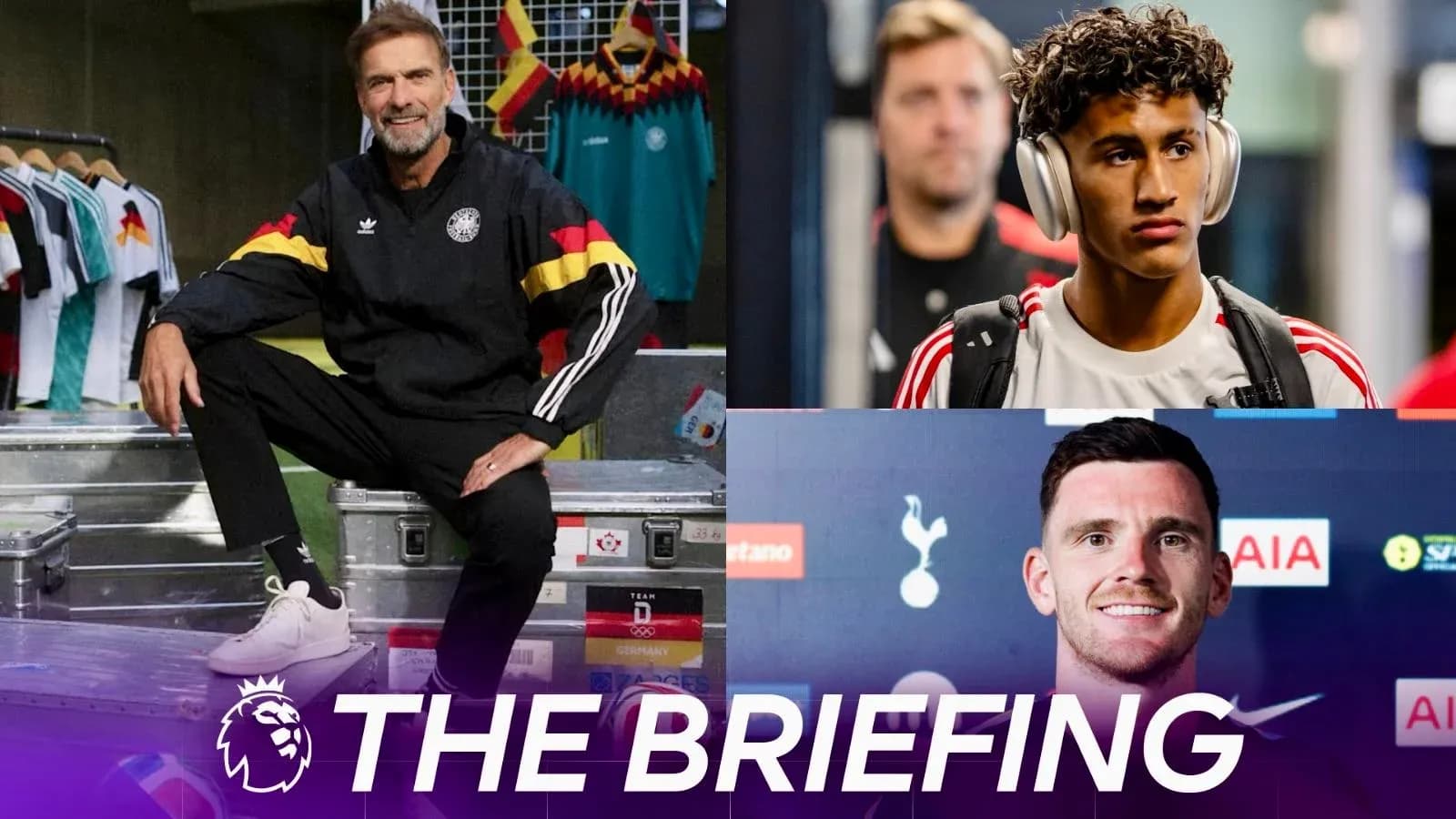
Jurgen Klopp Returns as Germany's Head Coach
Jurgen Klopp is back.
After a self-imposed exile from the touchline and months spent away from the daily grind of club football, the former Liverpool manager has been confirmed as Germany’s new head coach on a contract running through to the end of the 2030 FIFA World Cup.
The man who dragged Liverpool back to the summit of English and European football now walks into one of the most demanding jobs in the game, charged with reviving a national team that has lost its way.
Klopp, who left Anfield in 2024 after nine years, cited fatigue when he stepped aside. He did so as a Premier League, UEFA Champions League and FIFA Club World Cup winner, among a haul of other trophies that restored Liverpool’s status among Europe’s elite. Since late 2024, he has worked as Red Bull’s global head of soccer, watching from a distance as others took centre stage.
A broken giant, a new figurehead
Germany’s slide has been as stark as it has been painful. The latest blow came last month, a round-of-32 exit to Paraguay that prompted Julian Nagelsmann’s resignation. A team once synonymous with tournament certainty finds itself at one of its lowest points in modern history.
Klopp now becomes the man expected to change that story. His remit stretches across the next UEFA European Championship and the 2030 World Cup, a full tournament cycle in which Germany will be judged not on plucky progress but on whether it can again look like Germany.
He will not do it alone. Familiar faces are coming with him. Former Liverpool assistants Pep Lijnders and Peter Krawietz will join his coaching staff, reuniting the core brains trust that underpinned Liverpool’s resurgence. In January, Per Mertesacker will step in as the German Football Federation (DFB)’s new sporting director, leaving behind his role overseeing Arsenal’s academy at the end of the 2025/26 season.
The structure is being built around Klopp. The expectation is already in place.
“It was almost like a movie happening to myself,” Klopp admitted as the scale of the job sank in. “I have always surmised the job of Germany head coach is really big, but now it is really dawning on me what being the national team head coach is all about.
“For many, many years it was unimaginable for me to assume this position. As the years went by, it became more or less evident that sooner or later I would be asked to do this job. Now I think the time is right.”
His first test carries its own narrative twist. In September, Germany face the Netherlands, captained by Virgil van Dijk, the defender who became a pillar of Klopp’s Liverpool era. Old alliances will be set aside for 90 minutes. The scrutiny will not.
JJ Gabriel steps onto United’s senior stage
While Germany turn to a proven heavyweight, Manchester United are looking to the future.
In Trondheim on Friday, a 15-year-old forward will travel with the senior squad and offer supporters a glimpse of what might be coming. JJ Gabriel, the club’s latest teenage sensation, has been named in a 25-man party for a pre-season friendly against Rosenborg.
Gabriel dominated at youth level last season. He began the campaign at just 14, yet finished it as the Under-18 Premier League player of the season. Across all competitions for United’s Under-18s, he scored 29 goals in 32 appearances, driving the team to the FA Youth Cup and Premier League Under-18 Cup finals.
Rules, not talent, kept him out of the Premier League spotlight. Academy players must have turned 15 before the end of August to feature in that season’s senior squads, so Gabriel’s age barred him from a competitive debut. His performances still dragged him into the orbit of the first team. He became a regular at senior training sessions, learning the rhythms of the top level before he was even eligible to play there.
A winger by trade, he spent much of last season operating centrally, showing the kind of adaptability that excites coaches. The comparisons will come thick and fast. The history is already there. The youngest player to feature in a competitive match for United remains David Gaskell, who made his debut in 1956 at 16 years and 19 days. Gabriel does not turn 16 until October.
United manager Michael Carrick, speaking last season, did not bother to disguise his admiration.
“JJ’s a big talent,” he said. “It’s pretty obvious to know that. And he’s had a really good season for the Under-18s. We obviously think an awful lot of him, but patience is important in managing everything that comes with working with him.”
The message is clear. United believe they have something special, but they intend to manage his rise carefully. Trondheim is the next step, not the destination.
Newcastle double down on youth with Bamba
Up the Premier League ladder, another club is betting heavily on potential.
Newcastle United’s recruitment drive has turned decisively towards untapped talent, and the signing of 20-year-old central midfielder Aladji Bamba is the latest piece of that strategy. Bamba, who only made his professional debut for Monaco last season, joins a summer intake with an average age of just 19.5.
He follows goalkeeper Ewen Jaouen (20) from Reims, winger Bazoumana Toure (20) from Hoffenheim and central midfielder Sean Steur (18) from Ajax. This is not a scattergun collection of prospects; it is a clear attempt to reset the squad’s age profile after major departures.
Sandro Tonali has gone to Tottenham Hotspur. Anthony Gordon has left for Barcelona. Both exits ripped out proven quality from Eddie Howe’s side. Newcastle’s answer has been to lean into youth, to find the next wave rather than chase like-for-like replacements at inflated prices.
Bamba, naturally more defensive-minded but capable of playing higher up the pitch, looks a candidate to evolve into a long-term successor to Tonali. The numbers from Ligue 1 last season back up the impression of a midfielder who relishes the contest. Among midfielders who played at least 500 minutes, he ranked in the top five for duels won (9.1 per game on average), tackles (3.6), successful take-ons (1.6) and aerial duels won (1.9).
Those figures paint a picture of a player who can break up play, carry the ball and dominate physically. If Newcastle’s gamble on youth pays off, Bamba will be central to the story.
Robertson trades 26 for 3 out of respect to King
At Tottenham, a new signing has made his first mark not with a tackle or a cross, but with a number.
Andy Robertson, fresh from ending his nine-year spell at Liverpool, has chosen not to wear his customary No 26 shirt at Spurs. Instead, the Scotland captain will line up with No 3 on his back, a decision rooted in respect for club legend Ledley King.
Robertson wore 26 at Dundee United, Hull City and Liverpool. At Tottenham, that number has not been used since King retired in 2012. The former Spurs captain, now a club ambassador, remains a towering figure in the club’s recent history.
“From my point of view, I wanted to respect that,” Robertson explained. “He was an unbelievable player and has done so many good things for this football club.
“Number 3 means a lot to me – that’s my national team number, I’ve had so many good memories as number 3 for Scotland so when I knew 3 was going to become available, it was a no-brainer for me."
His first minutes in that shirt should come on Spurs’ pre-season tour to New Zealand and Australia, with fixtures against Auckland, Sydney FC and Chelsea on the agenda. The travel has already produced its first glimpse of dressing-room life.
Robertson revealed that his closest friend in the squad is James Maddison, and the England midfielder wasted no time showing it. Maddison posted a photo of Robertson looking less than thrilled on the flight to New Zealand, captioned: “He better liven up if he’s my company for this 26 hour flight.”
Twenty-two hours later, Maddison supplied the update: Robertson, smiling this time.
Klopp stepping into a national storm, Gabriel edging towards the spotlight, Bamba trying to grow into Tonali’s shadow, Robertson rewriting his identity at Spurs by choice of number alone – different stories, same undercurrent. Careers turning. Clubs reshaping. The next season will not wait for anyone.



