Harry Kane vs Erling Haaland: A Clash of Strikers
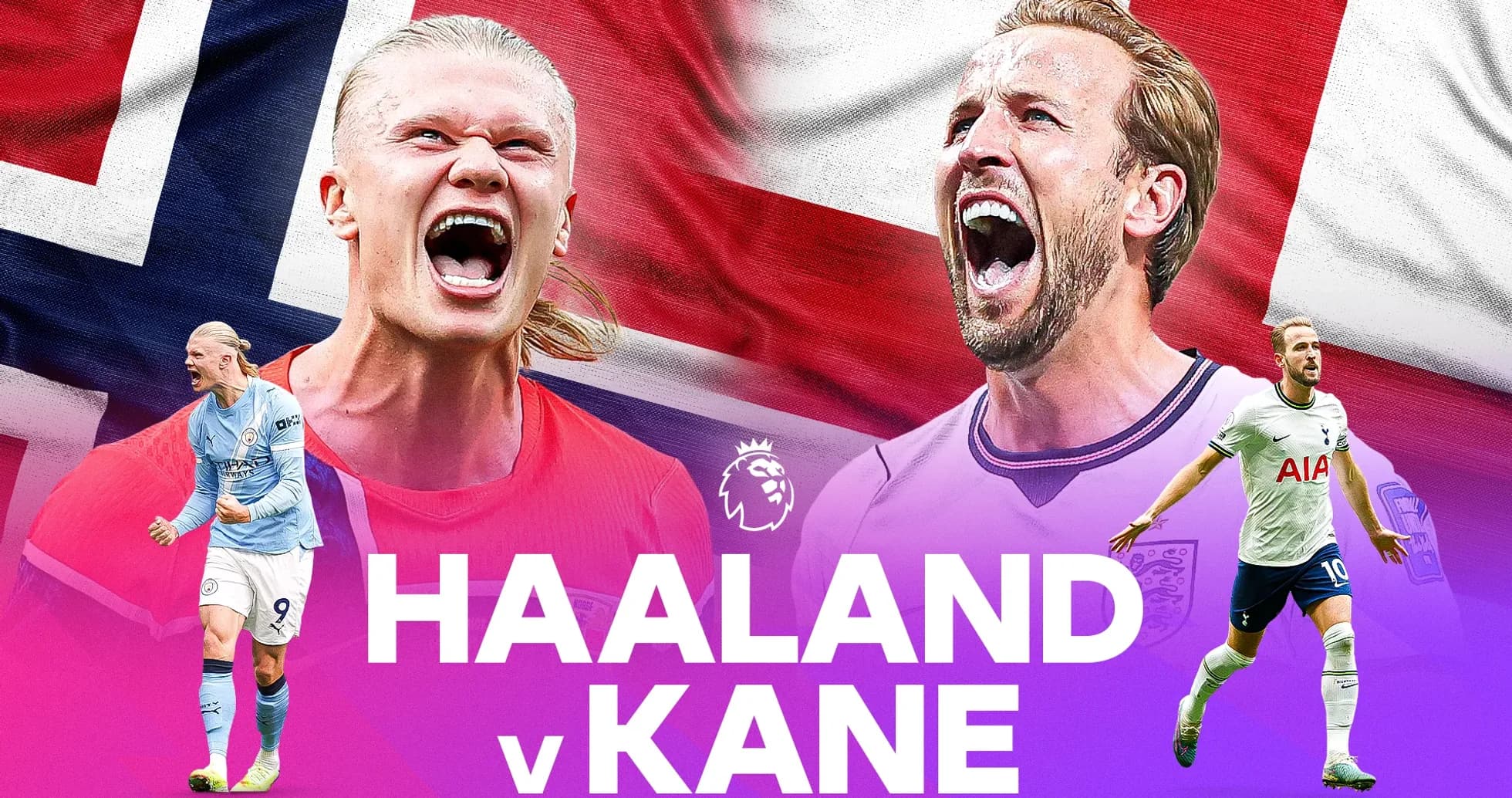
On Saturday in the 2026 FIFA World Cup quarter-final, England v Norway is being billed as Kane v Haaland. It’s more than a meeting of centre-forwards. It’s a clash of two different ideas of what a striker should be.
Both are giants of the Premier League era. Both have bent entire seasons to their will. Yet they could hardly be more different.
Haaland is the purest finisher of his generation, a cold-eyed executioner who lives for the final touch. He prowls on the shoulder, then explodes. One chance, one swing, one goal. A ruthless machine, built to harvest numbers and medals.
Kane is something else entirely. Creator. Conductor. Finisher. He wore the number 10 at Tottenham Hotspur by choice, a statement that he saw himself not just as the spearhead but as the heartbeat. He drops off, he threads passes, he dictates tempo – and then still turns up to score the winner.
They have shared only one Premier League season, 2022/23, yet their rivalry has grown in parallel, line by line on the record books.
The Numbers: Haaland’s Freakish Rate, Kane’s Towering Total
Strip it down to the bare numbers and you’re looking at two of the most devastating forwards the Premier League has ever seen.
Haaland has 112 Premier League goals, already 25th on the all-time list. His goals-per-90 figure is astonishing: 0.91, the best in the competition’s history.
Kane sits on 213 Premier League goals, second only to Alan Shearer’s 260. His rate? 0.71 per 90, fourth-best of all time. Not as explosive as Haaland’s, but sustained over almost a decade at Spurs.
That’s the key context. Kane’s tally came over nine seasons as a first-team regular in north London. Haaland has had just four Premier League campaigns.
Project Haaland’s current output forward and the picture changes. At 0.91 goals per 90, he needs roughly 113 more games – about four more seasons at his current average of 33 matches – to score the 102 goals required to move past Kane into second place on the all-time list.
He has eight years left on his current contract. On that timeline, he needs only half of it to overtake Kane, then another 52 matches to chase down Shearer’s 260.
Give him the games, and Haaland is on course to become the Premier League’s greatest goalscorer. That’s the brutal, simple truth of his numbers.
For now, though, Kane still stands higher on the mountain.
Peak Seasons: Kane’s Consistency v Haaland’s Explosion
Their arrivals in the Premier League could hardly have been more different.
Kane eased into the spotlight. He was 21 by the time Mauricio Pochettino unleashed him properly in 2014/15, his breakthrough a slow build rather than a lightning strike.
Haaland did the opposite. He tore the door off its hinges. In his debut season in English football, 2022/23, he smashed the single-season goals record with 36 league goals. No one had seen anything like it.
That same season was Kane’s Spurs farewell. He signed off with 30 Premier League goals – the second time he had hit that mark in the competition.
Look at their top scoring seasons and Kane’s sustained excellence stands out.
Haaland’s 36 in 2022/23 sits at the top. Kane’s 30 in 2022/23 and 2017/18 follow. Kane’s 29 in 2016/17 also makes the top bracket, before Haaland reappears with 27 in 2025/26.
Kane, then, has more entries among the elite single-season hauls. Haaland’s counter-argument is obvious: he simply hasn’t had as many seasons to populate the list.
Records, Awards, and the Trophy Gap
On the record front, they trade blows.
Haaland owns the fastest-ever race to 100 Premier League goals, the single-season goals record, and that outrageous per-90 rate. He has redefined what “instant impact” looks like.
Kane counters with longevity and loyalty. He holds the record for most Premier League goals for a single club – 213 for Spurs – and the most goals in London derbies, with 51.
Individual awards? Again, it’s tight, with a tilt towards Kane on volume, and towards Haaland on age and trajectory.
Haaland has five Golden Boots: three in the Premier League and two in the UEFA Champions League. He has three Player of the Year awards – one each in the Premier League, Bundesliga and UEFA competitions – plus a European Golden Shoe.
Kane has nine Golden Boots across his career: three in the Premier League, three in the Bundesliga, one in the Champions League, one at the World Cup and one at the Euros. He has a Bundesliga Player of the Year award and two European Golden Shoes.
The major difference comes when you zoom out from individuals to teams.
Haaland’s sides have lived at the summit. He has three league titles – two Premier Leagues and one Austrian Bundesliga – a Champions League, and five domestic cups: two FA Cups, one EFL Cup, one DFB-Pokal and one Austrian Cup.
Kane’s trophy cabinet has filled up late. He has two Bundesliga titles and a single DFB-Pokal.
That disparity fuels one of the central arguments of the Kane-Haaland debate. Haaland has won more because he has played more often in title-winning environments. Kane’s supporters will point out that his numbers came for a Spurs side that rarely operated at that level, which makes his scoring output all the more remarkable.
Kane in Germany, Haaland for Norway: Elite Numbers in Tough Settings
Kane’s move to Bayern Munich has underlined that point in bold.
His Bundesliga record is absurd: 98 goals in 94 matches. Those are Messi-Ronaldo numbers, the sort of output that makes you wonder what his Premier League tally might look like had he spent his peak years in a Pep Guardiola super-team.
Haaland has his own version of that argument on the international stage.
Norway are not England. They do not live in the latter stages of major tournaments. Yet Haaland has ripped up their scoring history: 62 goals in 54 caps, a rate of 1.26 goals per 90 minutes. He has scored in each of his last 14 internationals.
Kane’s England record is outstanding in its own right: 85 goals in 119 caps, at 0.83 goals per 90. He is a record-breaker for his country. Haaland’s ratio is simply on another level.
So you end up in a familiar place: relatively even. Kane leads in many categories because he has been at it longer. Haaland leads in trophies because he has played more often in trophy-winning teams.
The 2025/26 Verdict – and a Quarter-Final Stage
So who is better right now?
As of July 2026, the answer leans towards Kane, and it does so for one overwhelming reason: the season he has just produced.
In 2025/26, Kane scored more goals in all club competitions than any player in Europe. He finished with 61. Kylian Mbappe was next on 42. Haaland, by comparison, hit 38.
That gap is not marginal. It is the difference between an elite season and a historic one. At this moment, Kane is the best striker in the world.
Haaland, of course, is never far from the conversation. His numbers say that if he stays fit and stays put, he will own the Premier League record books in time.
But time is a luxury he does not have on Saturday.
In a World Cup quarter-final, there is no projection, no extrapolation, no “by 2030 he will…”. There is only 90 minutes, maybe 120, and the thin line between going home and marching on.
Kane arrives as the reigning king of European goalscoring. Haaland arrives with the hunger of a man who has spent his career proving that the next record is only ever one more goal away.
One has the edge today. The other has the numbers to take it away tomorrow.
On the biggest stage of all, which version of greatness will matter more?