
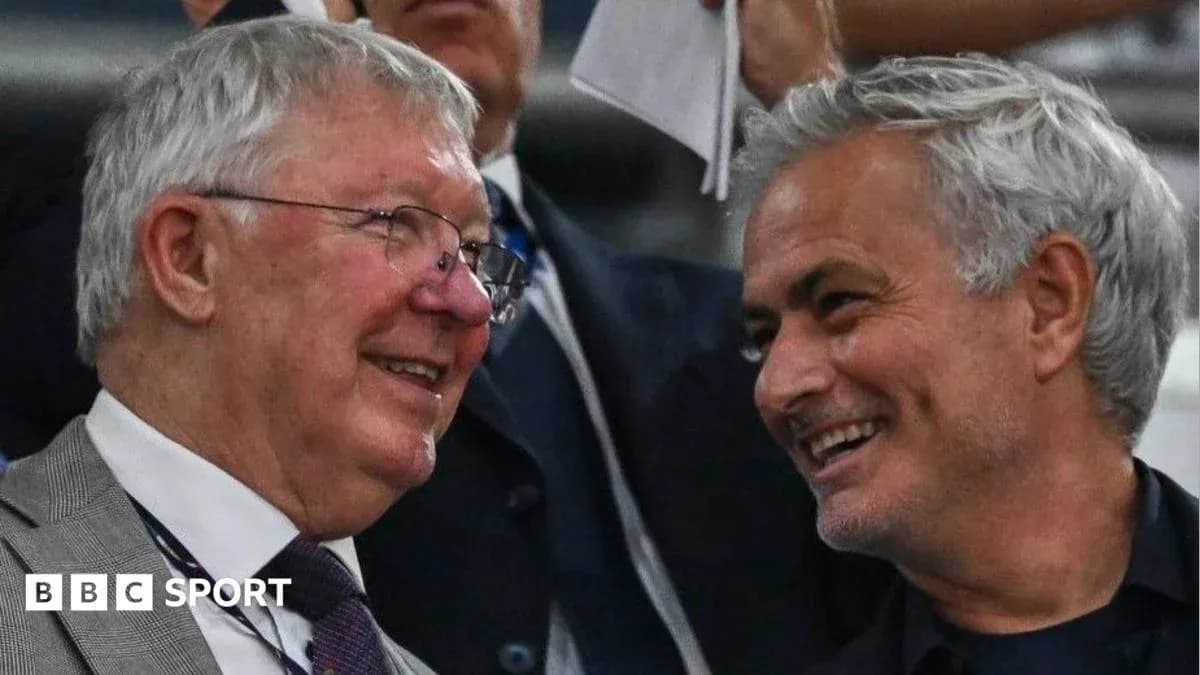
Jose Mourinho and Manchester United's Missed Opportunity
“Sliding doors.”
Inside Manchester United, that is how some still describe the moment in 2013 when Jose Mourinho slipped from their grasp as Sir Alex Ferguson’s heir. A decision flipped in days, after weeks of planning, that still feels like a jolt to the club’s timeline.
A new Netflix documentary on Mourinho, released on 11 August, finally pins down what had long been whispered. United thought they had him. Mourinho thought he was taking over. Then everything spun.
The succession that never was
By the spring of 2013, the conversations were serious. Meetings in Madrid. Meetings in London. Ferguson, who had long admired Mourinho’s edge and charisma, stunned him by revealing he would step down at the end of the 2012-13 season.
The talks accelerated. Terms were discussed. A deal, sources say, was effectively agreed.
Then it collapsed.
Ferguson recalls the pivotal phone call in the documentary. Mourinho rang him in tears.
"Alex, I can't take it. I've given my word to Chelsea and I'm not going to break my word."
That was it. The door slammed shut.
Mourinho pointed to his family as the reason. He had a home in London. When Chelsea sacked him in 2007, he had promised to return. He also retained a working relationship with Roman Abramovich that mattered to him.
Some at United never fully bought the family line. They still don’t. But the outcome was the same: Chelsea reclaimed their man, and United were left staring at a future without Ferguson and without the one coach they believed had the shoulders broad enough to carry the shock.
A club at a crossroads
The timing could hardly have been more delicate. Ferguson was leaving. So was David Gill, the respected chief executive who had worked in lockstep with him.
United knew they were not just appointing a new manager. They were trying to rebuild the entire structure around a man who had, for decades, controlled virtually every football decision. Ferguson was unique. The model that worked for him could not simply be handed to someone else.
Mourinho, in the eyes of senior figures at the time, was the rare personality who might stride straight into that void and relish it. He would not flinch at the comparison. He would not tiptoe around the job. He would attack it.
But with Mourinho gone and Pep Guardiola already committed to Bayern Munich, United pivoted. They chose David Moyes.
The Everton manager shared some of Ferguson’s values: discipline, work ethic, a long-term eye. What he did not share was experience at the game’s highest level, or the force of personality required to bend a giant club to his will.
United christened him “The Chosen One”. The banner hung at Old Trafford. The reality was far harsher.
When Mourinho finally came
Mourinho did eventually walk through the doors at Carrington, but not until 2016, three managers and three turbulent seasons after Ferguson’s farewell. He replaced Louis van Gaal, who had just lifted the FA Cup but paid with his job 48 hours later.
By then, the landscape had shifted. The Old Trafford dressing room was no longer the one Mourinho would have inherited in 2013.
Of the 18 players who started 10 or more Premier League games in Ferguson’s final, title-winning season, only six did so in Mourinho’s first year: David de Gea, Phil Jones, Wayne Rooney, Chris Smalling, Michael Carrick and Antonio Valencia. The core had aged, dispersed or been replaced. The Ferguson imprint had faded.
Mourinho had changed too. He had returned to Chelsea and won the Premier League again, but his second spell ended in bitterness in December 2015, with the champions languishing 16th, one point above the relegation zone. The edge that once energised clubs now cut deeper, more often.
His United tenure still splits opinion. On one hand, he delivered the Europa League and the EFL Cup in his first season and twice qualified for the Champions League. He has even called his second-place finish in 2017-18 – 19 points behind Manchester City – one of the finest achievements of his career.
The numbers back up at least part of that claim. United’s 81 points that year remain, by a distance, their best Premier League return since Ferguson retired.
Yet the story is not just about trophies and totals. Mourinho clashed with players, most notably record signing Paul Pogba. He publicly questioned the club’s ambition and recruitment, and accused the hierarchy of failing to back him on key decisions, including his desire to sell Anthony Martial.
He left with silverware in the cabinet and scorch marks on the walls.
What if he’d come in 2013?
Inside the club, there is a lingering belief that the Mourinho of 2013 would have been a better fit – and that United, in turn, would have been better for him.
The argument is simple. He would have stepped straight into a dressing room full of champions, many of them still close to their peak. His personality, his certainty, his willingness to dominate the environment might have driven them on rather than allowed standards to slide.
No-one doubts that Ferguson squeezed everything from that final title-winning squad. They overperformed for him. Yet the drop-off under Moyes, from champions to seventh, shocked even the players. They still struggle to explain it.
Those who wanted Mourinho at the time are convinced his presence would at least have slowed the decline.
There is also the transfer market. Under Moyes, United hesitated. They dithered over targets and paid for it. Thiago Alcantara, whose move from Barcelona had been lined up, never arrived. Marouane Fellaini did, but only on deadline day for £27.5m, after United had failed to trigger a cheaper release clause earlier in the window.
People close to the 2013 talks insist that under Mourinho, Thiago would have signed. Fellaini, they say bluntly, would not.
Mourinho had already offered his assessment of several potential recruits, including Daniele de Rossi. The sense is that he would have moved quickly, reshaped the squad with conviction and demanded more from the experienced core he inherited.
Instead, United lurched. The structure they knew needed changing was never properly rebuilt. The manager who might have fronted that transformation watched from London.
The call that changed a club
In the documentary, Ferguson speaks with the clarity and authority that defined his reign as he recalls Mourinho crying down the phone, torn between the promise he had given Chelsea and the opportunity of a lifetime at Old Trafford.
For Ferguson, it was a personal blow. For United, it was something bigger.
That single conversation did not cause every problem that followed. But it did close off a path the club had spent weeks preparing to walk. They have been searching for the right one ever since.



