
Iran’s World Cup Chaos: Players Left Without Recovery Time
The final whistle had barely faded at SoFi Stadium when Iran’s players were told to leave.
No cool-down. No ice baths. No night’s sleep in Los Angeles after a draining, politically loaded World Cup opener. Just a blunt instruction: get on a plane, fly 140 miles back to Tijuana, and do it now.
“They didn’t even give us time to recover,” coach Amir Ghalenoei said through an interpreter after the 2-2 draw with New Zealand on Monday night. “After the game today, they said to us, ‘You have to leave immediately.’”
Who gave that order? Ghalenoei didn’t say. But his frustration was unmistakable. Iran’s staff had planned a normal tournament rhythm: arrive in California two days before the match, stay over after the game, travel back at lunchtime the following day. Instead, their schedule was ripped up without explanation.
“It seems like others are doing the planning for us,” he said. “The decision-making for us is being made elsewhere.”
A World Cup under siege
Iran’s World Cup has been overshadowed from the start. The campaign has unfolded against the backdrop of war, after the U.S. and Israel launched military action against Iran on February 28. The federation asked FIFA to move its three group matches out of the U.S. The request was rejected. The team came anyway.
What followed has been a tournament preparation in name only.
Captain Mehdi Taremi described a five-hour slog of travel and security checks just to make the short hop from Tijuana to the Los Angeles area on Sunday, a journey that would usually be routine. Even basic logistics have turned into an ordeal.
“We don’t know why they are returning us, to be honest,” Ghalenoei said. “We were supposed to come two nights before the game, and we were supposed to stay tonight to recover and return tomorrow at lunchtime. We have no idea why.
“I think our team is perhaps the most oppressed in the World Cup.”
Key figures are missing too. The president of Iran’s football federation never made it. Nor did several members of the coaching staff and media team. U.S. visa denials stripped away much of the support structure elite sides rely on at this level, leaving players and remaining staff to improvise their way through a World Cup.
“We have to leave Los Angeles right now, and it’s not good for us,” Taremi said about an hour after full time. “I think FIFA have to help us more than this. ... Everything is like a disaster, actually, for us.”
Cramps, chaos and a 2-2 draw
On the pitch, Iran’s night was as wild as everything swirling around it.
Ranked 65 places above New Zealand in FIFA’s standings, Iran expected to win. Instead, they twice trailed to Elijah Just, who struck early in each half. Twice, Iran had to drag themselves back into the game.
Ghalenoei said the physical toll of their disrupted build-up was obvious. Several players cramped up despite the mild conditions, forcing substitutions that had nothing to do with tactics.
“Before the game, I said we haven’t had time to adjust because of the travel,” he explained. “Many of our players, they had cramps, and that’s why we had to substitute them. So it wasn’t for technical reasons. It was because of the injury and because of the cramp.”
The staff will examine the players on Tuesday, he added, but he has no doubt where the blame lies. Delayed arrivals. Forced early departures. No proper window to rest. “They are making the situation more difficult.”
Yet in the middle of that strain, Iran produced moments of real quality.
Ramin Rezaeian dragged his side level in the first half with a deft finish off the side of his boot. In the second, with the game slipping away again, he delivered a perfect cross from the right. Mohammad Mohebi met it with a thumping header in the 64th minute, sending SoFi’s pro-Iranian crowd into a roar that felt like release as much as celebration.
The draw was disappointing on paper. The performance, at times, was anything but.
A divided crowd, united for 90 minutes
This was no ordinary World Cup crowd.
Los Angeles is home to the largest Iranian population outside Iran, and that diaspora arrived with its own internal conflict. Outside the stadium, several hundred Iranian Americans protested against the current government. Inside, some turned their backs during the national anthem or jeered in defiance.
Once the ball rolled, most of that anger turned into something else. For 90 minutes, the focus shifted from politics to players.
“It was an incredible atmosphere in the game, all 90 minutes,” Taremi said. “It was like at home for us.”
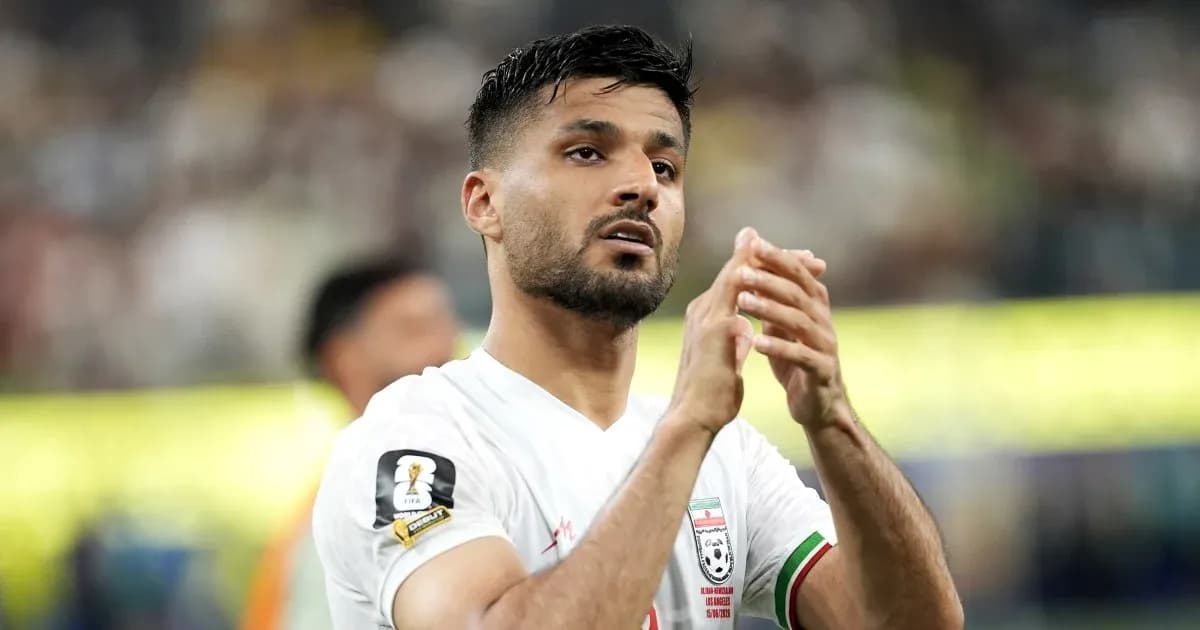
Flags rippled, drums thudded, and every Iranian attack drew a surge of noise. The players responded, staying on the pitch long after the final whistle to applaud the thousands who remained, still waving, still chanting, still there for Team Melli even as they raged at the regime.
Ghalenoei sat alone in the dugout for a spell, watching his players circle the stadium. They swapped shirts with New Zealand’s squad, hugged opponents, and tried to savor a night that had given them so little time to breathe.
Mohebi’s celebration under the spotlight
Mohebi’s equaliser brought its own controversy.
After scoring, he appeared to mime firing a gun, a gesture that drew immediate criticism online. He followed it with the “ice in my veins” pose made famous a decade ago by then-Los Angeles Lakers rookie D’Angelo Russell, just a few miles from SoFi, before finishing with a heart sign to the stands.
“The Iranians who live in Los Angeles, they make a great atmosphere,” Mohebi said. He insisted the celebration was spontaneous. “That celebration, it comes in the mind, and I did like this” — he motioned to his arm — “for all the fans. Just a celebration.”
Group on a knife-edge
The draw leaves Group standings finely balanced and brutally unforgiving.
Iran, Belgium, Egypt and New Zealand all sit on one point after the opening round. On paper, Iran’s hardest work still lies ahead: Belgium in Inglewood on Sunday, then a long trip north to face Egypt in Seattle next week.
Both opponents carry more pedigree than New Zealand. Both will punish any lapse.
Ghalenoei knows what his side is up against — on and off the pitch.
“We’re facing more hurdles, but we’re not going to let that stop us from doing our best,” he said. He called the 2-2 a showcase. “I think today was one of the best games in the World Cup so far, and I think the fans really enjoyed it inside the stadium and outside the stadium.”
Enjoyment will mean little if Iran cannot escape the group. They have never reached the World Cup knockout stage. Now they must try to make history while fighting fatigue, bureaucracy and geopolitics, all at once.
The football, on Monday night, showed they have the courage for it. The question is whether they will be allowed the chance to prove it.



