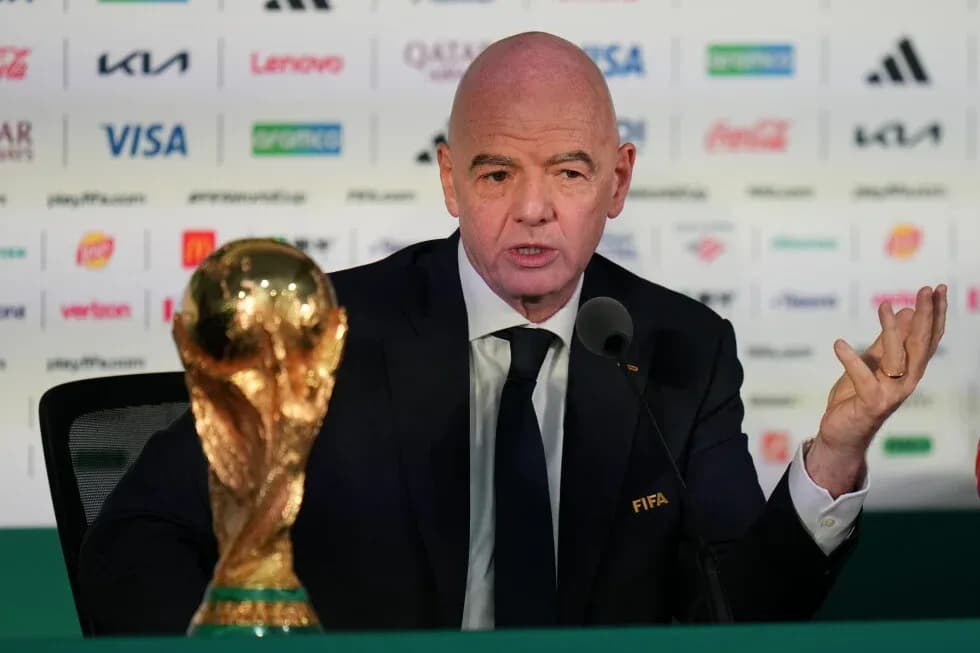
Infantino’s $20 Billion Proposal Risks World Cup Integrity
Gianni Infantino has put a price tag on the World Cup. Now he wants the world’s game to sign on the dotted line — fast.
In a letter sent to FIFA’s 211 member federations, the president has given them until Sept. 19 to accept a one-off $20 million payment in exchange for backing a radical plan: selling a 20% stake in a new $20 billion FIFA subsidiary to private investors, led by Joshua Kushner’s Thrive Capital.
The offer is framed as a “singular and unique funding opportunity.” The reaction has been anything but warm.
A World Cup for Sale?
Under the proposal, FIFA would create a commercial arm — FIFA Forward Enterprise — that would run its competitions and events, including World Cups and Club World Cups. Private investors would own a fifth of it for 12 years. The World Cup, the sport’s crown jewel, would effectively be part of the package.
For Infantino, this is his latest “game-changing” vision. For many in football, it looks like a line being crossed.
UEFA’s response landed with force. The European body, blindsided by the plan, moved to call its 55 member associations into an emergency online meeting and fired a statement that cut to the heart of the matter: the World Cup “is not FIFA’s to sell.”
The message was unmistakable. Infantino may run FIFA, but he does not own the game.
Old Allies Turn to Open Opposition
Infantino has grown used to pushing big ideas with limited consultation. A biennial World Cup. A secretive $25 billion private equity plan in 2018. A FIFA Peace Prize that ended up being awarded to Donald Trump at the World Cup draw. Each project has deepened the sense among traditional powerbrokers that the president operates above, not with, the game’s institutions.
This time, the backlash has come quickly and widely.
UEFA’s fury was echoed across continents. CONCACAF, usually a reliable Infantino ally, said it was “deeply concerned by the lack of due process.” The Asian Football Confederation called it “disappointed” that such a major issue hit the public domain before its members could even discuss it.
The influential European Football Clubs group, which partners with UEFA to run the Champions League, said it “learned about this proposal in the same way as most global football stakeholders — without warning and through the media.” For a project of this scale, that lack of consultation is not a detail. It is the story.
The Money on the Table
Infantino’s pitch is blunt. Approve the new FIFA subsidiary, and each federation receives $20 million from the commercial cycle tied to the men’s 2030 World Cup. Reject it, and they get the previously promised $10 million over the next four years.
Over 12 years, the difference is stark. The new plan, he wrote, would yield around $86 million per federation, compared to about $36 million if they turn it down. A $50 million gap, dangled in front of associations that, in many cases, rely on FIFA money to survive.
The process, Infantino said, will be led by J.P. Morgan, with Thrive Capital as anchor investor and “a pool of diverse international investors” to follow.
UEFA saw the deadline as a tell. The rush to lock in support by Sept. 19, it said, “says everything you need to know about this plan. FIFA cannot continue to use our sport to enrich themselves and their friends.”
Power, Votes, and the Global Divide
The political calculus is obvious. FIFA’s one-member, one-vote system means that the most powerful nations on the pitch — those who fill stadiums, drive TV ratings, and win trophies — can be outvoted by dozens of smaller federations that rarely reach the top level.
Those same smaller federations often depend on FIFA funding, have little realistic chance of qualifying for a World Cup, and see their best players leave for foreign clubs. For them, a guaranteed $20 million, with the promise of much more to come, is not a theoretical debate about governance. It is budget, infrastructure, and survival.
That tension — between financial need and sporting principle — sits at the heart of this fight.
The Threat to Existing Competitions
If private equity flows into FIFA’s commercial arm, the pressure to grow revenue will only intensify. That could mean more World Cups, more Club World Cups, more teams, and more frequent tournaments for both men and women.
For UEFA, CONMEBOL, and other confederations that run their own lucrative competitions — the Champions League, European Championship, Copa America — the alarm is obvious. Expanded FIFA events could cannibalize their calendar, dilute their products, and weaken their leverage.
Sports governance expert Antoine Duval warned that private investors could “incentivize FIFA to further commodify the World Cup,” pointing to ideas like more hydration breaks and dynamic ticket pricing. Each tweak would be justified as “innovation.” Each one would also be designed to squeeze more money out of the same spectacle.
Political Fire from Britain
The backlash has not been confined to football’s corridors of power.
In Britain, Prime Minister Andy Burnham, a committed football fan whose government is backing a joint bid by England, Scotland, Wales, and Ireland to host the 2035 Women’s World Cup, came out swinging.
“Football does not belong to investors,” Burnham said in a video message. “Once you have sold a piece of (the World Cup), you have sold out. Football belongs to the fans. It always has, and it always will.”
British politicians have form in this arena. In 2021, threats of legislation from then-Prime Minister Boris Johnson helped torpedo the European Super League, a project seen as an existential threat to UEFA’s Champions League — and one Infantino had quietly supported. J.P. Morgan, again, was the bank behind that doomed venture.
The echoes are hard to ignore.
Infantino’s Long Game
Infantino, now deep into his 11th year as FIFA president, had seemed to be gliding toward a fourth and final term through 2031, with little sign of serious opposition. His power base has always been built on promising more money to member federations, a theme that ran through his election speech in 2016 and his unopposed re-elections in 2019 and 2023.
This new plan fits that pattern, but it also raises fresh questions about his future.
Some within the game have long suspected that Infantino’s ambitions stretch beyond a standard presidency. A CEO or commissioner role at a powerful FIFA subsidiary such as FFE — partially privatized, commercially aggressive, and running the sport’s biggest events — would be a natural landing spot for a man who has spent more than a decade centralizing power.
For now, he remains in charge, but the mood music has changed. This week’s revolt has pushed discontent well beyond the usual European critics. Confederations in Asia and North America have broken ranks. Club groups are openly angry. National associations have less than four months to decide whether to mount a challenge.
The deadline for presidential candidates is Nov. 18. The election is set for March 18 in Rabat, Morocco — a key Infantino ally and co-host of the 2030 World Cup.
Before that, the sport must answer a more immediate question: will its guardians take the money and accept a World Cup part-owned by private investors, or will they draw a line and risk walking away from a fortune?
The clock to Sept. 19 is ticking, and with it, the shape of football’s future.