
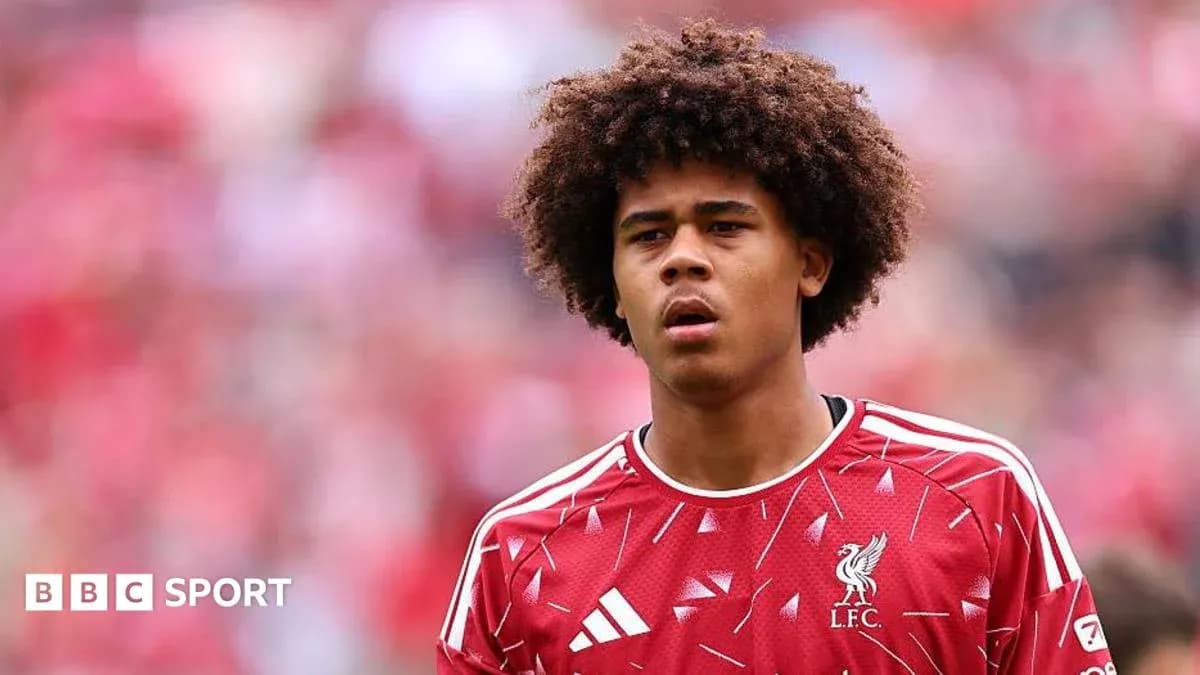
Ifeanyi Ndukwe: Liverpool’s 18-Year-Old Defensive Sensation
Liverpool’s pre-season under Andoni Iraola has been a jolt to the system. New ideas, uneven results, a squad in flux. But in the middle of the uncertainty, one towering figure has stepped out of the shadows: 18-year-old centre-back Ifeanyi Ndukwe.
He has been impossible to ignore.
A teenager thrown in – and standing tall
Liverpool’s warm-up schedule has been chaotic enough. Two wins, two defeats. Comfortable victories over Sunderland and Wrexham, then maddening collapses against Leeds and Monaco, both from two goals up. The performances have been streaky, the defending even more so.
Injuries have stripped Iraola’s options at the back. Joe Gomez limped out of the first pre-season game. £60m signing Jeremy Jacquet has yet to settle into any rhythm because of a persistent knee problem. Giovanni Leoni is still working his way back from serious knee damage.
Into that gap walked an 18-year-old from Austria Vienna’s academy, all 6ft 6in of him.
Ndukwe has already banked two full 90-minute outings and another 80-minute shift. On Sunday, he was trusted from the start alongside captain Virgil van Dijk against Monaco at Anfield. That alone told its own story.
Then he started playing.
Early in the game, with Monaco pressing, Ndukwe produced a deft backheel that left Mika Biereth wrong-footed and the Kop audibly gasping. Moments later he was winning duels, stepping in, using his frame with authority rather than raw aggression. Not just surviving. Belonging.
For a club still digesting the departure of Ibrahima Konate, the question of who partners Van Dijk against Newcastle on the opening Premier League weekend looms large. Ndukwe has done enough to force his name into the conversation on footballing merit.
And yet, he cannot be the answer. Not now.
The talent Liverpool can’t use
The barrier is not form, fitness or faith from the manager. It is paperwork.
Post-Brexit rules mean Ndukwe is not allowed to play for Liverpool in a competitive game in 2026 because he has not hit the points threshold required for a UK work permit. No Governing Body Endorsement, no visa, no competitive minutes.
Since the UK left the European Union, clubs have been forced to work through a harsher, more complex system for overseas signings, especially for players who have not yet established themselves at the highest level. Every appearance, every league, every international cap carries a value. Add them up, reach the magic number, and the door opens.
Right now, Ndukwe is short.
The Austria youth international does not currently earn enough points for a standard GBE. There is a separate route: the Elite Significant Contribution (ESC) slots, designed for exceptional foreign players who fall outside the normal criteria.
Premier League and Championship clubs can have up to four ESC players, but those places are earned, not handed out. They depend on how many minutes clubs give to England Qualified Players (EQP) over the season. Hit 35% of total minutes with EQPs, and you can use four ESC slots. Fall below that, and the number drops.
Liverpool fell short. Their EQP percentage last season leaves them with just one ESC place.
That solitary golden ticket has already gone, to 18-year-old Senegalese forward Mor Talla Ndiaye.
It is the consequence of a squad that has thinned out its English core. Trent Alexander-Arnold, Jarell Quansah and Tyler Morton departed, Harvey Elliott was sent out on loan, and the remaining English contingent – Freddie Woodman, Gomez, Rhys Williams, Curtis Jones, Trey Nyoni and Rio Ngumoha – managed a combined 83 Premier League appearances.
The end result? No ESC safety net for Ndukwe. No fast-track. No competitive football in a red shirt until the numbers change.
From Vienna to Anfield – and straight back out?
This is not some unknown plucked from obscurity.
Ndukwe came through Austria Vienna’s academy, forced his way into their reserve side and earned a place in senior matchday squads, making one first-team appearance. His breakout moment arrived on the international stage at the Under-17 World Cup last November, where his performances for Austria caught Liverpool’s eye.
The club moved quickly. A deal in principle was struck in January, with a £2.6m transfer agreed and parked until his 18th birthday. Once he came of age this summer, the move became official and Ndukwe walked into a new footballing world.
He has not tiptoed through pre-season. He has attacked it. His displays have left supporters wanting more, eager to see how far and how fast he can grow.
They will get one last look, for now, when Liverpool face Como in their final friendly on 16 August. After that, the equation changes. Friendlies are one thing. The Premier League and the work permit system are another.
Van Dijk has already seen enough to speak openly.
“Big talent, big guy and he wants to learn,” the captain said after partnering him against Monaco. He talked about brief conversations, about guidance, about the next phase. “The matter of fact is that he has to go on loan and wherever he goes, he needs to learn, get better and be ready when he comes back to hopefully stay there.”
The path is clear. Liverpool must send him out.
The loan that decides everything
A decision on Ndukwe’s next move is expected within the next two weeks. The choice will shape not only his season, but his entire Liverpool trajectory.
His agent, Georg Lederer, spelt out the plan in July to Sky Sports Austria: a loan club where Ndukwe can gain playing experience “at a very high level”. He described the situation as “a great opportunity” and confirmed that several top international clubs have already shown concrete interest.
Speaking to BBC Sport on Monday, Lederer said the process of choosing that destination in Europe is still ongoing.
The stakes are simple. Ndukwe must reach 15 points across various categories while out on loan to qualify automatically for a visa. The stronger the league, the more points he collects. Appearances, minutes, competition level – all of it feeds into the total.
With the right move, that target could be hit as early as January. If that happens, Liverpool would suddenly have a new option mid-season. They could recall him, register him, and finally use a defender who has already shown he can live with the pace and pressure of Anfield.
But that possibility cuts both ways. Any club taking him on loan knows that if things go too well, they might lose him halfway through the campaign. For a team planning its back line, that is a significant complication.
So Liverpool must balance development, minutes, league strength and the needs of the borrowing club, all while the clock ticks towards the new season.
An 18-year-old centre-back has already proved he can handle the ball, the stage and the scrutiny. Now comes the tougher test: can he navigate a system that has turned one of Liverpool’s brightest pre-season stories into a bureaucratic race against time?



