Ibrahim Mbaye: Youngest African to Score at FIFA World Cup
There is a version of 16 June 2026 that disappears into the archives.
France 3, Senegal 0, MetLife Stadium drifting towards full-time, the cameras already half-dreaming of Kylian Mbappé montages and tournament storylines. Then, with five minutes left, a teenager steps off the bench for a beaten side and refuses to behave like a footnote.
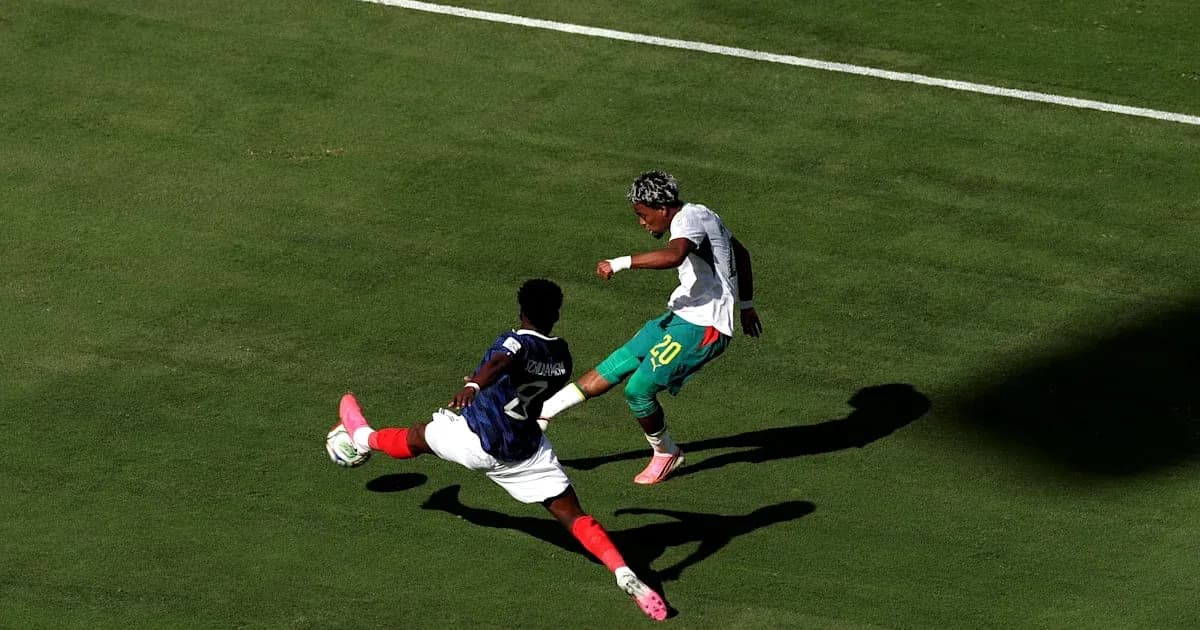
Ibrahim Mbaye collects the ball wide on the right. One feint, one roll of the foot, and Théo Hernandez is suddenly facing the wrong way. Mbaye doesn’t hesitate. He lashes his shot past Mike Maignan and into the far corner.
Stoppage time. Minute 95. France 3, Senegal 1.
The result doesn’t change. The record books do.
At 18 years and 143 days, Mbaye becomes the youngest African ever to score at a FIFA World Cup, taking a record from his compatriot Moussa Wagué, set in 2018. Stretch the lens wider and the company sharpens into focus: only Pelé, Mexico’s Manuel Rosas, Spain’s Gavi and Lamine Yamal have scored younger on this stage.
C’est du sérieux. This is serious business. It has been for a while.
Books before Ballon d’Or
Rewind ten months and the scene is less glamorous, but just as telling.
Paris Saint-Germain are flying to Marseille for a Ligue 1 game. Mbaye, then 17, is not on the plane. While his team-mates settle into their seats, he is sitting his baccalauréat, the exam that turns French teenagers into officially educated adults. Only when he has finished solving equations does the club put him on a separate route south, rushing him into the squad in time for an 8pm kick-off.
For most players, that story would become the defining anecdote of a career. For Mbaye, it was just another day.
This is how PSG’s academy works now. The same system that pushed Warren Zaïre-Emery and Senny Mayulu into the first team also hammers home the idea that the classroom matters as much as the training ground. Academy director Yohan Cabaye can point to a 95 per cent baccalauréat pass rate among the club’s youngsters and argue that academic discipline and football intelligence are two sides of the same coin.
In Mbaye, that philosophy has found its clearest proof. The nutmeg and finish against France did not look like a wild improvisation. It looked like a problem solved in real time, under pressure, by someone who treats an exam hall and a 95th‑minute World Cup chance with the same measured calm.
The choice that shook Clairefontaine
Mbaye’s story starts in Trappes, a Paris suburb that knows a thing or two about producing footballers. Nicolas Anelka came from here. So did a generation of French youth internationals who passed through the national system at Clairefontaine and beyond.
Mbaye followed that path. Senegalese father, Moroccan mother, French education. He grew up in the blue of Les Bleus, the kind of talent France rarely worries about losing.
Then, in November 2025, he chose Senegal.
No tug-of-war, no public spat, no pressure campaign. Just a teenager deciding where his heart lay. Months later, with an Africa Cup of Nations winner’s medal around his neck after navigating the tournament as a teenager among veterans, he told Senegalese broadcaster RTS: “I will never regret choosing to play for Senegal because it was a decision from the heart.” Reflecting again later, he was even clearer: “If only you knew… it’s the best decision I’ve ever made in my life. The Senegalese have such huge hearts; it’s incredible.”
That is why his goal against France carried such weight. A boy raised in the Paris suburbs, shaped by the country’s most storied academy, scoring his first World Cup goal against the nation that schooled him — and doing it in Senegal green.
Quelle histoire. Any scriptwriter would have thrown it out as too tidy.
Numbers that belong to another age
Strip away the romance and Mbaye’s rise still looks unreal.
He made his Ligue 1 debut at 16 years, 6 months and 23 days, becoming PSG’s youngest-ever league starter and taking a record from Zaïre-Emery. He signed his first professional contract in February 2025, scored his first senior goal weeks later, and by August had become the youngest Frenchman to appear in a UEFA Super Cup, overtaking a mark set by Ryan Giggs in 1987.
In May 2026, away at Lens, he stepped up again. Stoppage time, title on the line, he scored the goal that sealed PSG’s 14th Ligue 1 crown.
The Senegal timeline is just as compressed. Debut against Brazil in November 2025. First international goal three days later, on his second cap. Youngest player ever to feature at the Africa Cup of Nations in December. Then the youngest AFCON goalscorer in his country’s history in January, as Senegal lifted the trophy before CAF later ruled to award the victory to Morocco.
The paperwork may have changed. The impression he made did not. Four goals in 12 caps before his 19th birthday hardly need embellishment, and the comparisons with Kylian Mbappé no longer feel lazy.
What coaches talk about most, though, is not the numbers. It is his brain. When to drive, when to release, when to slow the game down. His decision-making belongs to a player with hundreds more senior minutes. He does not need twenty touches to leave a mark.
He often needs one.
“Mbaye is world class, and he is ours, he did not choose France – he chose Gaindeyi,” Senegalese journalist Wahany Johnson Sambou told Olympics.com in January, referencing the Wolof name for the national team. “He’ll do great things, just watch.”
Dakar, Los Angeles and the Olympic road
Senegal’s Olympic football story remains a short one. The men’s team has appeared only once, at London 2012, a tournament that helped propel Sadio Mané, Idrissa Gueye and Cheikhou Kouyaté onto the global stage. Since then, nothing.
That may be about to change.
This October, Dakar will host the Youth Olympic Games, the first time the event lands on African soil. The spotlight will fall on Senegalese sport in a way it never has before, and football sits right at the centre of that moment.
By the time Los Angeles 2028 arrives, Mbaye will be 20 — prime age for an Under‑23 tournament that has showcased Lionel Messi, Neymar and Mohamed Salah. Olympics.com has already highlighted him as one of Africa’s standout prospects for the Games, and the logic is obvious.
His trophy cabinet is impressive enough. Ligue 1 titles, continental glory with Senegal, a World Cup goal against France. But it is the temperament behind those achievements that makes the LA28 prospect so intriguing.
This is the same teenager who calmly sat a baccalauréat exam while his club flew to a league match, then joined them and played. The same teenager who walked into a World Cup opener against the country of his birth and, deep into stoppage time, still had the clarity to roll a full-back and pick his spot.
For now, Ibrahim Mbaye carries on as he always has: quietly, calmly, ahead of schedule.
The rest of the world is only just catching up.