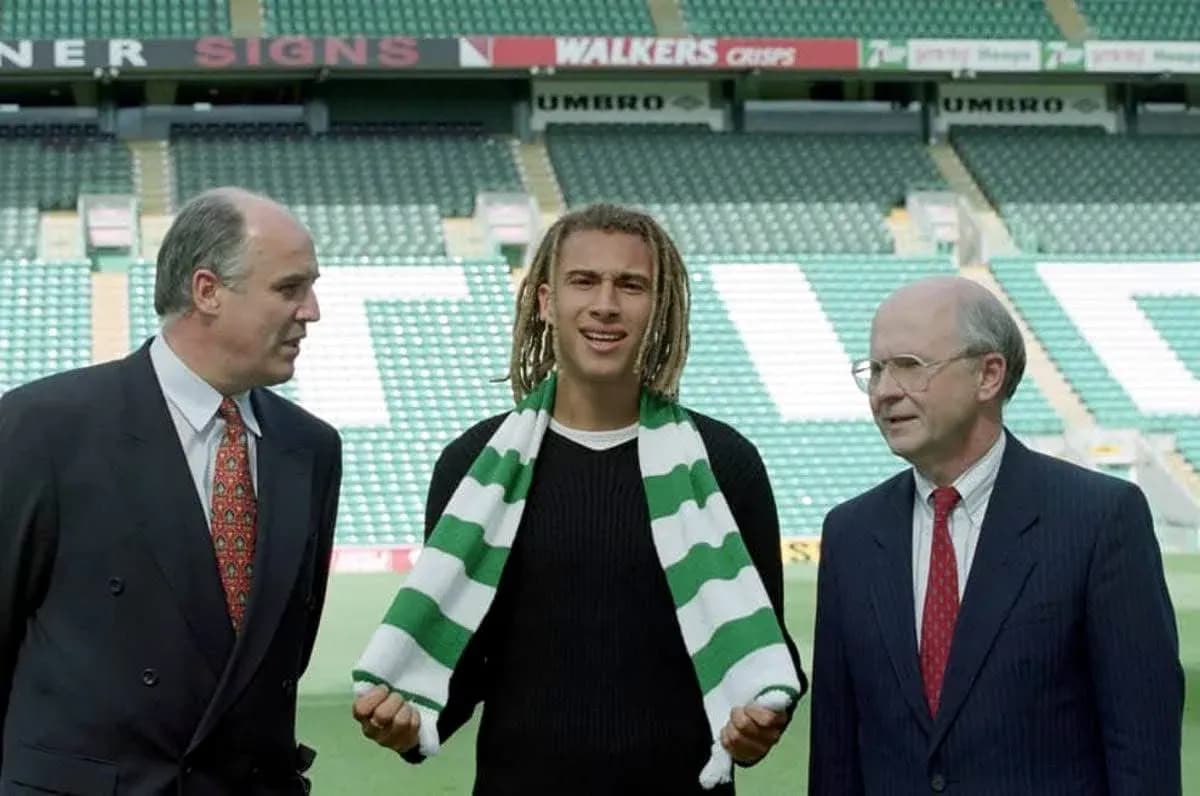
Henrik Larsson: The King of Kings at Celtic
On a warm July day in 1997, a slim, dreadlocked Swede in a Hoops top and denim strolled onto the Celtic Park turf. No fanfare beyond the roar from the stands, no hint yet of the legend he would become. Henrik Larsson had just signed for Celtic.
He cost £650,000 from Feyenoord, a fee that looked modest at the time and laughable now. Wim Jansen, newly installed in the Celtic dugout and armed with inside knowledge from his own spell in Rotterdam, knew exactly what he was doing. He had signed Larsson once before. This time, he was about to change a club’s modern history.
The start, though, was anything but regal. Larsson’s Celtic debut is remembered for all the wrong reasons, his misplaced pass contributing to an opening-day defeat at Hibernian. For a moment, the doubts crept in. Was this really the man to halt Rangers’ march towards ten-in-a-row?
The answer came quickly, and emphatically. Game by game, goal by goal, the dreadlocks, the work rate, the ice-cold finishing – they all began to stitch themselves into the fabric of Celtic life. The supporters warmed to him first. Then they clung to him. Soon, they built a team around him.
By the end of that first season, Larsson had helped deliver the League Cup and, far more importantly, Celtic’s first league title in a decade. They stopped Rangers reaching ten, a psychological and sporting turning point for an entire generation of fans. Larsson was at the heart of it, the new talisman in green and white.
He didn’t stop there. Under Dr Jozef Vengloš, Larsson’s game went up another level. He became the complete striker: movement, intelligence, finishing off both feet and in the air. He scored 38 goals in that second season, a haul that announced him as one of Europe’s most ruthless forwards, not just Scotland’s.
Then came Lyon. A horrific leg break in a European tie that could have ended careers and dulled ambition. For Larsson, it became a pause, not a full stop. His mental strength, always evident in his relentless running and refusal to hide, took centre stage. He came back sharper, more driven, and even more decisive.
Celtic, in contrast, wobbled. That injury cast a long shadow over John Barnes’ short-lived reign, removing the club’s most reliable match-winner at a critical time. Without Larsson, Celtic looked vulnerable. With him, they would soon look unstoppable.
Martin O’Neill’s arrival lit the fuse. Under the Irishman, Larsson hit a peak that few forwards in Celtic’s long history have matched. Paired with Chris Sutton, he formed a devastating partnership: Sutton the battering ram and foil, Larsson the ruthless finisher and conductor. In O’Neill’s first season, Larsson scored an extraordinary 53 goals as Celtic swept to a domestic treble, their first clean sweep in 32 years.
Those numbers tell part of the story. The moments tell the rest. The chipped finishes, the volleys, the towering headers. The way he seemed to glide into space in packed penalty areas. The way Celtic Park would almost hold its breath when he received the ball facing goal.
His influence stretched well beyond Scotland. Larsson’s goals powered Celtic deep into European competition, culminating in the run to the UEFA Cup final in 2003. On that night in Seville against Porto, with legs tiring and the heat draining energy from players and fans alike, Larsson produced two world-class headers in extra time, dragging Celtic back into a final that kept slipping away. The trophy eluded them, but his reputation on the continent did not.
By the time he walked away in 2004, Larsson had scored 242 goals in 313 appearances. Third on Celtic’s all-time scoring list, behind only Jimmy McGrory and Bobby Lennox, and comfortably clear of almost everyone else. The raw numbers, again, are staggering. The emotional imprint is even greater.
Every generation has its icons. The older Celtic support can point, rightly and proudly, to Jimmy Johnstone and the Lisbon Lions, the men who conquered Europe in 1967. Those who grew up in the 1970s will mention Kenny Dalglish, another King who would later be crowned Liverpool’s greatest ever player.
Yet for the majority of Celtic supporters watching in the modern era, Henrik Larsson is the benchmark. The standard by which all others are measured. The King of Kings.
He arrived as a bargain signing in a denim jacket. He left as a legend carved into Celtic’s unbroken history. Twenty-nine years on from that quiet unveiling, the question lingers over every new forward who pulls on the Hoops: can anyone ever truly follow him?