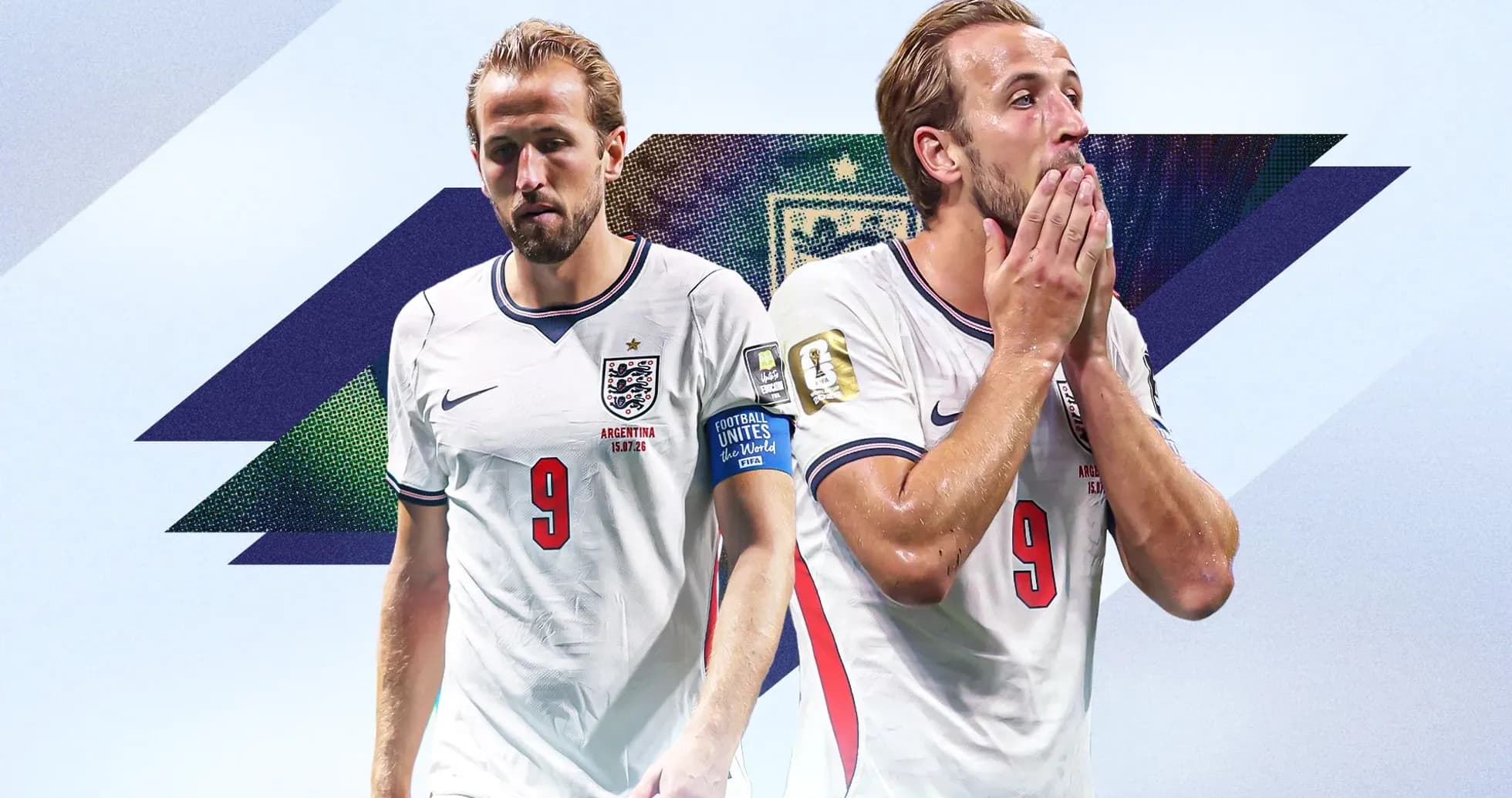
Harry Kane's World Cup Miss: A Semi-Final Analysis
For an hour in New Jersey, England went toe-to-toe with the world champions and did not blink. Thomas Tuchel’s side did not dominate Argentina, but they did not bow to them either. They traded punches. They held their ground. When Anthony Gordon swept in the opener on 55 minutes, it felt like the first blow in a proper heavyweight contest, not a smash-and-grab. Argentina would hit back, of course. England looked ready to answer.
They never did.
Once ahead, England shrank. Argentina surged. Lionel Scaloni spoke of his side “smelling blood in the water”; Tuchel’s England responded by chumming the ocean. The game tilted, then tipped, and England never found a way to slow the tide.
In the middle of it all, Harry Kane drifted through the chaos like a bystander at his own storm.
His numbers are brutal: 26 touches, nine completed passes, one shot – blocked – and not a single touch inside Argentina’s penalty area. On paper, it reads like a disappearing act. In truth, it was more complicated than that.
This was a scrappy, bruising semi-final, and Kane embraced the fight early. The first half was less football match, more wrestling meet. Kane threw himself into duels, attempting more than Lisandro Martínez and Alexis Mac Allister. He chased lost causes, flew into challenges and, at times, put his body in harm’s way with a recklessness that bordered on self-sacrifice.
In that opening spell, when England could not string three passes together, his graft mattered. He helped turn it into a contest of inches and collisions rather than patterns and passing lanes.
But when the game changed, he didn’t.
Once Gordon scored, England needed something different from their captain. They needed an outlet. A threat on the shoulder. Someone to pin one of Argentina’s lumbering centre-backs, to give the defence a reason not to squeeze up to halfway. Instead, Kane did what he always does when the storm comes: he dropped deep, looking to plug gaps and calm the game.
He doesn’t have the pace to run in behind, so he tried to control it instead. The problem? With Argentina swarming and England retreating, his deeper role only added another body to a congested midfield England could not keep. Wave after wave of sky-blue pressure broke in front of him, and he could not stem it.
This was no longer a game for Kane. Tuchel should have taken him off. He didn’t. Kane stayed on, rooted between halfway and his own box, watching the collapse unfold in front of him, unable to change it.
Strip away the emotion and it is still a crushing way for his season to end.
At Bayern Munich, Kane was outrageous. He shattered the single-season scoring record for a Bundesliga player with 58 goals in all competitions. No one in Europe’s top five leagues matched his 36 in the league. He became the fastest Bayern player ever to reach 100 goal contributions. Bayern cantered to the title, 16 points clear, even after easing off late in the campaign.
On raw output alone, the Ballon d’Or argument was real. These were numbers that Robert Lewandowski never quite hit in Bavaria. They were Messi-and-Ronaldo-era figures. If you looked only at goals, assists and trophies, you could make a serious case for Kane as the first Englishman since Michael Owen to lift the award.
But Bayern’s season frayed on the biggest stages. They went blow-for-blow with eventual champions PSG in Europe, yet failed to overturn a first-leg deficit and slipped out in a 6-5 semi-final defeat. The Champions League platform that usually crowns a Ballon d’Or campaign never quite materialised.
So the World Cup became his reset button. Kane admitted as much. A dominant tournament, he knew, would drag him right back into the conversation.
“I’d be one of the favorites, definitely,” he said before a ball was kicked. “Given the trophies I’ve won this season and the number of goals I’ve scored, I’d be in the running. Especially as, should England win the World Cup, one could imagine the trophy going to an English player.”
For five games, he played like a man chasing history. Two against Croatia, one against Panama, two more versus Congo, plus an assist in the Azteca against Mexico. He and Jude Bellingham set the tempo; everyone else filled in around them. The Golden Boot – that great individual marker at a World Cup – sat within reach. Heading into the semi-final, he was two goals behind Lionel Messi and Kylian Mbappé. If England were going to reach the final, logic said Kane would have to be central to it.
He was primed for the decisive moment. It never came.
By failing to score against Argentina, he has almost certainly seen the Golden Boot vanish. Even if he were to stay on for a third-place game against France – a match he really should be nowhere near after this workload – and somehow score a hat-trick, few would bet against Messi finding the net against Spain in the final. Kane will fly back to Germany without the Golden Boot, without a final, and without the individual coronation his season had set up.
His chance has gone.
The bleak part? This might have been his last great shot at it.
Kane’s move to Bayern felt like a career reboot. In hindsight, he lingered at Tottenham a year or two too long. He was superb there, consistently one of the Premier League’s outstanding players, but always fighting against structural issues and cautious spending from ownership – the same ownership now loosening the purse strings with almost mocking timing.
His explosion in Munich over these first two seasons did more than pad his statistics. It validated him. It proved he could still dominate at the highest level. It hinted that, even into his thirties, he might be edging towards a late peak. Kane has spoken often of studying other sports, of learning from elite athletes who extend their primes by obsessively managing their bodies. He wants to keep Father Time at bay. At club level, it looks like he might.
International football does not play by the same rules.
There are no long arcs here, no months to refine systems, no soft weeks to rest heavy legs. There is no clever rotation over 34 league games. England stretched their World Cup camp as far as they could, but it still amounted to less than two months at the end of a draining season. It was a sprint. And when the race reached its fiercest point, Kane could not find that extra step.
If this really is the beginning of the end for him at this level, his England legacy will be one of the strangest in the country’s history.
On one hand, the numbers are staggering. He is, by any sensible measure, England’s greatest striker. Barring injury, he will cruise past 100 goals for his country. Peter Shilton’s 125-cap record is well within reach; Kane already sits on 121. He has scored more penalties at World Cups than anyone in history and claimed the Golden Boot in 2018.
Yet the major tournaments keep slipping through his fingers. Euro 2024 passed him by. In Qatar in 2022, he missed the penalty that mattered most. Even allowing for the weaker squads around him at the 2018 World Cup and Euro 2021, he has never quite carried England in the way a forward of his talent is expected to. The great record-breaking scorers of the modern game – Messi, Ronaldo, Pelé, Maradona, Henry – all have a defining trophy with their country. Kane does not.
And England’s problem is not just about legacy. It is about what comes next.
Look at the striker depth chart and the picture is stark. Tuchel brought a 30-year-old Ollie Watkins and a 30-year-old Ivan Toney to this World Cup. There is no obvious heir, no 21-year-old phenom waiting in the wings. Kane is not just the present; he is, by default, the future. For all the frustration, he will be brutally hard to dislodge.
So the national team will roll on with him. Fast-forward to 2028 and it is hard to imagine an England XI without Kane in it. They will probably be competitive again. They may even be among the favourites. But by then he will be deep into his thirties, with the miles of a decade at the top in his legs. And still, there is no clear alternative.
Kane has no intention of stepping aside.
“The national team is my pride and joy,” he said. “It’s what I love to do most more than anything. Obviously four years is a long way away, I’m 33 this summer but it never ended with Leo [Messi] there, he’s still performing at the highest level. I never want to put a limit on these things.”
It is a noble aim. It cannot be a plan.
Kane has had tournaments before in which he could etch his greatness into stone. Each time, the door has opened. Each time, it has swung back in his face. This World Cup, with his club form, his status, his numbers, felt like the clearest path of all.
That is what makes this semi-final, this subdued performance, this missed opportunity, feel like the biggest miss of his career – and the one England might spend the longest time trying to replace.