Harry Kane's Incredible Goal-Scoring Journey: Can He Keep It Up?
Harry Kane is still piling up goals and records, but the questions are no longer about what he can win. They are about how long he can keep doing this at the very top.
He has just walked away from another major tournament with a personal haul that would satisfy most strikers across an entire international career. Six goals, the captain’s armband on his sleeve, and England once again falling short – this time to Argentina in the semi-finals before settling for third place. A campaign that promised a defining moment instead delivered another familiar emptiness.
Kane’s numbers, though, remain outrageous. He is England’s all‑time leading scorer with 85 goals, the same story at Tottenham, and he has torn through defences in Germany as if the Bundesliga were just another playground. Bayern have watched him hit 146 goals in 147 games – a video-game return for a centre-forward who turned 33 and still looks like he’s playing within himself.
No wonder Bayern want to lock him down again. With only 12 months left on his current deal at the Allianz Arena, a new contract is expected. There is no hint of a player winding down, no sense that he is drifting towards the exit. On the contrary, he is favourite to collect the Ballon d’Or in 2026. At 33.
England’s dilemma is obvious. There is no natural heir waiting to step in as the next No.9, no obvious successor to take the captain’s armband and the responsibility that comes with it. The expectation inside the camp and around the FA is that Kane will lead the Three Lions into a home European Championship in 2028. A generation of players will be built around him once more.
The Real Debate
The real debate starts after that.
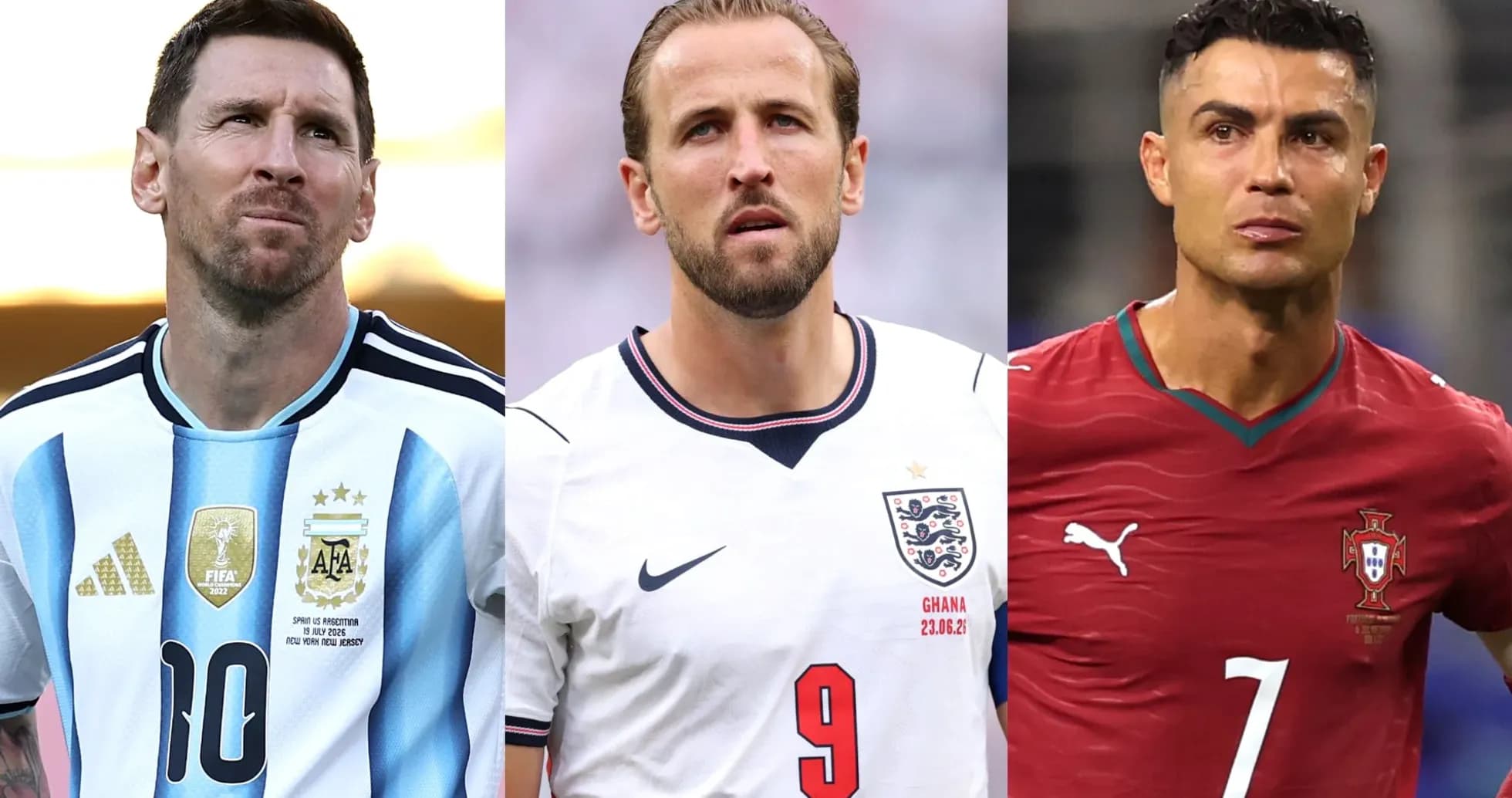
Can he stretch his career at the very highest level into his late thirties, like Cristiano Ronaldo and Lionel Messi? Or does the toll of a decade and a half of relentless football eventually catch up with him?
Dietmar Hamann, who knows Bayern from the inside and understands what it takes to survive at the top, did not dodge the question when speaking to GOAL via MrQ. Asked whether Kane could still be there at the World Cup in four years’ time, Hamann cut through the romance.
“He’s turned 33 now so he'll be 36 going on 37 in four years' time. It's a big ask,” he said.
He pointed straight to the two giants who have defined an era. “Obviously, we saw two of the all-time greats playing in the World Cup, one 39, one 41. One did well, the other one didn't. You know, I wouldn't put him in the same bracket as those two.”
The comparison is brutal but fair. Ronaldo and Messi are outliers, freaks of longevity and talent. Kane is elite, but he is not built in quite the same way. Hamann’s concern is not just age. It’s the mileage.
“Even though he would be a few years younger than these two guys playing in the World Cup, I think it's a big ask. It's a big ask because he started playing pretty early. He went out on loan in the lower leagues, played an awful lot of games in the Premier League, didn't really have many injuries. The odd ankle injury, I think he's had.
“He hardly missed a game in the last couple of years here in Munich. To see him in the World Cup in four years' time, if you put me down to an answer now, I'd probably say no.”
That “no” hangs in the air. Not because Kane looks finished, but because the sport rarely shows mercy to ageing strikers, even the clever ones.
Chris Waddle, another former England international who understands what it means to carry the hopes of a nation at major tournaments, has his own doubts about Kane’s World Cup future. Speaking to GOAL, he framed it around the one thing every veteran watches more closely than anything else: their legs.
“Fitness is a great thing to have. Some players develop, get better as they get older. Some find it easier. Not easier, but easy,” Waddle said.
The next checkpoint, for him, is not a distant World Cup. It is much closer. “We'll see how his legs are in two years' time, at the Euros even. People will be questioning that. The thing with Harry's advantage is he's a fit lad, we know that. He doesn't rely on pace. He's got a great football brain.”
That intelligence has always been Kane’s secret weapon. He drops off the front line, links play, drifts into pockets of space and punishes teams with movement rather than raw speed. That kind of game can age well – but only up to a point.
“Sometimes you see players in tournaments and you think, ‘His legs are going there’,” Waddle added. “I'm looking at Ronaldo as an example. I watched Portugal play in the World Cup and his legs were gone in my eyes for that level of football. Lionel Messi still had bits of brilliance until the rest of his team-mates decided to try and kick everybody out of the country.”
The contrast is stark. One legend still finding moments of genius, the other fighting a battle his body no longer wanted to wage.
“So I think there's a time and a place where you've actually got to think, ‘Yeah, he can still play, and he can still play like Messi does in Miami, a good level for him’. You know, Ronaldo in Saudi can still handle it. And Harry, eventually he'll come to a time where you think the Bundesliga is too quick. Where do you go from there?”
That is the question England dare not ask out loud yet. When the Bundesliga feels too sharp, when Bayern’s pressing game becomes a sprint too far, the knock-on effect will hit the national team almost immediately.
“The next World Cup, it's a big ask for him, I think, to play in that tournament,” Waddle continued. “I think some of these players can think, ‘Yeah, I'm still playing football, but that level's out of me now, and I've enjoyed it’. I think some of these players try and play too long and it doesn't look great on them. But I'm sure Harry will know when the time's right to say, ‘No, I can't play for England anymore’.”
For now, Kane remains the undisputed focal point for club and country, a record-breaker still operating at frightening efficiency. Bayern want more of him. England need more of him. The numbers keep coming.
The real drama lies not in what he has already done, but in how – and when – he chooses to walk away from the stage that made him.