Hapoel Beer Sheva Dominates Sabah FA in Tactical Showdown
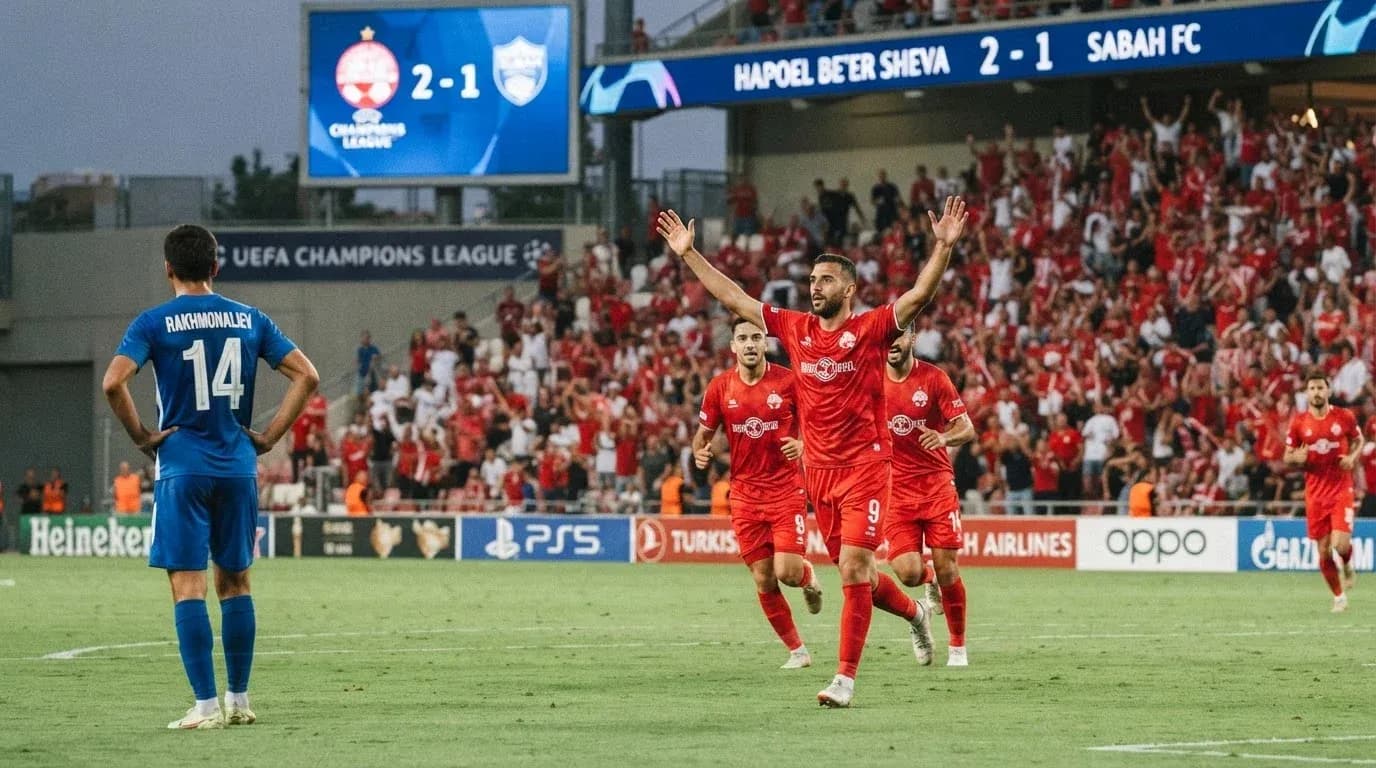
Hapoel Beer Sheva’s 2-1 win over Sabah FA at Rapid-Giulesti Stadium was a classic example of territorial and possession dominance eventually breaking down a compact 4-2-3-1 block. The Israeli side’s 4-3-3, with a clear emphasis on high volume attacking through central and half-space occupation, generated 18 total shots to Sabah’s 8 and a massive 67% share of the ball. Yet they had to come from behind, showing both structural control and the need for patience against a low, disciplined opponent.
First Half
From the outset, Sabah FA’s 4-2-3-1 was built to absorb. With I. Lepinjica and U. Rakhmonaliyev as the double pivot and V. Simic as a hard-working central presence ahead, the visitors conceded territory but tried to compress the central lane. Their early 6th‑minute goal from V. Simic, assisted by T. Puchacz, was a textbook transition: winning the ball deep, progressing quickly down the flank, and exploiting the spaces left by Hapoel Beer Sheva’s advanced full-backs. That strike allowed Sabah to drop even deeper, often defending in a 4-4-1-1, with J. Mickels staying high as an outlet.
Hapoel Beer Sheva’s 4-3-3 was built on a broad passing platform. With 659 total passes and 595 accurate (90%), they circulated the ball methodically, using the back four and three-man midfield to stretch Sabah laterally. The front three of Z. Ahmed, I. Zlatanovic and J. East constantly rotated positions, trying to pull Sabah’s back line out of shape. The payoff came at 43', when J. East equalised, reflecting the mounting pressure: by half-time the shot count and territorial control were already heavily tilted towards the home side, even though the score was 1-1.
Second Half
The second half was about adjustments and energy management. Sabah’s first substitution at 56' — O. Mbina (IN) came on for X. Severina (OUT) — aimed to refresh the attacking midfield line without altering the 4-2-3-1 structure. For Hapoel Beer Sheva, the key change was more aggressive verticality and fresh legs in the final third. At 66', A. C. Ganah (IN) came on for Z. Ahmed (OUT), adding direct running and one‑v‑one threat from wide areas. Later, at 71', M. Abu Rumi (IN) came on for J. East (OUT), reshaping the front line but maintaining the same 4-3-3 spacing.
The decisive tactical moment arrived with the 79' winner: I. Zlatanovic, assisted by E. Peretz, finished a move that encapsulated Hapoel Beer Sheva’s plan — sustained possession, midfielders stepping into pockets between Sabah’s lines, and the centre-forward attacking the box as the final reference point. By then, Sabah’s block had been stretched repeatedly by 16 shots inside the box from Hapoel Beer Sheva, a figure that underlines how deeply the visitors were forced to defend and how frequently the home side managed to penetrate into dangerous zones.
Defensive Work
Defensively, Hapoel Beer Sheva accepted a higher risk line. Their back four pushed up to keep Sabah pinned, which is reflected in the relatively modest defensive workload in their own box: Sabah managed only 8 total shots, 5 on goal, and 5 shots inside the box. The three yellow cards for Hapoel Beer Sheva — Miguel Vitor at 76' for “Tripping”, I. Rotman at 77' for “Roughing”, and A. C. Ganah at 84' for “Foul” — all came in the final quarter of an hour, a period when Sabah tried to play more direct and the home side had to manage transitions and duels in larger spaces.
Sabah FA's Discipline
Sabah FA’s tactical discipline is clear in their numbers: only 6 fouls and no yellow cards, despite spending long stretches under pressure. Their 305 total passes, with 237 accurate (78%), show that they were selective with possession, prioritising clearances, long passes to relieve pressure, and quick outlets rather than sustained build-up. The lack of blocked shots (0) further underlines their low attacking volume; they rarely managed to pin Hapoel Beer Sheva back long enough to generate second or third-phase shooting chances.
Goalkeeping
In goal, both keepers had symmetrical headline numbers in terms of shot-stopping: 4 goalkeeper saves each. For Hapoel Beer Sheva, O. Marciano’s work was concentrated around dealing with the early goal phase and a handful of sharp Sabah transitions; for Sabah FA, S. Pokatilov had to withstand a barrage of 7 shots on goal and repeated incursions into his box. That both goalkeepers finished with 4 saves despite the disparity in shot volume highlights how much of Hapoel Beer Sheva’s pressure translated into attempts from advantageous positions inside the area rather than speculative efforts, and how rarely Sabah reached truly clear-cut positions after their early strike.
Set Pieces and Rest Defence
Set pieces and rest defence played a subtler but important role. Hapoel Beer Sheva earned 3 corner kicks to Sabah’s 2, another reflection of territorial dominance, and managed offsides more aggressively (3 to Sabah’s 1), an indicator of their willingness to push the defensive line high and attack the space behind Sabah’s back four. Sabah’s low foul count and compact structure meant Hapoel Beer Sheva did not rely on dead-ball situations for their comeback, instead trusting their positional play and circulation to wear down the visitors.
Overall, the tactical story is of a home side using a high-possession 4-3-3 to control the match, create a large volume of shots inside the box, and eventually convert that pressure into a second-half winner, against an away side that executed a low-block, transition-focused 4-2-3-1 well enough to stay in the contest but lacked the attacking depth to threaten consistently after taking an early lead.