Hapoel Beer Sheva Dominates FK Crvena Zvezda in UEFA Champions League
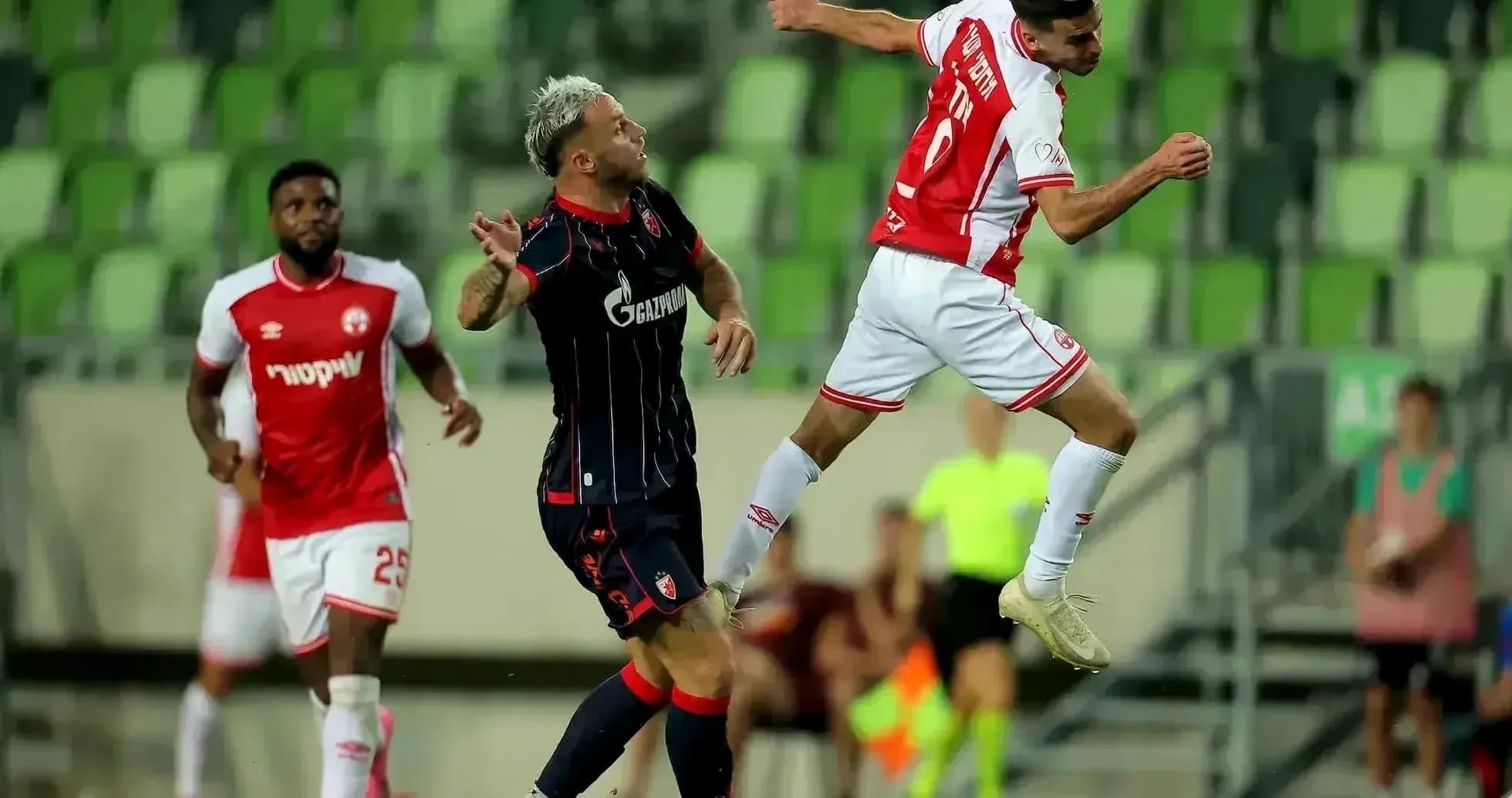
FK Crvena Zvezda’s 0-2 home defeat to Hapoel Beer Sheva at Stadium Rajko Mitić in the UEFA Champions League 3rd Qualifying Round was defined by an extreme territorial imbalance and a collapse in discipline rather than a simple off night in front of goal. With possession listed at 4% to 96%, Zvezda spent almost the entire match defending deep, rarely establishing sustained phases on the ball, while Hapoel Beer Sheva controlled tempo, spacing and pressing triggers. The visitors’ 4-3-3 structure systematically stretched Zvezda’s 4-2-3-1, and once the hosts went down to ten and then nine men, the Israeli side converted their dominance into two well-constructed second-half goals.
Hapoel Beer Sheva’s Tactics
Hapoel Beer Sheva’s 4-3-3 offered clear positional reference points: P. Amador and G. Mizrahi (before his substitution) provided width from full-back, with Lucas Ventura and N. Yehoshua supporting E. Peretz in a three-man midfield that dictated rhythm. High possession was not just sterile circulation; it was used to lock FK Crvena Zvezda into their own half, with J. East, I. Zlatanovic and Z. Ahmed pinning the back four and constantly attacking the channels between full-back and centre-back.
FK Crvena Zvezda’s Formation
Against that, FK Crvena Zvezda’s 4-2-3-1, with Matheus in goal behind a back four of N. Tiknizyan, S. Erakovic, D. Luckassen and Seol Young-Woo, never established the double pivot as a stable platform. T. Elsnik and R. Krunic were forced into a reactive role, sliding laterally to plug gaps rather than stepping out to press. The three behind J. Enem – O. Bukari, V. Kostov and Bruno Duarte – had almost no sustained ball to work with, leaving the lone striker isolated and transitions rushed and imprecise.
Shot Profile
The shot profile underlines how territorially one-sided the game became. Hapoel Beer Sheva produced 6 shots on goal to Zvezda’s 2, with an overall balance of 6 on target, 2 off target and 1 blocked versus Zvezda’s 2 on target, 7 off target and 2 blocked. The hosts’ volume of shots off goal relative to their meagre possession suggests that most of their efforts came from hurried counters or speculative strikes rather than well-crafted attacks. With no recorded expected goals data, we cannot quantify chance quality, but the combination of Hapoel’s control and their higher on-target count is consistent with the 0-2 scoreline.
Tactical Discipline
The key tactical hinge was discipline and game state. At 0-0, FK Crvena Zvezda were already ceding the ball but still had the numerical parity to compress central spaces. The first-half yellow card for I. Rotman (Hapoel Beer Sheva) for “Holding” at 22' showed that the visitors were willing to foul to prevent rare Zvezda transitions, but it did not alter the overall pattern. The turning point came after the interval: the red card to D. Stankovic (FK Crvena Zvezda) at 57' stripped the hosts of leadership and further compromised their ability to press in midfield. Even before the second red, Zvezda’s 4-2-3-1 morphed into a 4-4-1 out of possession, with the “10” dropping into the line of midfield to cover width and the lone forward left chasing shadows.
Goals
Hapoel Beer Sheva exploited this immediately. At 61', I. Zlatanovic finished a move created by J. East, whose assist from the right side reflected the visitors’ ability to overload the flanks and then find the central forward between the centre-backs. With Zvezda’s double pivot stretched horizontally and the back four pinned deep, the passing lane into Zlatanovic remained open. The second goal at 79' – J. East scoring from an E. Peretz assist – encapsulated Hapoel’s structural superiority. Peretz, operating as a central midfielder, found space between Zvezda’s tiring lines, and East, now attacking from a slightly different starting position after substitutions, exploited the half-space to finish. The fact that both goals came from combinations between the front line and midfield underlines how well the 4-3-3’s vertical connections functioned.
Substitution Patterns
Substitution patterns further reveal the divergent tactical realities. FK Crvena Zvezda’s changes were largely reactive and aimed at injecting energy rather than altering the structural problem of being outnumbered around the ball. At 46', M. Arnautovic (IN) came on for J. Enem (OUT), and M. Abu Fani (IN) replaced T. Elsnik (OUT), signalling a desire to add fresh legs and perhaps more vertical running. Later, at 62', M. Ivanic (IN) replaced V. Kostov (OUT), and at 73', M. Cham (IN) came on for O. Bukari (OUT). Finally, at 80', A. Katai (IN) replaced N. Tiknizyan (OUT), suggesting a late attempt to push an extra creative player higher while accepting greater defensive risk on the flank. However, with possession stuck at 4%, these moves could not meaningfully shift the territorial balance.
Hapoel Beer Sheva’s substitutions, by contrast, were about maintaining intensity and managing game state from a position of control. At 66', H. Kanaan (IN) replaced G. Mizrahi (OUT) and M. Abu Rumi (IN) replaced N. Yehoshua (OUT), refreshing both full-back and midfield energy while preserving the 4-3-3 shape. At 76', D. T. Diop (IN) came on for I. Zlatanovic (OUT), adding fresh legs up front to press Zvezda’s build-up. In added time at 90+2', O. Davidzada (IN) replaced P. Amador (OUT) and A. Ohana (IN) came on for J. East (OUT), conservative, clock-managing changes to close out a game already firmly under their control.
Discipline in Stoppage Time
Discipline finally broke for FK Crvena Zvezda in stoppage time. At 90+2', M. Abu Fani received a red card for “Roughing”, reducing Zvezda to nine men and symbolically ending any hope of late pressure. Hapoel Beer Sheva’s own yellow to Lucas Ventura at 63' for “Roughing” did not materially disrupt their structure; with only 5 fouls to Zvezda’s 10, they controlled not only the ball but also the rhythm of contact.
Goalkeeper Statistics
Goalkeeper statistics are not recorded in the data, so we cannot quantify the contributions of Matheus (FK Crvena Zvezda) or O. Marciano (Hapoel Beer Sheva) in terms of saves or goals prevented. However, the shot and possession data imply that Marciano enjoyed a relatively protected evening behind a dominant block, while Matheus spent most of the match exposed to sustained pressure, even if Zvezda’s defensive line managed to limit the final shot volume to 6 on target and 1 blocked.
Statistical Verdict
From a statistical verdict, the match paints a picture of almost total control by Hapoel Beer Sheva. A 96% possession share, more shots on goal (6 vs 2), fewer fouls (5 vs 10), and an equal number of corners (3-3) despite that possession disparity highlight how deep FK Crvena Zvezda were forced to defend and how rarely they advanced into the final third with structure. The 0-2 final scoreline aligns closely with the underlying patterns: Zvezda’s lack of the ball, their inability to convert rare transitions into high-quality chances, and the double red-card meltdown combined to turn a difficult evening into a comprehensive tactical defeat in Belgrade.