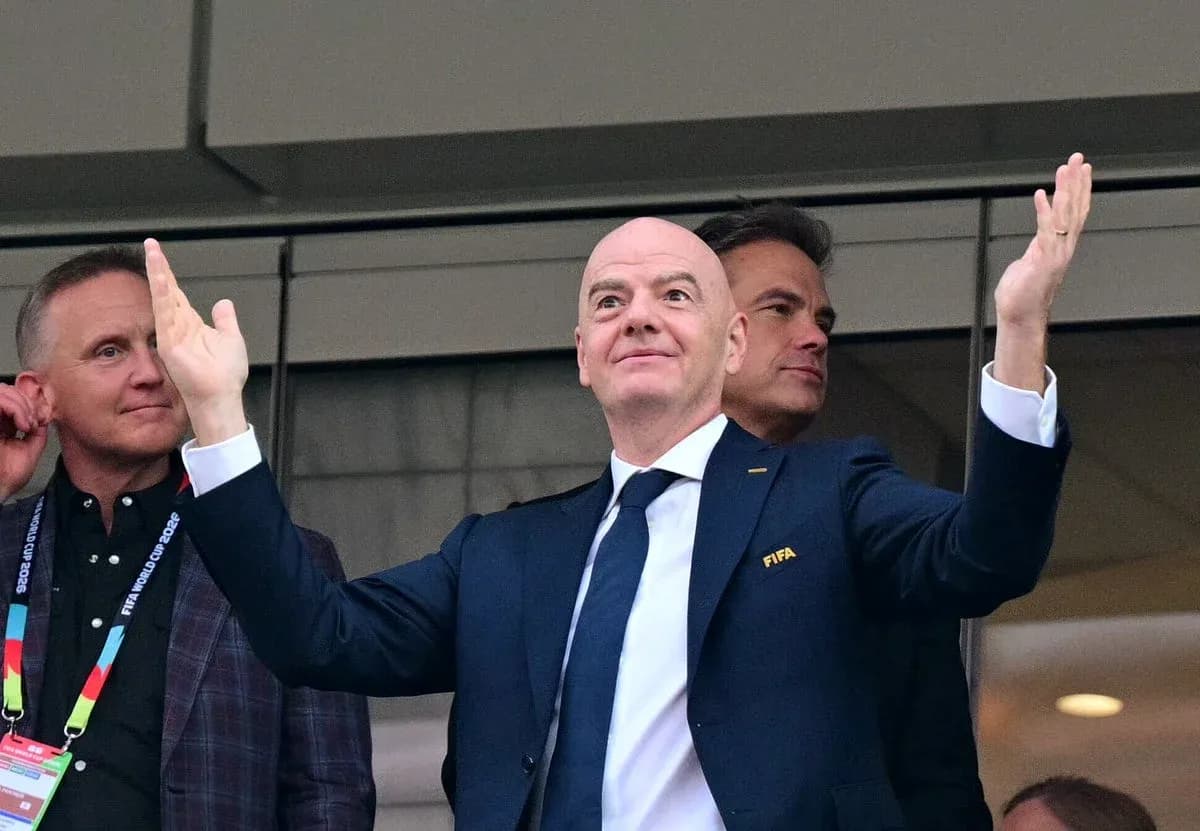
Gianni Infantino's Plan to Sell FIFA Stake Collapses
Gianni Infantino’s grand plan to sell off a slice of FIFA’s future has collapsed in spectacular fashion, leaving the president bruised, isolated and suddenly vulnerable.
Late on Friday night, after a week of escalating revolt, FIFA confirmed it was abandoning its proposal to sell a minority stake in a new commercial vehicle, FIFA Forward Enterprises (FFE), to outside investors. The U-turn was as dramatic as it was swift.
“Having listened carefully to all the views, it has become clear that the project has created divisions of a nature that, regardless of the level of support, are no longer in the interest of the objective set out in the first place,” Infantino said in a statement. “Our purpose has always been — and will always be — to unite and improve. As a result, this proposal will not proceed.”
By then, the damage had already been done.
A plan built on billions – and broken trust
FIFA had unveiled the FFE project on Tuesday, presenting it as a bold financial leap. The governing body wanted to create a private entity to run its flagship competitions, including the World Cup and Club World Cup, and then sell a 21 per cent minority stake to investors.
The numbers were eye-catching. The sale was projected to raise $4.2 billion, money FIFA said would flow quickly to its 211 member associations via a new funding stream: the FIFA Fast-Forward Programme (FFFP). Over the next four years, FIFA’s total development funding, it claimed, would climb beyond $10 billion.
There was also a hard financial edge to the proposal. FIFA made clear that even if associations opposed the plan but it passed, they would still receive $20 million each in the 2027-30 cycle, rising to $22 million in 2031-34 and $24 million in 2035-38, regardless of whether any stake in FFE was actually sold. Those that backed the proposal, however, were promised $40 million in 2027-30, with the later payments identical.
Money on the table. Pressure in the background. But the resistance proved far stronger than the calculations in Zurich.
Confederations revolt
UEFA moved first, and it did not whisper. The European confederation made clear that all 55 of its members were prepared to boycott FIFA competitions, including World Cups, if the project stayed alive. That was not a negotiating tactic; it was a line in the sand.
Concacaf and the Asian Football Confederation soon followed. AFC publicly declared it stood in solidarity with UEFA and Concacaf, aligning Asia and North and Central America with Europe in a powerful front.
Between them, those three confederations represent 137 of FIFA’s 211 member associations. A majority bloc. A warning shot aimed directly at the president.
FIFA initially tried to stand its ground. In a statement issued early Friday morning in Europe, it insisted “nobody is selling football” and said it “acknowledges and respects feedback and concern aired in public” while at the same time pledging to press on, reaffirming its commitment to an “open and democratic consultation”.
The words landed, but the momentum had already shifted. Once UEFA, Concacaf and AFC moved in unison, Infantino’s leverage began to crumble.
CONMEBOL, South America’s governing body, stopped short of outright opposition but still added to the pressure. Its late Friday statement stressed that financial and commercial decisions “must always serve the interests of football and never take precedence over its essence.” It was not a rejection, yet it read like a warning.
Inner circle cracks
External opposition was one thing. The real shock came when the walls began to close in from within.
First, Carlos Cordeiro, one of Infantino’s advisers, resigned. In a scathing statement, he branded the project “a bad deal for FIFA’s Member Associations, a bad deal for football, and a bad deal for the long-term future of the game.” For a sitting adviser to walk away and attack the plan so openly was a jolt to FIFA’s leadership.
Then came an even more damaging blow. Kevin Lamour, FIFA’s chief operating officer, told The Associated Press that staff had been “deceived” by Infantino over the project. He said he would sleep better having spoken out, even if it cost him his job.
“It is the project of one person,” Lamour said. “Not only must this project not go ahead… but the time has now come for football political leaders to ask themselves the right questions and make the right decisions.”
With those words, a controversial idea turned into a full-blown leadership crisis. The project was no longer just a debate about commercial strategy; it had become a referendum on Infantino’s style of governance and his grip on power.
Joshua Kushner’s venture capital firm Thrive had, as of Friday night, not withdrawn from the deal. It did not need to. Once FIFA’s top brass pulled the plug, the investment talks became irrelevant overnight.
From World Cup riches to political freefall
Only days earlier, Infantino had been riding high. He presided over a men’s World Cup that generated $15 billion in revenue and was widely expected to cruise unopposed into another term as FIFA president in March 2027. Many federations had already sent in letters backing him.
This week has changed that landscape.
The Athletic reported that his future was openly questioned in meetings of UEFA and Concacaf on Thursday. Behind closed doors, the conversation shifted from whether to accept his commercial vision to whether he should continue to lead at all.
Lise Klaveness, president of the Norwegian Football Federation, captured the mood in an interview with VG. “My clear impression at the moment is that he has lost a great deal of trust,” she said. “We didn’t vote for him last time, and we’ve been sceptical about this. There are many good things about FIFA, but if you take a lax approach to governance principles and rules, you quickly lose trust.”
Trust is the currency Infantino has spent most lavishly this week. The failed FFE project has left him politically exposed and facing questions he has largely managed to avoid since succeeding Sepp Blatter in February 2016.
A president under siege
In the end, Infantino chose survival over the deal.
Faced with the threat of a boycott, the public revolt of three confederations, and senior insiders breaking ranks, he stepped back from the brink. FIFA’s late-night statement removed the proposal from the agenda and tried to reset the tone.
But the retreat does not erase the memory of the attempt, nor the way it was forced to a halt.
What began as a plan to reshape FIFA’s commercial future has turned into a test of Infantino’s political one. The vultures, as one insider put it, are circling.
Nominations for the 2027 FIFA presidential election must be submitted by November. For years, the assumption was that Infantino would stand alone on that ballot.
After this week, who still believes that?