
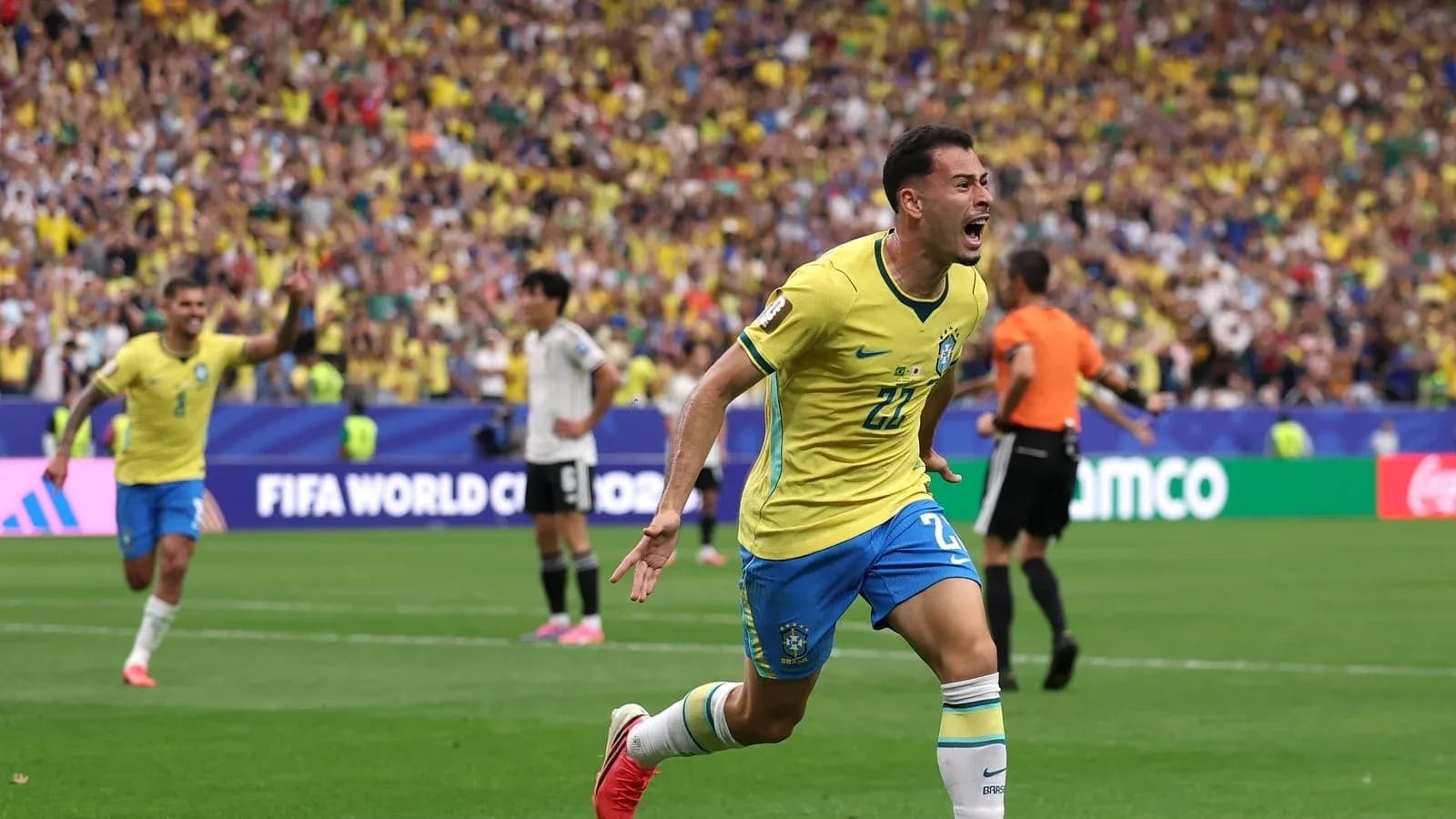
Gabriel Martinelli's Dramatic Winner Sends Brazil to Last 16
Gabriel Martinelli stepped off the bench and into Brazilian World Cup folklore, smashing a 96th‑minute winner to complete a late turnaround against Japan and drag the Selecao into the last 16 with a 2-1 victory.
In Houston, with the clock bleeding into stoppage time and anxiety tightening around Brazilian shoulders, the Arsenal winger showed the calm of a veteran and the ruthlessness of a finisher in form. One touch to settle himself. One cold, precise strike. Post, net, bedlam.
Brazil rescued at the death
Carlo Ancelotti’s side had made this far harder than it needed to be. Japan, organised, sharp and fearless, struck first in the 29th minute when Kaishu Sano punished Brazil, silencing a crowd that had arrived expecting a procession, not a knife-edge knockout tie.
Brazil laboured to respond before the interval, heavy in possession but light on incision. The mood changed after the restart. The tempo rose, the tackles bit, and the pressure began to squeeze Japan back.
The breakthrough came 11 minutes into the second half, and it came from another Arsenal man. Gabriel, who has quietly become a rock at the heart of this Brazil defence, reminded everyone he can deliver at the other end too. He whipped in a superb cross from the right, hanging the ball up at the back post. Casemiro timed his run, attacked it with all his usual ferocity and powered his header past Zion Suzuki. Brazil were level, and suddenly the noise matched the stakes.
Still, the game drifted into that dangerous late territory where one mistake or one moment of brilliance decides everything. Ancelotti turned to his bench and to Martinelli, doubling the Arsenal contingent on the pitch and, as it turned out, tilting the tie.
A Premier League move, a Brazilian finish
The winner was a goal with a distinctly Premier League accent and a Brazilian signature.
Bournemouth’s Rayan snapped into a challenge on the edge of the box to win back possession, refusing to let Japan breathe. The ball fell to Bruno Guimaraes, Newcastle United’s captain and Brazil’s metronome in midfield. His response was instant and incisive: a perfectly weighted, slide-rule pass through the gap, straight into Martinelli’s stride.
The winger didn’t snatch at it. He took a touch, opened his body and slid his shot low past Suzuki. Time slowed as the ball kissed the post and then dropped into the net. Relief roared around the stadium.
Afterwards, Martinelli struggled to put the moment into words. He spoke of joy, of his family, of seeing the Brazilian people celebrating qualification. He recalled hitting the post days earlier and feeling another chance would come. This time, it did. This time, it went in. His first World Cup goal, in his second finals, could hardly have been scripted with more drama.
It was his fifth goal for his country, scored on his 26th cap. Gabriel, meanwhile, has now started all four of Brazil’s matches at this tournament and moved on to 21 caps, his status as a mainstay underlined with every outing.
Arsenal threads through Brazil’s route
Brazil now move on to a last‑16 clash on Sunday against either Norway or Ivory Coast. That draw carries an intriguing subplot: a possible meeting with Martin Odegaard, which would guarantee Arsenal representation in the quarter-finals and add a layer of club intrigue to an already tense knockout stage.
For now, though, the story belongs to Martinelli and Gabriel. One supplying the cross for the equaliser, the other delivering the decisive blow at the death. Two Arsenal players, central to Brazil’s survival.
Havertz scores, Germany fall
While Brazil surged on, Germany’s World Cup story unravelled again.
Kai Havertz, another Arsenal forward, did his part in normal time but could not drag his country through a penalty shootout as Germany fell to Paraguay after a 1-1 draw.
Julio Enciso had given Paraguay a 42nd‑minute lead, a sharp finish that piled yet more pressure on a German side carrying the scars of recent tournaments. Havertz responded, rising to meet a Florian Wirtz cross and heading in the equaliser to restore some order and belief.
Germany pushed. Jonathan Tah thought he had found the winner in extra time, only to see his effort ruled out. The match marched to penalties, and that is where it all slipped away.
Havertz was one of three German players to miss from the spot as Paraguay completed a shock victory, sending Germany out and deepening the sense of crisis around a nation that once treated the latter stages of major tournaments as a given.
Havertz did not hide afterwards. He called himself speechless, admitted that his second World Cup had ended in failure just like his first, and labelled recent tournaments a disaster. He spoke of responsibility, of the need for players to look hard at themselves, and of the weight of representing a country with such a rich football history.
On one side of the world, a late Brazilian winner and an eruption of joy. On the other, a German exit and a striker staring into the cameras, searching for answers.



