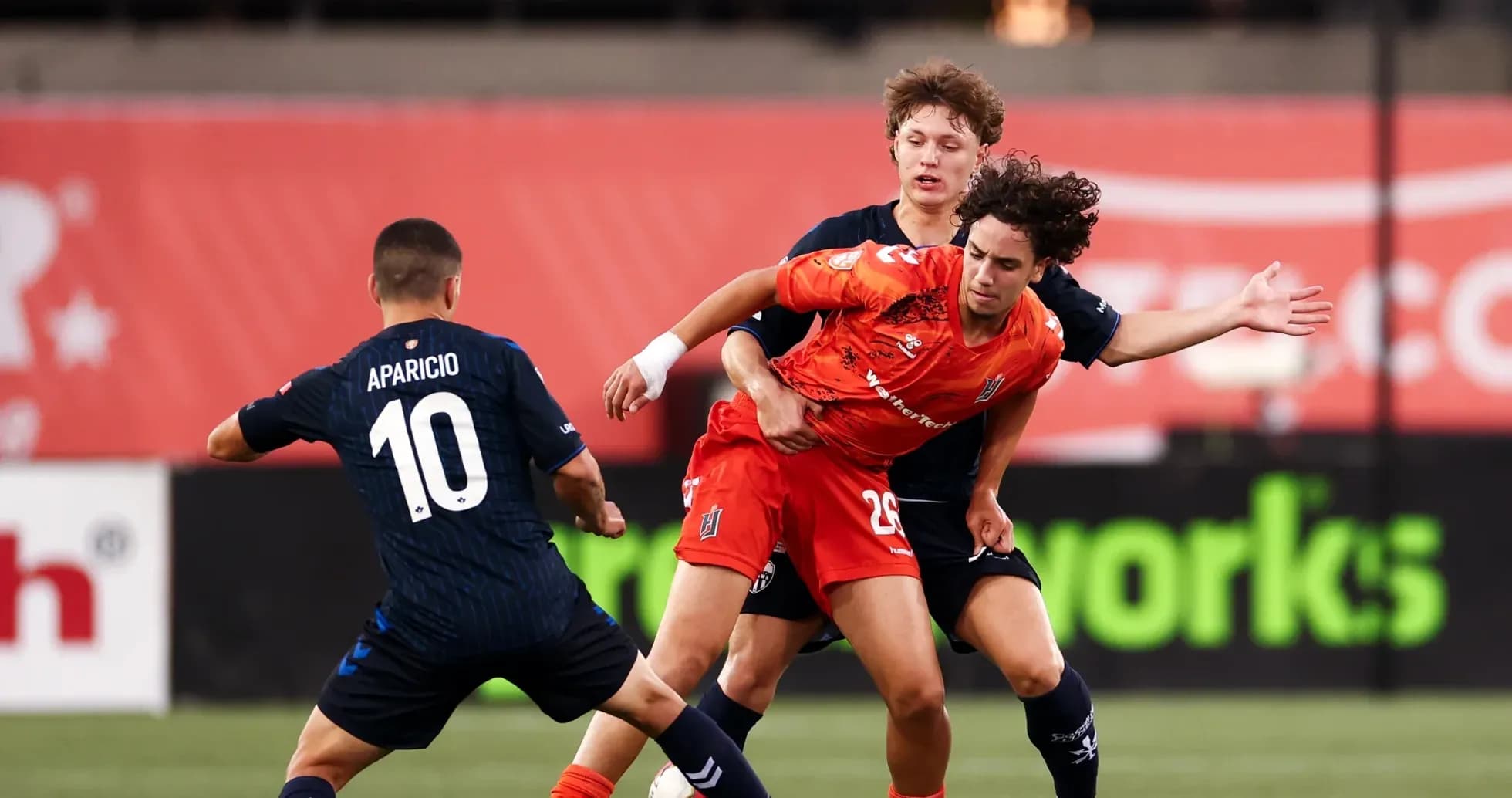
Forge Dominates Atlético Ottawa in 3–0 Victory
The lights at Tim Hortons Field have already dimmed on a statement 3–0 victory for Forge, but the ninety minutes just played feel less like a conclusion and more like a manifesto. In a Canadian Premier League season defined by fine margins, this Group Stage clash between second‑placed Forge and third‑placed Atlético Ottawa underlined the gulf in collective cohesion between a side built to dominate and one still searching for an away‑day identity.
Heading into this game, Forge’s season‑long profile was clear: a team that controls games through structure and repetition. Overall they had taken 14 wins from 21 matches, scoring 33 and conceding 15 for a goal difference of +18. At home, the numbers were even more ruthless: 8 wins from 11, with 17 goals scored and only 6 conceded, averaging 1.5 goals for and 0.5 against per home match. Atlético Ottawa arrived as dangerous but flawed challengers: overall 34 scored and 37 conceded from 22 games (goal difference −3), and on their travels only 3 wins from 11, with 13 goals for and 24 against, an away average of 1.2 scored and 2.2 conceded.
Those patterns played out almost to the letter.
Forge lined up in their now‑signature 4‑3‑3 under Bobby Smyrniotis, a shape that has been their most used configuration this season. Daniel Bertaud stood behind a back four of Rezart Rama, Daniel Nimick, Alexandre Batisse and Marko Jevremović. In front of them, the midfield trio of A. Sadek, A. Aromatario and captain Kyle Bekker formed a layered engine room, with M. Bourgeois and H. Massunda flanking central striker B. Wright.
Atlético Ottawa, by contrast, went with a 4‑4‑2 under Gustavo Leal – a departure from the back‑three structures they have often preferred. C. Kalongo was shielded by a youthful back line of Rony Mbomio, Loïc Cloutier, Sergei Kozlovskiy and Joaquim Coulanges. The midfield four of J. Castro, Manuel Aparicio, D. Gutiérrez and Gabriel Antinoro supported a front pair of Nicolas Fleuriau Chateau and Ballou Tabla, the latter one of the league’s standout attackers with 5 goals and 1 assist in 22 appearances.
From the opening whistle, the tactical contrast was stark. Forge’s 4‑3‑3 morphed into a 2‑3‑5 in possession, with Rama and Jevremović stepping high and Sadek dropping alongside the centre‑backs to build. Aromatario and Bekker then occupied the half‑spaces, pulling Ottawa’s flat midfield line into uncomfortable decisions: step out and leave the forwards isolated, or sit and allow Forge’s centre‑backs to dictate.
Aromatario, who has quietly become one of the league’s most combative midfielders, again embodied Forge’s balance. Over the season he has made 29 tackles and 23 interceptions, and his 8 yellow cards speak to a player operating on the edge. Here, his positioning shut down Ottawa’s central lanes and allowed Bekker to orchestrate, threading passes into the front three and switching play to pin the visitors back.
Behind them, Nimick and Jevremović were the calm core of Forge’s dominance. Nimick, already on 3 goals for the season and with a passing accuracy of 90%, repeatedly broke lines with vertical balls into Wright’s feet. Jevremović, who has 23 tackles and 3 successful blocks this campaign, stepped into midfield to compress space, safe in the knowledge that Bertaud and the rest of the defensive unit had conceded only 6 goals at home before this match and kept 7 home clean sheets overall. The 3–0 scoreline only reinforced that defensive steel.
For Ottawa, the 4‑4‑2 never quite solved the puzzle. Away from home they had already failed to keep opponents under control, with 24 goals conceded on their travels and only 1 away clean sheet all season. The pairing of Tabla and Fleuriau Chateau promised threat – Tabla with 19 shots (13 on target) and Fleuriau Chateau with 3 goals and 2 assists in just 368 minutes – but they were starved of structured service. Too often, Ottawa’s attacks devolved into direct balls into the channels, easily swallowed by Nimick and Batisse.
The “Hunter vs Shield” duel that was supposed to define the night – Tabla and Fleuriau Chateau against Forge’s back line – became instead a showcase for Forge’s collective defending. Nimick’s aerial dominance, Jevremović’s aggression, and Batisse’s reading of second balls meant Ottawa’s forwards rarely received possession between the lines. When they did, Aromatario and Sadek collapsed the space, forcing play wide where Rama’s physicality and overlapping threat turned defence into attack.
In the “Engine Room” matchup, Bekker and Aromatario outmanoeuvred Aparicio and Gutiérrez. Aparicio, who has completed 670 passes at 83% accuracy this season and sits on 6 yellow cards, is usually Ottawa’s metronome. Here, he was forced deeper and wider to escape Forge’s press, which blunted his ability to feed Tabla and Fleuriau Chateau. Antinoro, a dribbler by instinct with 46 attempted take‑ons and a red card already on his record this season, was repeatedly funneled into traffic, his 1‑v‑1 ability neutralised by Forge’s numerical superiority on the flanks.
Discipline always loomed in the background. Forge’s season‑long card profile shows a spread of yellow cards across all phases, with noticeable spikes between 31–45 minutes (20.83%) and 61–75 minutes (also 20.83%), while Ottawa’s most combustible period is late: 34.69% of their yellows arrive between 76–90 minutes. In a match where Forge led and controlled tempo, Ottawa’s tendency to fray late was a latent risk every time they chased the game. Their season‑long red card, and the 50.00% penalty conversion rate (2 scored, 2 missed), underline a side that can be both emotionally and technically volatile in decisive moments.
Forge, by contrast, carry a cleaner penalty record: 3 taken, 3 scored, with no misses this campaign. That composure from the spot mirrors their broader game management. With a biggest home win of 3–0 already on their seasonal ledger and an away high of 4–1, this is a team that, when it smells weakness, knows how to turn control into margin.
Following this result, the statistical prognosis only hardens. Forge’s home averages – 1.5 goals scored and 0.5 conceded – remain the foundation of a title push built on structure, depth and a spine featuring Bertaud, Nimick, Jevremović, Aromatario and Bekker. Ottawa’s away profile – 1.2 scored, 2.2 conceded – tells of a side whose attacking talents in Tabla, Fleuriau Chateau, Emiliano García and the creative sparks of Kamron Habibullah and Coulanges are too often undermined by structural fragility and late‑game indiscipline.
On this night in Hamilton, the narrative was simple: a drilled, data‑backed machine in orange against a talented but brittle visitor. Forge did not just win 3–0; they played to type, and in doing so, underlined why their season‑long numbers are no accident.