Ferran Torres: A Career at a Crossroads in Barcelona
Ferran Torres has never spoken louder in Barcelona colours than he did without a ball at his feet.
Linked heavily with PSG, the forward stepped in front of Sportico’s microphones and laid down his terms. “Every time these teams want you it’s a good thing,” he said. “In football you never know what can happen, but the good thing is that, as I have a contract, I can wait and decide on my own. What do Barca need to do to keep me? They have to show me they want me, come to negotiate, and in the end it’s all about talking.”
At Camp Nou, those words did not land softly. According to The Athletic, the comments “raised eyebrows” inside the club. They came at a delicate moment, with Barcelona wrestling not just with their future attacking structure, but with the fine print of Torres’ past.
A contract that complicates everything
When Barca signed Torres from Manchester City in January 2022 for a total of €65 million, they also accepted a sting in the tail. As reported, sporting director Deco is “reluctant” to offer an extension because of a clause that would trigger another €7m-€8m payment to City if new terms are agreed.
Keep him, and they pay again. Sell him, and they escape the add-on.
PSG’s interest suddenly looks like a financial lifeline. If the French champions come up with a substantial fee, Barcelona not only dodge that extra payment but also free up room for their priority target: Julian Alvarez. The arithmetic is brutal. The Catalans are weighing the cost of faith in Torres against the price of a younger, more rounded centre-forward.
Torres’ camp see that pursuit of Alvarez as a clear signal. A lack of belief. A lack of trust. From their perspective, how else can you interpret a club chasing another striker while your own numbers stand up so well?
Hansi Flick has hardly soothed the tension. “I have complete confidence in Deco and we know we have to do something [about signing a new striker],” the Barcelona coach said. “But it also depends on Ferran, so we will see what happens.” Supportive on the surface, but the message is obvious: Barca are moving in the market, and Torres is part of the equation, not the solution.
Numbers that impress, doubts that persist
On paper, Torres has a case. A strong one.
With Robert Lewandowski now gone on a free to MLS side Chicago Fire, Barcelona need goals. Torres delivered 21 of them in 49 games across all competitions last season, two more than Lewandowski and second only to Lamine Yamal’s 24. The previous campaign he hit 19. Those are not the returns of a fringe player.
Yet inside and outside the club, he is not spoken about in the same breath as Yamal, Raphinha, Pedri or even the departing Lewandowski when the story of Barca’s back-to-back Liga titles is told. There is a reason.
Flick has undoubtedly improved him since taking over in 2024, sharpening his movement and confidence in the box, but the inconsistencies remain. Between January and April, precisely when titles are usually won and lost, Torres went 14 games without a goal. For a forward at Barcelona, that is an eternity. The spotlight on his finishing turned harsh, and it stayed there.
Meanwhile, the squad has moved around him. Anthony Gordon and Karim Adeyemi have arrived, both able to play across the front line. If Alvarez follows, Torres’ role shrinks further. He can operate wide, of course, yet those channels are already owned by Yamal and Raphinha. The path to becoming an undisputed starter is not just narrow; it is almost blocked.
Diario Sport report that Barcelona want to recoup the full €65m they invested in Torres. If PSG pay it, the deal makes sense on every balance sheet in Catalonia. This is peak selling time: his stock is high after a prolific season and international exploits, but his contract is running down. Wait too long and the value plummets as he edges towards free agency.
Flick, bolstered by his new signings, can live with that scenario even if Alvarez never lands. The safety net up front is already in place.
The Paris temptation
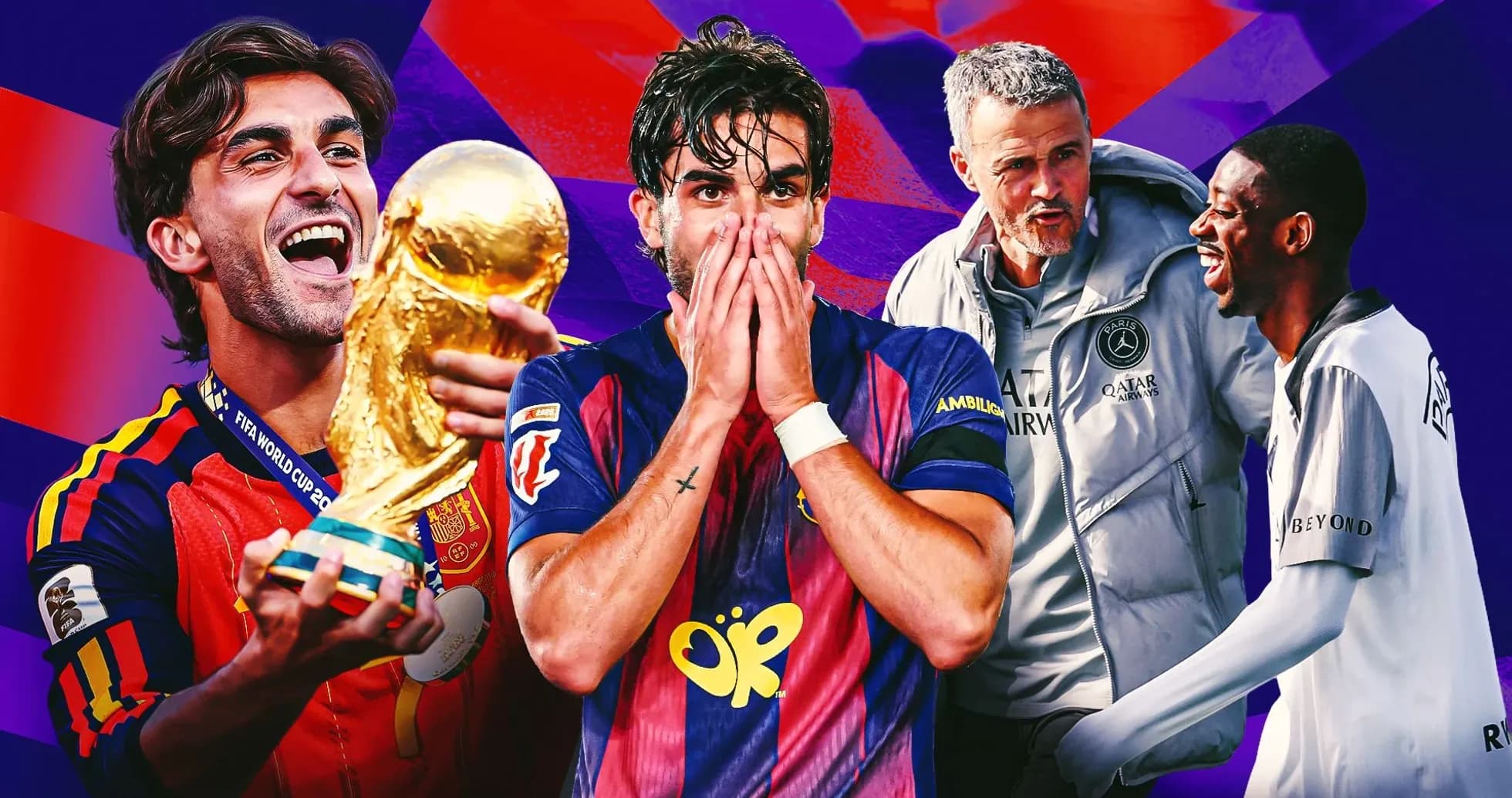
For Torres, the prospect of PSG is intoxicating. Luis Enrique’s side have just won back-to-back Champions League titles, beating Barcelona in Catalonia on their way to lifting the trophy in May. They are Europe’s current benchmark, and they are calling.
Yet if Torres believes a starring role awaits at the Parc des Princes, he is misreading the script.
Luis Enrique wants him because he fits a specific profile: a mobile attacker, comfortable drifting between both flanks and dropping into a false nine role. PSG sold their only orthodox centre forward when Goncalo Ramos left for AC Milan at the end of June. Even before that, Luis Enrique regularly preferred Ousmane Dembele through the middle in the biggest games, rotating Ramos in and out.
Torres’ versatility should earn him more starts than Ramos managed, especially if Bradley Barcola completes his proposed move to Liverpool. But the hierarchy of talent in Paris is clear. Khvicha Kvaratskhelia, Dembele and Desire Doue are the front three that terrify the rest of Europe. They are the combination every other club envies.
Ligue 1 will not be the measure of Torres. The league’s level and intensity lag behind La Liga, and at PSG domestic dominance is assumed. He will be judged almost entirely on Champions League nights. That is a problem for a player with just 12 goals in the competition across four seasons at Barcelona.
Yes, the medal count could swell. It is entirely reasonable to argue that his chances of adding another Champions League title to his CV are greater in Paris. Barcelona, even with the expected arrival of his Spain team-mate and Ballon d’Or winner Rodri, are still chasing PSG’s current standard. But medals do not always build legacies. Roles do.
A career at a crossroads
Torres had other options. Atletico Madrid, Tottenham, Aston Villa, Napoli, Juventus – all have been credited with interest this summer. Each of those clubs could have offered him something different: the chance to lead a line, to become the focal point of an attack, to prove he can be an elite, self-sufficient forward rather than a cog in a larger machine.
Instead, if he chooses Paris, he will again be part of a system, not its centre.
The limitations that have held him back in Barcelona will not magically disappear. When he has to drop deep or hold off powerful defenders, his touch and strength falter. He is excellent at finding space in behind, timing his runs, exploiting gaps. He is far less convincing when asked to create for others or dictate the tempo of an attack.
Those flaws explain his stop-start role at Barca. They also explain why, during Spain’s World Cup triumph, he started just one of his eight appearances. Even under a coach who clearly values him, he was a weapon to be deployed, not the platform everything was built upon.
Luis Enrique’s tactical plan in Paris will suit him. It will hide some weaknesses, accentuate his movement and finishing, and ask him to do what he already does well. But it will not force him to evolve. It will not demand that he becomes something more than a high-level specialist.
Back in Barcelona, patience with his public flirting has worn thin. Supporters never fully embraced him, despite his relentless work rate, and his open courting of PSG has only deepened the distance. After his exploits in North America, he holds a strong negotiating hand and he knows it. Perhaps too well.
The grass in Paris will be lush, the trophies plentiful, the spotlight bright. Yet for Ferran Torres, the real question is not where he plays next season, but what he becomes there. A leading man at last, or once again the ultimate utility forward dressed in superstar colours?