Fenerbahçe Dominates Sturm Graz with 2-0 Victory
Fenerbahçe’s 2-0 win over Sturm Graz at Chobani Stadium was a controlled, system-driven performance built on structural superiority and relentless occupation of the opposition half. The scoreline matched the flow: a 2-0 lead already secured by half-time and then managed with maturity, with Fenerbahçe using their 4-2-3-1 as a territorial lock rather than chasing further goals at all costs.
First Half
Ismail Kartal’s 4-2-3-1 was textbook in its spacing. With M. Gunok in goal, a back four of N. Semedo, M. Skriniar, N. Ake and J. Oosterwolde provided a stable rest-defense platform that allowed the front four to stay high. In front of them, the double pivot of M. Guendouzi and N. Kante controlled rhythm and counter-pressing lanes. Ahead, M. Greenwood (right), M. Asensio (central), K. Akturkoglu (left) and Talisca as the lone forward formed a fluid attacking box between the lines.
The statistical profile underlines how dominant the structure was. Fenerbahçe had 72% possession and completed 578 passes, with 520 accurate at 90%. That level of passing security is only possible when the team is consistently offering short options and recycling through the pivot; Guendouzi and Kante were clearly central to this, always available behind the ball to reset and switch play. The 12 shots inside the box out of 17 total attempts show that this was not sterile possession: the ball circulation was purposeful, used to move Sturm’s 4-4-2 block until a central or half-space lane opened.
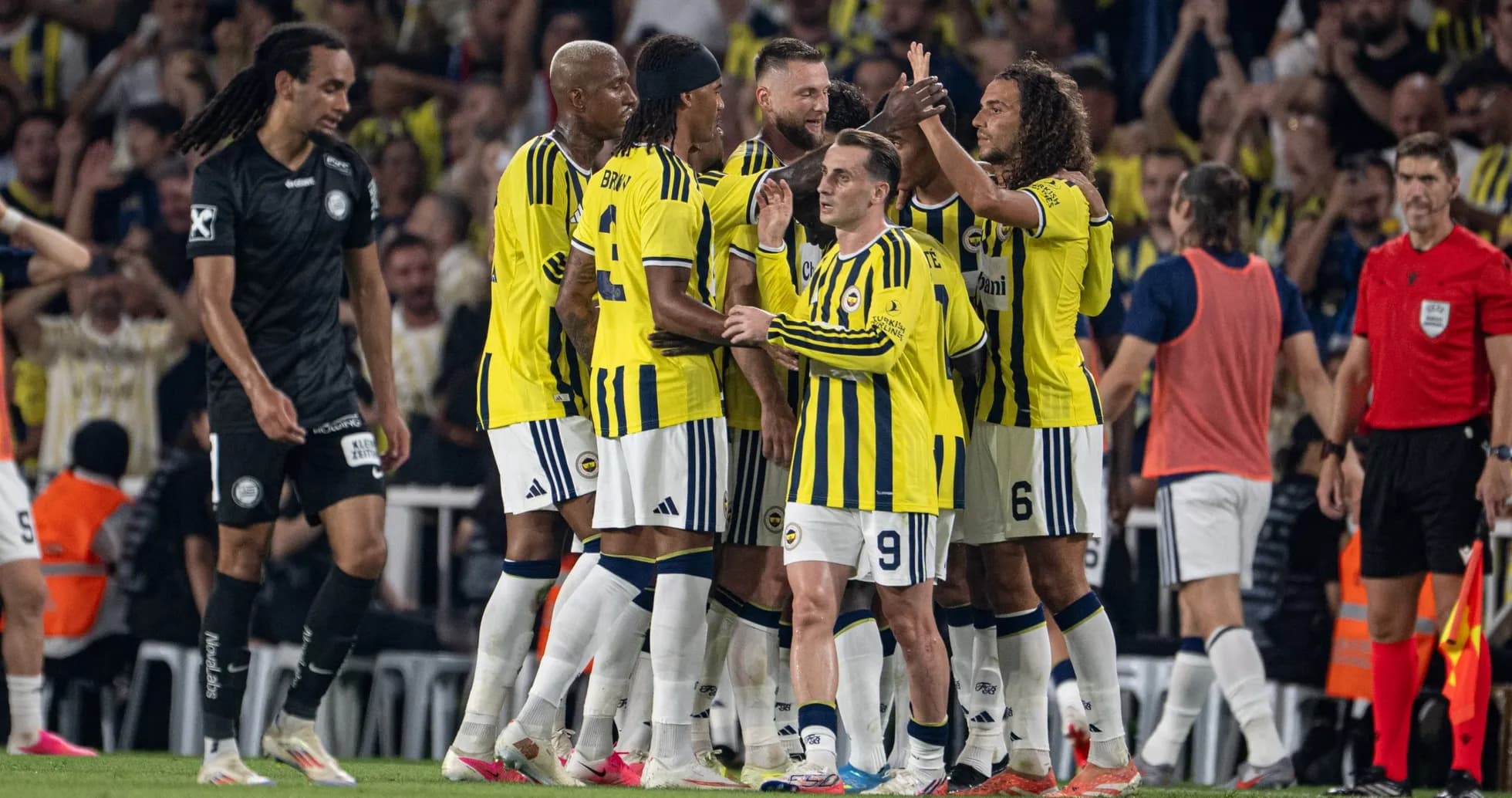
The goal patterns fit the tactical design. The early opener from Talisca at 9', assisted by K. Akturkoglu, reflects Fenerbahçe’s ability to pin Sturm back quickly. With Akturkoglu starting wide on the left, his assist suggests a classic pattern: overload on one side, then a decisive action into the box for the striker. The second goal at 45' from M. Greenwood, assisted by M. Asensio, reinforces the centrality of the attacking midfield trio. Asensio, operating as the No. 10, had the freedom to receive between Sturm’s lines; Greenwood, from the right, could attack the far post or the inside channel, and that combination produced the 2-0 that effectively killed the tie before the break.
Defensive Control
Out of possession, Fenerbahçe’s control is evident in the defensive stats. Sturm Graz managed only 5 total shots, with just 1 on target. Fenerbahçe committed 10 fouls to Sturm’s 19, a sign that they were rarely forced into emergency defending. The back four, shielded by Kante’s ball-winning and Guendouzi’s positioning, kept Sturm’s front two of S. Wlodarczyk and S. Jatta largely disconnected from their midfield. With 5 blocked shots, Fenerbahçe also showed good penalty-box discipline, stepping out at the right moments to prevent clean looks on goal.
In goal, M. Gunok (Fenerbahçe) had a quiet but precise night, making 1 save. That low number of interventions is less about his individual display and more about the team’s collective defensive structure: Sturm were pushed so deep and forced so wide that they rarely generated threatening final actions. At the other end, D. Khudyakov (Sturm Graz) made 8 saves, a clear indicator of the volume and quality of Fenerbahçe’s finishing positions. The 10 shots on goal from Fenerbahçe were not speculative; they were the product of sustained pressure, second balls won around the box, and repeated entries into the area.
Sturm Graz Tactics
Fabio Ingolitsch’s 4-4-2 for Sturm Graz was set up to be compact, but it never really transitioned into a threatening counter-attacking shape. With 28% possession and just 222 passes (164 accurate, 74%), Sturm spent most of the match in a low or mid block, shuffling laterally to close central lanes. The problem was their inability to progress once they recovered the ball: the double pivot of J. Gorenc Stankovic and L. Weinhandl was often pinned deep, and the wide midfielders J. Hodl and S. Seidl (before his substitution) were forced so far back that the first pass out was usually under pressure. The 19 fouls and 3 yellow cards underline how often Sturm resorted to breaking Fenerbahçe’s rhythm rather than contesting the ball higher up.
Substitutions from Kartal were primarily about energy management and maintaining the tactical framework rather than changing it. At 30', A. Brown (IN) came on for J. Oosterwolde (OUT), a like-for-like full-back adjustment that preserved the back-four structure. Later, on 69', Fred (IN) replaced M. Greenwood (OUT) and I. Kahveci (IN) replaced M. Asensio (OUT), refreshing the attacking midfield line but keeping the same 4-2-3-1 roles. At 85', M. Muldur (IN) came on for N. Semedo (OUT) and O. Aydin (IN) for K. Akturkoglu (OUT), further rotating full-back and wing positions without altering the system’s geometry.
Sturm’s changes at 46' and the triple switch on 64'—A. Kayombo (IN) for S. Wlodarczyk (OUT), G. Mamageishvili (IN) for S. Seidl (OUT), R. Fosso (IN) for L. Weinhandl (OUT), and N. Weiper (IN) for S. Jatta (OUT)—were attempts to inject pace and ball-carrying into the front line and midfield. However, the underlying problem remained: without the ball and under such sustained territorial pressure, the new players were mostly chasing rather than exploiting space.
Statistical Verdict
The statistical verdict is clear: this was a one-sided tactical contest. Fenerbahçe’s 72% possession, 17 total shots (10 on goal, 5 blocked) and 578 passes at 90% accuracy show a team in full command of both tempo and territory. Sturm Graz, with 5 shots (1 on goal), 222 passes at 74%, and 19 fouls, played almost exclusively in survival mode. The 2-0 scoreline, reached by half-time and calmly protected thereafter, accurately reflects a match in which Fenerbahçe’s 4-2-3-1 structure, technical superiority in midfield, and coordinated pressing suffocated any hope of an Austrian comeback.