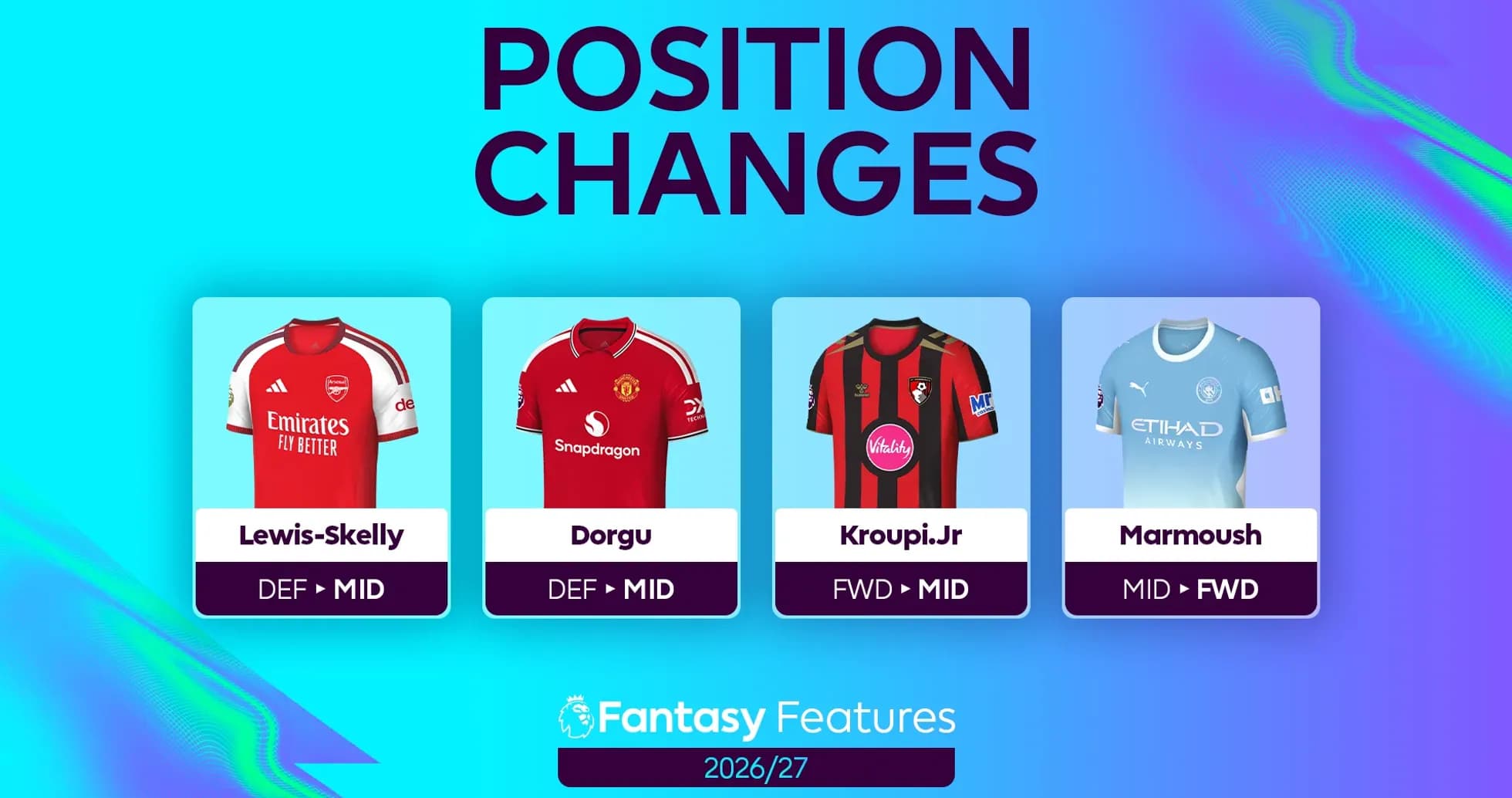
Fantasy Premier League 2026/27: Key Positional Reclassifications
The Fantasy Premier League game board has been nudged again, and this time it’s the positional reclassifications that will reshape how managers build their squads for 2026/27.
Some are subtle tweaks. Others are seismic. Junior Kroupi, Patrick Dorgu and Omar Marmoush sit right at the heart of that shift.
Kroupi: From penalty box to points machine
Bournemouth’s Junior Kroupi was already on the radar. Now he’s marching straight into the template conversation.
Listed as a forward last season, Kroupi has been reclassified as a midfielder after spending most of 2025/26 operating as a No 10 behind Evanilson. The role suited him brutally well. He struck 13 goals in 33 appearances in his breakout campaign, a return that would look strong for a striker and becomes even more dangerous now he’s in the midfield bracket.
The numbers underline just how sharp he was. Kroupi averaged a goal every 134.0 minutes. That wasn’t just tidy; it was explosive. Among regular midfield starters last season, Antoine Semenyo set the pace at Bournemouth with 188.2 minutes per goal. Kroupi beat that by more than 50 minutes.
Now layer on the FPL scoring system. As a midfielder he earns an extra point for every goal and collects clean sheet points as well. The same output in 2026/27 will be worth significantly more. Managers don’t need much more persuasion than that.
He was already a high-ceiling asset. The reclassification turns him into a potential cornerstone.
Dorgu: Carrick’s winger gets a Fantasy promotion
Patrick Dorgu’s shift is less about volume and more about what he did when finally unleashed.
The Manchester United man moves from defender to midfielder after Michael Carrick pushed him into a more advanced role in the second half of last season. On paper, that sounds like a routine update. In reality, it reflects a dramatic change in how he was used.
Dorgu started only three matches under Carrick from Gameweek 22 onwards. Three starts, three goals. Each one from the left wing.
He scored against Arsenal. He scored against Manchester City. He then produced a goal and an assist against Brighton & Hove Albion. That’s not padding numbers in low-pressure fixtures; that’s delivering against serious opposition from a very attacking berth.
When you stack him up against United’s other midfield options under Carrick, he doesn’t fade. He stands out. Dorgu averaged a shot every 33.2 minutes, the quickest rate among the trio of Dorgu, Matheus Cunha and Bryan Mbeumo. He also matched Cunha’s tally of three big chances, despite playing more than 800 minutes fewer than the Brazilian.
As a defender, those attacking flashes made him an intriguing differential. As a midfielder, the clean sheets disappear, but the classification finally reflects the role he’s actually playing. If Carrick keeps trusting him high on that left flank, Dorgu becomes a live mid-price option with the numbers to back the eye test.
The question now isn’t whether the position change is justified. It’s whether he’ll get the minutes to turn that small sample into a season-long weapon.
Marmoush: Guardiola’s striker steps into the spotlight
At Manchester City, the arrow points the other way.
Omar Marmoush has been shifted from midfielder to forward after Pep Guardiola consistently used him through the middle in his final campaign in charge. The Egyptian led the line, and the game has caught up with that reality.
Marmoush delivered three goals and three assists in that central role. Those figures are solid rather than spectacular, but the context matters: a City forward slot, under a manager who trusted him to operate as the focal point.
As a midfielder, those returns came with the added appeal of extra goal points and clean sheet bonuses. That cushion has gone. Listed as a forward, Marmoush now has to be judged directly against out-and-out strikers, where expectations are harsher and the competition is fiercer.
The reclassification is a correction, not a gift. It reflects his job on the pitch, and it forces FPL managers to make a clearer decision: is he good enough, and explosive enough, to justify a forward slot in a City attack that often spreads the goals around?
New shapes, new traps, new opportunities
Behind the headline names, the wider table of changes tells its own story.
- Myles Lewis-Skelly (Arsenal) and Lamare Bogarde (Aston Villa) both shift from defence into midfield, a nod to their more progressive roles.
- Keane Lewis-Potter (Brentford) and Ryan Sessegnon (Fulham) also move from defender to midfielder, removing their clean sheet upside but better reflecting their advanced positions.
- Mats Wieffer (Brighton & Hove Albion) drops from midfield into defence, while Georginio Rutter goes the other way, from Brighton defender to forward.
- Rio Cardines (Crystal Palace) and Eric Moreira (Nottingham Forest) flip from midfield to defence and vice versa, fine-tuning how the game categorises their hybrid duties.
Each change nudges value around the board. Some players lose a layer of appeal. Others, like Kroupi, gain a powerful scoring boost without changing anything on the pitch.
That’s the crux for Fantasy managers now. The roles are largely set. The data is there. The reclassifications simply redraw the lines on the game’s map.
Who adapts quickest to that new landscape could define the early weeks of 2026/27.