Enzo Maresca: A New Era at Manchester City
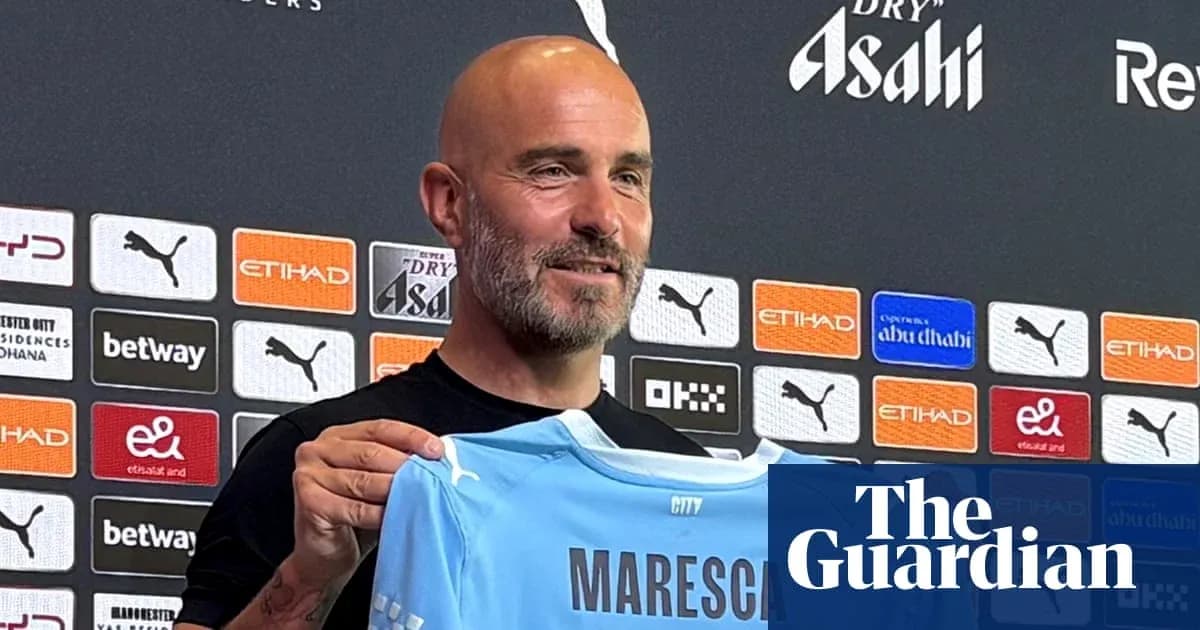
Enzo Maresca did not try to shrink the task in front of him. He walked into his first press conference as Manchester City manager and called following Pep Guardiola “a privilege” – then immediately acknowledged the graveyard of great dynasties that came before.
At Old Trafford and the Emirates, the succession stories are warnings. At the Etihad, Maresca is determined they become inspiration.
Stepping into Guardiola’s shadow
Maresca, appointed last month, inherits a club reshaped in Guardiola’s image over a decade of near-total dominance: 17 major trophies, a defined playing identity, a culture of control. City’s greatest ever manager, by any reasonable measure.
“First of all, I have to say that it’s a privilege because the club decided to go for me,” the Italian said. He has never hidden his admiration for Guardiola. “I said many times that I consider Pep probably the best coach in the world in the last 20, 25 years.”
That is the bar. Not just winning, but winning with a style that has bent English football to his will.
Maresca did not pretend the past will simply be a foundation. It can just as easily be a weight. He referenced the struggles that followed the departures of Sir Alex Ferguson and Arsène Wenger – two men who, like Guardiola, defined eras as much as teams.
“It’s a challenge. It’s nice,” he said. “Also, the history of the manager with many years in the same club always struggled a little bit. After Sir Alex, after Arsène.” The implication was clear: long reigns leave long shadows. “But also, it’s a challenge to try to do the right things immediately for this organisation, for the fans, for everyone.”
Betting on City’s structure
Where others crumbled, Maresca believes City’s structure can steady the transition. He leaned heavily on that word: organisation.
“The organisation is the main thing,” he said. “This club, this organisation, they had three managers in 17 years.” Roberto Mancini, Manuel Pellegrini, Pep Guardiola. Three men, almost two decades, and a clear line of evolution. “This is not normal. It doesn’t happen often.”
The message was not subtle. City are not lurching into a new era; they see this as a continuation of a project that began with Mancini, moved through Pellegrini and reached its peak with Guardiola. Maresca framed his own role in those terms.
“I’m confident that we can do a great job. We can continue to do the job that has been done since Roberto was here, then after Manuel and for 10 years Pep.”
Continuity, not revolution. The club’s hierarchy has backed that idea by appointing a coach steeped in Guardiola’s methods, from his time on the City staff to his work elsewhere. Now he has to live up to it.
Early blow: Rodri sidelined
Maresca’s first significant piece of team news underlined how quickly theory collides with reality. Rodri, the metronome of City’s midfield and arguably the most important player in the squad, will undergo back surgery on Monday and is set to miss the start of the season.
“First of all, around big players there is always speculation,” Maresca said when asked about the 30‑year‑old’s future amid interest from Real Madrid. “I’m not worried about that.”
His reasoning was blunt. Perform at the level Rodri has reached, and the rumours will never stop. “Also because they [Spain] won the World Cup and he was the best player or one of the best players, I think every manager wants to have Rodri because he’s a top player.”
The immediate concern is not Madrid, but medicine. “But now he has surgery on, I think, Monday. He needs holiday, rest. Then he will be back here with us.”
For a new manager trying to imprint his ideas, losing the side’s tactical anchor for the opening weeks is a serious complication. City’s structure might be stable; its midfield will not be, at least at first.
Futures in flux: Grealish and Trafford
The transfer window adds another layer of uncertainty. Maresca stopped short of making guarantees about the futures of Jack Grealish and James Trafford, both of whom could leave before the deadline.
Grealish has returned to City after last season’s loan at Everton. His status, for now, is simple enough. “Jack, at the moment, he’s a Man City player,” Maresca said. The caveat came quickly. “I always said the same – in any club I join, I like to know if there are players that belong to the club, it’s my duty to try to coach them. Then we see what happens.”
That last line summed up the reality of a modern elite club: no door is fully closed in July.
The same applies to Trafford, the second-choice goalkeeper and a target for Leeds. Maresca knows him well. “I know James because he was my keeper when I was with the City Under-23s [in 2020-21].”
The familiarity does not automatically guarantee a long-term role. “But again, when the transfer window is open now, January, anything can happen. So we see. But at the moment, he’s one of our keepers.”
For Maresca, this is the landscape: follow the most successful manager in the club’s history, lean on one of the game’s strongest structures, start the season without your midfield cornerstone, and navigate a window where key squad decisions remain unresolved.
The privilege he talked about is real. So is the risk. Now he has to prove that, unlike those who followed Ferguson and Wenger, he can turn succession into a new chapter rather than an epilogue.