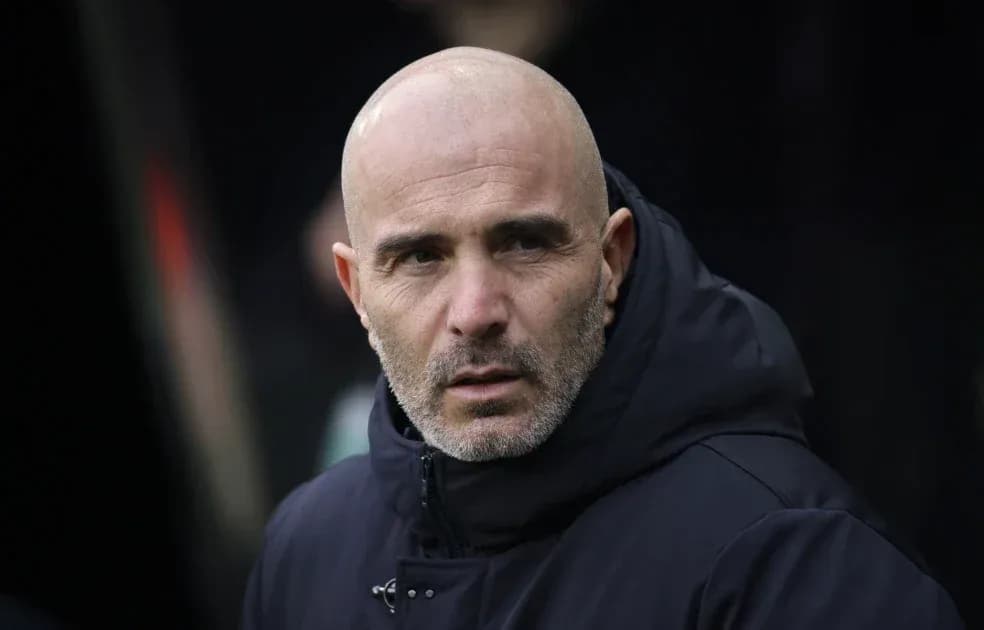
Enzo Maresca Takes On Challenge of Following Guardiola at Manchester City
Enzo Maresca walked into Manchester City with his eyes wide open. He knows exactly whose chair he is taking.
To follow Pep Guardiola at the Etihad is to walk into the most demanding job in English football. Maresca didn’t try to dilute that.
“I consider Pep probably the best coach in the world in the last 20, 25 years,” he said in his first press conference as City manager. “But again, it's a challenge. It's nice. It's a privilege.”
No false modesty. No attempt to pretend this is normal. Guardiola leaves behind 20 trophies in 10 years, a treble, a style of play that reshaped a club and, arguably, a league. Maresca inherits the lot — the expectation, the standards, the microscope.
Living with giants
The Italian knows the history. Clubs rarely glide smoothly into life after a dynasty.
“The history of (following) the manager with many years in the same club always struggled a little bit – after Sir Alex, after Arsene,” he said, invoking Alex Ferguson at Manchester United and Arsene Wenger at Arsenal.
Those two names still haunt boardrooms. United and Arsenal both lurched through years of missteps once their great architects stepped down. Maresca’s challenge is to prove City are different, that their power lies not just in the genius of one man on the touchline.
He believes the structure gives him a fighting chance.
“I think the organisation is the main thing,” he said. “This club, this organisation, they had three managers in 17 years. This is not normal, it doesn't happen often.
“So this is probably one of the reasons that I'm confident we can do a great job.”
This is Maresca’s third spell at City. He has seen the machine from the inside: first with the elite development squad, then as Guardiola’s assistant in the 2022/23 treble season. He returns now as the man at the front of it all, the one who will be judged on what happens when the trophies are handed out.
Rodri, surgery and speculation
He will not have long to settle. The new season looms, and already one of his most important players is at the centre of the story.
Rodri, World Cup Golden Ball winner and the heartbeat of City’s midfield, needs back surgery. He is also in the final year of his contract and, inevitably, has been linked with Real Madrid.
“We have to say that around big players there is always speculation,” Maresca said. “I'm not worried about that. I think it's normal.
“Because they won the World Cup, and he was the best player or one of the best players, I think every manager wants to have Rodri.
“But now surgery on Monday, and he needs holiday. He needs to rest. He needs to recover and then he will be back here with us.”
The message was clear: City expect Rodri to return, to remain central to Maresca’s first campaign. Lose him, and the transition from Guardiola becomes even more precarious. Keep him, and the new manager builds on one of the most reliable pillars in European football.
A new signing, an old conviction
Maresca spoke a day after England midfielder Elliot Anderson completed a reported £116 million move from Nottingham Forest. Another bold, expensive investment in a squad already dripping with quality.
The Italian did not dwell on the fee or the hype. His focus stayed on identity, on continuity, on the idea that City’s strength lies in knowing exactly what they are.
It is a theme that runs through his recent career. He left Leicester and Chelsea with a conviction that his teams carried a clear imprint.
“I feel quite lucky in terms of my former clubs -- Leicester, Chelsea –- I think we did a great job,” he said, smiling.
“In both clubs, the identity of the team was clear, the success of the team was clear, and I feel very lucky to be part of these clubs.
“But now we are here. That is the most important thing, just about City. Nothing to add.”
No nostalgia. No looking back. The job in front of him dwarfs everything that came before.
Maresca steps into a role defined by relentless winning and radical football. The foundations are solid, the expectations even more so. The privilege he talks about comes with a simple, unforgiving question: can he keep Manchester City at the summit, or does he become another name in the long list of managers who found life after a legend too much to bear?