England's World Cup Challenge: The Third Chapter
Thomas Tuchel calls it “the third chapter”. The stakes say it is something harsher: the point of no return.
England have moved out of the comfort of group-stage routine and into the thin air of knockout football, where one bad decision or one tired tackle can kill a World Cup dream that has been carefully plotted since that training camp in Miami.
The mission has been clear from the start – bring the trophy back to England for the first time since 1966 – and Tuchel has even broken it into episodes. Preparation in Florida was Chapter One. Topping Group L to reach the last 32 was Chapter Two. Functional, sometimes flat, but effective: wins over Croatia and Panama wrapped around a goalless non-event against Ghana.
Now comes DR Congo in Atlanta on Wednesday. Now comes jeopardy.
A World Cup of shocks – and a warning
The pattern of this tournament is already screaming at the favourites. Germany, dumped out on penalties by Paraguay, have thrown Julian Nagelsmann into open debate about his future while Jurgen Klopp’s name is shouted from the sidelines. The Netherlands, heavy with Premier League talent, have gone home after losing to a slick Morocco, costing Ronald Koeman his job inside 24 hours.
Carlo Ancelotti’s Brazil, the heavyweight many expect to be waiting in Miami later in the competition, needed Gabriel Martinelli’s stoppage‑time escape act to edge past Japan.
This is not a World Cup gently easing the giants through. It is picking them off.
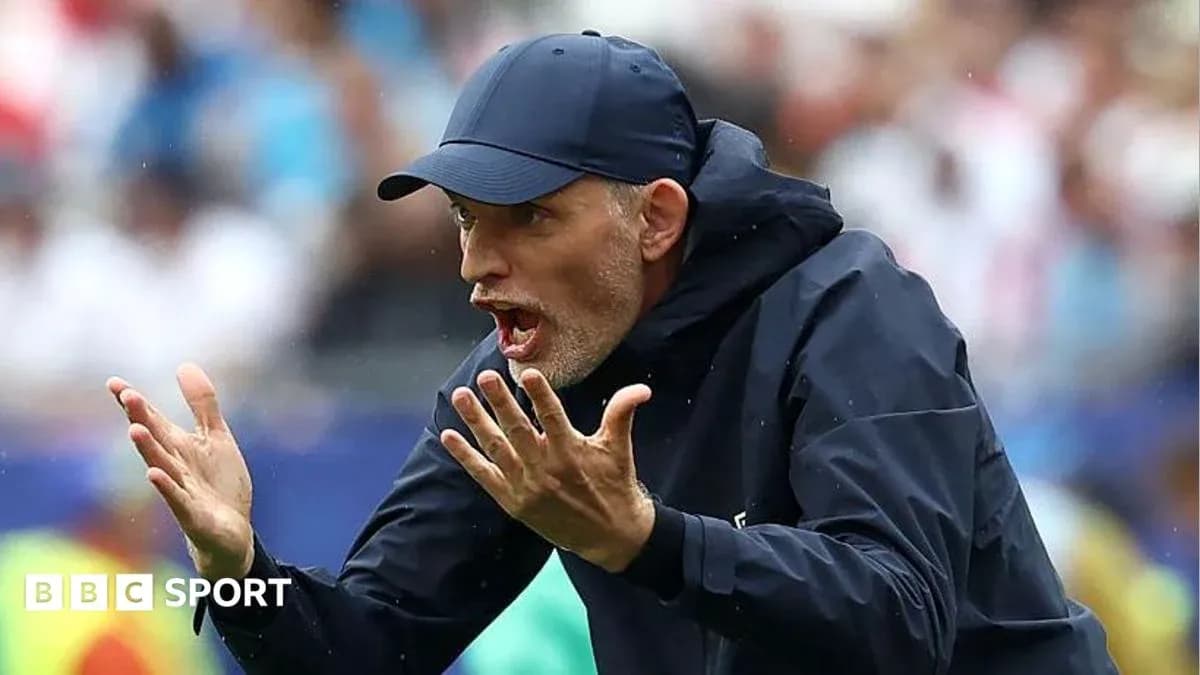
Tuchel knows it. “There is no percentage of over-confidence in our approach,” he said in Atlanta. He talked of “narrow margins”, of games that could just as easily be quarter-finals or semi-finals. It was the language of a man who has seen too much in knockout football to underestimate anyone.
DR Congo will not frighten England on paper. That is precisely the danger.
A brittle back line
Strip away the storylines and one problem sits at the heart of this England team: the defence.
Wayne Rooney, never one to sugar-coat, put it bluntly to BBC Sport: the one area of the pitch where you crave stability – goalkeeper and back four – has been in constant flux.
Jordan Pickford is the exception. Behind him, everything shifts.
Tuchel started the tournament with John Stones and Ezri Konsa in the 4-2 win over Croatia, then dropped Stones and paired Konsa with Marc Guehi. Not out of whim, but necessity. Stones, 32, arrived after a season in which he started only five Premier League games before leaving Manchester City. Reece James, the cornerstone at right-back, managed just 20 league starts for Chelsea and came to the World Cup with a medical file that worried everyone except, perhaps, his coach.
The warnings about England’s defensive fragility were there before a ball was kicked. Tino Livramento’s absence was already confirmed. James’ history of hamstring trouble hung over the squad. When he pulled up against Croatia, few inside the game were shocked. Tuchel publicly admitted his surprise; privately, he will have known this risk was baked in.
The situation worsened when Jarell Quansah, James’ deputy, was injured against Panama. Both will miss the DR Congo game. Tuchel insists they are “getting closer and closer”, with Quansah “a bit ahead” of James, but optimism about fitness is not the same as a clean bill of health.
So Djed Spence stands as the last specialist right-back. Tuchel could move Konsa across, which might reopen the door for Stones in central defence. Either way, the picture is makeshift, and elite opponents are already circling that flank in their minds.
Look ahead to a possible quarter-final with Brazil in Miami and the image sharpens: Vinicius Jr, running at a patched-up right side. That is not a duel for a stand‑in. That is a job for a specialist. Tuchel can only hope James is ready by then, and not just available in theory.
His preference for versatile defenders – full-backs who can switch sides, centre-backs who can shuffle wide – has given him options on the teamsheet. It has not given him the one thing managers crave at the back: certainty.
The Rice equation
If the defence is vulnerable, then Declan Rice has become the plaster holding the whole structure together.
Tuchel left him out of the win over Panama, a sensible decision with qualification already secure and the Arsenal midfielder sitting on a yellow card while nursing a hamstring issue and a bruised calf from the Ghana game. Without him, England won – but the performance told its own story.
Panama were allowed 13 shots. England looked loose, open to counters, with Elliot Anderson asked to patrol a midfield that had been tilted towards attack by the selection of Jude Bellingham and Morgan Rogers. Both offered threat going forward. Both left gaps behind them.
More polished opposition would have punished that space.
Rice is the difference between chaos and control. He screens an uncertain back four, reads danger, plugs holes before they become emergencies. He also builds play, steps into midfield with the ball, delivers from set pieces. He is not just the shield; he is part of the sword.
Strip him out and England are a different team – and not in a good way. Alongside Harry Kane and Bellingham, he now sits in that small category of players Tuchel simply cannot replace.
Saka, selection and the fine print of knockout football
Tuchel’s choices from here are unforgiving. Every decision carries weight.
Bukayo Saka is one of those calls. The Arsenal forward made his first World Cup start against Panama, playing 63 minutes while managing an Achilles tendon problem. His quality is obvious; his fitness is not guaranteed. DR Congo may not demand the full force of England’s attack, but Tuchel must balance the need to progress with the need to protect one of his most dangerous players for the rounds that really define tournaments.
The head coach has already shown he will rotate when he can. Resting Rice was common sense. Managing minutes for those with fragile histories – Stones, James, Saka – is not a luxury now. It is a necessity.
He also knows there is nowhere to hide. “We know these are the moments where we have to find ways to win,” he said. “We need to dig in and to play at the highest level. We are the favourites. We play against our own expectations. We expect to go further than the round of 32, so why should the public not expect that?”
This is the pressure England live under. Expectation at home, landmines abroad.
No room for missteps
Tuchel’s England have done what was required so far. They qualified with a game to spare. They avoided unnecessary suspensions. They managed injuries where they could. Complacency, with this coach, is unlikely.
If any trace of it lingered, the sight of Nagelsmann engulfed by criticism and Koeman out of a job will have erased it. This World Cup is already unforgiving. It has no patience for big names who believe their status will carry them through.
Tuchel insists the upsets have made him “more calm than nervous”, a curious but revealing line. He sees the pattern not as a threat, but as a reminder: every tie is tight, every opponent well prepared, every favourite one bad half from the exit.
England walk into the Atlanta Stadium under a closed roof, spared the brutal heat outside but not the rising temperature of expectation. The story Thomas Tuchel keeps referencing has reached its third chapter.
What happens next will decide whether it becomes a classic – or gets torn up in the round of 32 by DR Congo.