England's Thrilling 3-2 Victory Over Mexico in World Cup
England’s night of Azteca heroics ended with a jolt of cold reality.
Thomas Tuchel’s side, down to 10 men and hanging on in the thin Mexico City air, dragged themselves into the World Cup quarter-finals with a wild 3-2 win over Mexico – then watched Jordan Henderson leave the pitch on a stretcher after an injury suffered not in battle, but in celebration.
Bellingham ignites a classic
The Estadio Azteca has seen its share of World Cup drama. This belonged on that shelf.
England flew out of the blocks, Jude Bellingham silencing a ferocious home crowd with a blistering early salvo. Two chances, two goals, and Mexico were stunned. His quick-fire brace gave Tuchel’s team exactly what every visiting side dreams of at the Azteca: a cushion and a little oxygen.
Mexico, though, do not fold easily here. They had lost only two of their previous 89 competitive games in this stadium, and they came roaring back. Julian Quinones pulled one back to crack open the contest, and suddenly every England touch felt heavy, every clearance desperate.
Then came the twist that turned a thrilling tie into a survival mission.
Jarell Quansah saw red, and England were left to navigate the altitude, the noise and the World Cup co-hosts with 10 men for the final stretch. The game tilted. The Azteca sensed blood.
Kane at both ends of the story
Harry Kane, so often England’s calm in the storm, took centre stage in the chaos.
First, the captain did what he does best. From the spot, he restored England’s breathing space, burying his penalty and briefly muting the stadium again. Control, it seemed, was back.
Not for long.
Kane then conceded a penalty at the other end, and Raul Jimenez converted to drag Mexico to within one once more. The pressure surged. Every England player retreated a few more yards, every Mexican attack felt like it might be the one.
Tuchel’s side, though, refused to break. Ten men, lungs burning, legs heavy, they threw themselves into tackles, chased lost causes and hacked clearances into the night sky. This was not polished tournament football. It was resistance.
When the referee finally raised the whistle to his lips, Tuchel later admitted it felt like more than a last-16 win. It felt like a final.
A heroic night, a harsh ending
The final whistle unleashed bedlam.
England’s players sprinted towards their fans, who had turned a corner of the Azteca into a defiant pocket of noise. The now familiar post-match ritual followed: a line of players, arms around each other, facing the travelling support for a booming rendition of Oasis’ “Wonderwall”.
Then the mood flipped.
Jordan Henderson, an unused substitute who had still found his way into the referee’s book on the touchline, tumbled awkwardly as he climbed back over the advertising hoardings after the singalong. He fell heavily, injuring his wrist.
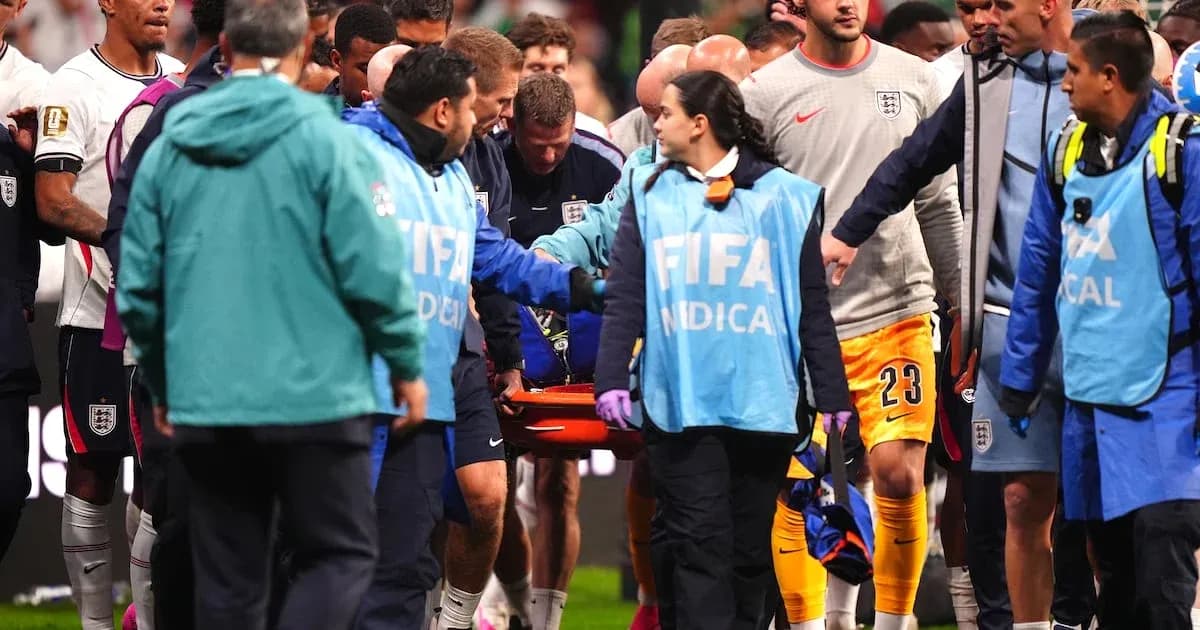
The celebrations continued around him at first, then thinned as the seriousness became clear. Henderson left the field on a stretcher and was taken straight to a hospital in Mexico City. Later, Tuchel confirmed the injury was “quite a serious” one and that the midfielder would not be flying back to Kansas City with the rest of the squad that night, remaining in Mexico for further treatment.
For a coach who had just watched his team produce one of the most resilient performances of his tenure, the blow cut through the euphoria.
Tuchel spoke of pride – in mentality, in heart, in a group that had “overcome every obstacle that was thrown at us”. He called it a “heroic performance and a heroic result”, placing it among the very highest moments of his career. Yet he also admitted to feeling exhausted, emotional, and saddened that Henderson was no longer with the group to share in it.
“It just doesn’t fit to the evening,” he said, the injury clashing jarringly with the joy of the result.
Altitude, adversity and a date in Miami
This was never a standard round-of-16 tie. The delayed kick-off, the altitude, the relentless Mexican crowd, the weight of the Azteca’s history – it all fed into the sense that England were walking into something bigger.
Tuchel felt it in the build-up. He said it still didn’t feel like a last-16 match even after the final whistle, more like a final survived rather than a step quietly taken.
England’s reward for surviving it all – Bellingham’s brilliance, Quansah’s dismissal, Kane’s double-edged involvement, Jimenez’s strike, the long siege with 10 men – is a quarter-final in Miami against Norway on Saturday.
They will travel with belief hardened by what they endured in Mexico City, but also with a reminder that this World Cup will not allow them a clean, uncomplicated night.
They left the Azteca with a famous win, a wounded leader and a growing sense that this campaign will be defined not just by how they play, but by how much more adversity they can absorb.