England's Knockout Challenge: Can Rice and Anderson Shine Together?
England step into knockout jeopardy with a familiar argument rumbling in the background: can Declan Rice and Elliot Anderson really play together?
It’s not a tactical quibble in isolation. It’s a question about England’s entire intent.
Many want both of them higher up the pitch, two number tens threading passes and breaking lines, not two deep-lying sixes recycling play. They want England on the front foot, not nursing possession. But strip away the noise and you’re left with a simple truth: these are two of the best central midfielders in the Premier League, and they bring very different weapons.
Anderson sees passes early, hits angles others don’t spot. Rice covers ground relentlessly, drags his team up the pitch with that engine of his. The issue isn’t whether they can play together. It’s what you ask of them when they do.
At club level, both usually sit in, build from deep and let others apply the finishing touch. They’re the launchpad, not the final act. For England, that double anchor gives licence to the full-backs to bomb on, to overload wide areas and pin teams back. On paper, it makes sense.
But if, by the hour mark, the pattern looks too safe and the game too slow, the dial has to shift. That’s the moment for brave changes, not more caution.
Managers live and die on those decisions. Get the substitutions right and you’re hailed as a genius. Get them wrong and control evaporates. Suddenly a game you’re dominating turns on a single counter, a single overload, because you’ve pushed too many bodies forward and left the back door open.
England can’t ignore that risk here. DR Congo carry far more threat than Panama and have earned their place on this stage. They will punish loose structure in transition.
But England cannot play this with the handbrake on either. The passes that break lines, the ones that look risky from the stands, are exactly the ones that open up a low block. Some will fail. Some will be cut out. The point is to keep forcing the issue, keep knocking, until something gives.
This will be another game where England see plenty of the ball, facing a compact shape, bodies behind it, space at a premium. That demands variety. Not just neat combinations around the box, but shots from distance, midfielders stepping in and taking responsibility, someone willing to take on a 20-yarder when the edge of the area opens up.
The approach has to shift from what we saw against Ghana and Panama in long stretches. The stakes demand it.
Because this is different now. Lose, and you’re out. No safety net, no time to “grow into the tournament”. The weight of the England shirt grows heavier in these moments, especially in a knockout game you’re expected to win. On paper, it’s straightforward. On the pitch, it rarely is.
Plenty in this squad will know that feeling. Some scars never quite fade. The memory of being overwhelming favourites and falling flat – like England did against Iceland at Euro 2016 – hangs in the background as a warning. Complacency doesn’t just hurt you; it humiliates you.
Full concentration isn’t a slogan here. It’s a necessity.
DR Congo arrive with more than just spirit. Their AFCON run showed a side with structure and bite, and this squad has a solid Premier League core. Yoane Wissa is the obvious attacking focal point, a forward who never lets centre-backs rest. He harries, he darts into awkward spaces, he forces defenders to stay switched on.
He hasn’t quite exploded at Newcastle yet in the way he would have hoped, but on this stage he’s come alive. DR Congo lean on him, and he’s embraced that responsibility.
Behind him, Axel Tuanzebe offers a different kind of presence. Those who watched him closely at Burnley saw a defender with recovery pace that bails out trouble, allowing his side to squeeze up and play on the front foot. He doesn’t always look electric to the naked eye, but he eats up ground, strong in the duel and calm under pressure.
Given the runs England made in their last outing, Tuanzebe’s role becomes pivotal. If England’s forwards drag the back line around, he will be asked to read danger, cover channels and organise the rest. His leadership is as important as his legs. He talks constantly, guides the line, and sets standards with the way he prepares and trains.
You don’t come through the system at Manchester United, reach the first team and survive that environment if you’re anything less than top class in your attitude and ability. Tuanzebe’s path has been interrupted by injuries, but his professionalism – the gym work, the rehab, the daily habits – has carried him back to this level.
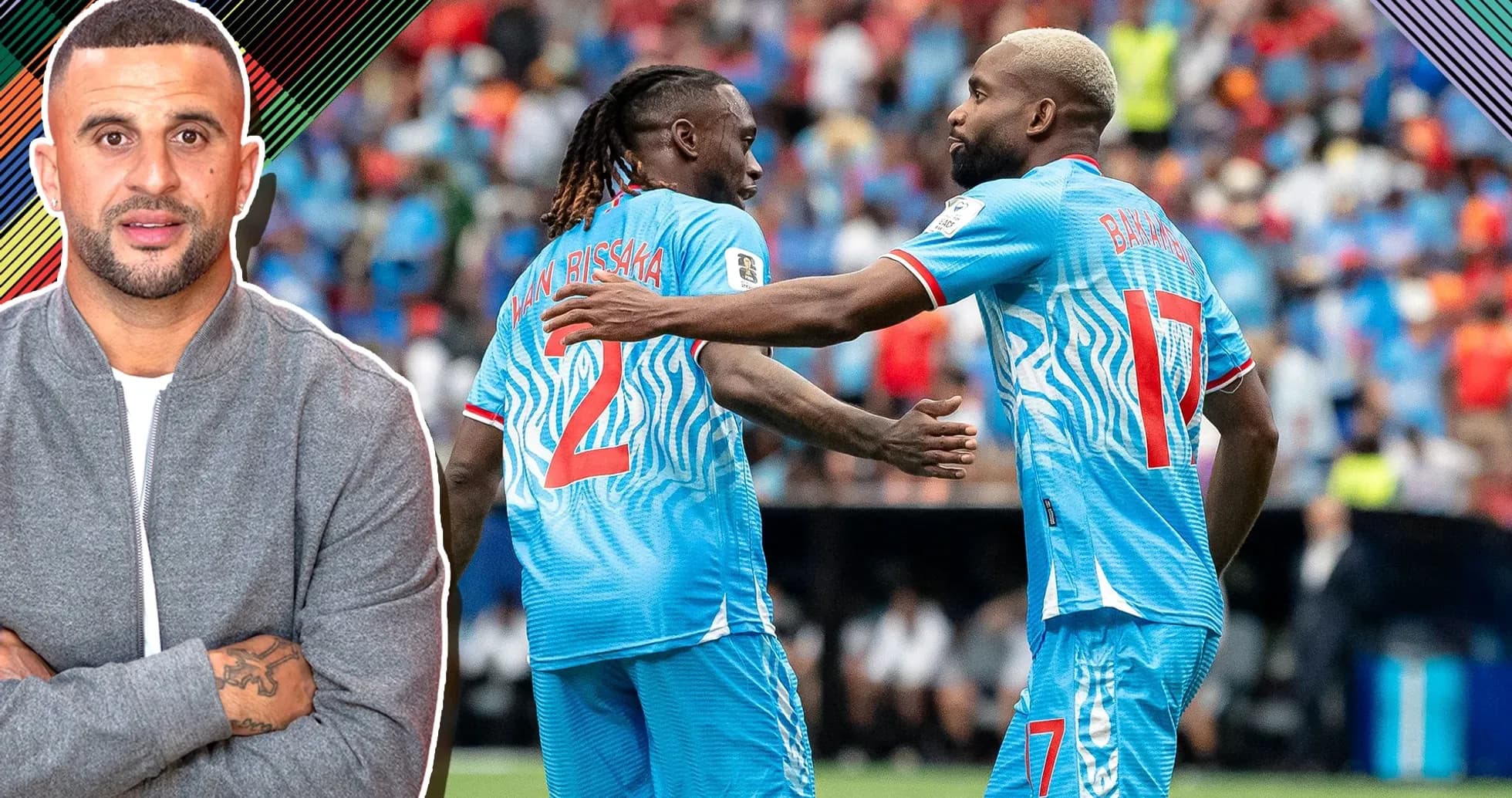
He’s also versatile enough to slot in at centre-back or right-back. In most teams that flexibility would guarantee minutes. For DR Congo, there’s a significant obstacle: Aaron Wan-Bissaka.
Wan-Bissaka has built a reputation as one of the game’s elite one-on-one defenders. Ask any winger who’s tried to isolate him. You think you’ve gone past him, then those telescopic legs appear from nowhere, nick the ball cleanly and send you back where you came from. At City, they used to call him “Go-Go Gadget” for exactly that reason.
He relishes those duels. Like any pure defender, he takes pride in shutting down the best, in turning a winger’s big night into a quiet one. If Marcus Rashford starts, that battle on the flank will carry an extra edge, forged from years on the same training pitch at Manchester United. Familiarity won’t make it easier; it will make it fiercer.
All of this feeds into a simple reality. England have more depth, more stars, more expectation. DR Congo have less to lose, more to prove, and enough quality to make this uncomfortable.
England should win. But they were “meant to win” on nights before, and we all remember how those ended.
This time, with Rice and Anderson under the microscope, with Wissa prowling and Wan-Bissaka waiting, the question is not just whether England go through – it’s whether they finally play like the favourites they keep being told they are.