Egypt Triumphs in Penalty Shootout to Reach World Cup Quarter-Finals
Egypt held their nerve from the spot to reach the World Cup quarter-finals, leaving Australia shattered after a draining, emotional night in Dallas that ended with Mohamed Salah in tears of joy and the Socceroos on their knees.
A gamble, a crossfire, and a miss
Tony Popovic rolled the dice at the death. As extra time faded and penalties loomed, he turned to experience and emotion, sending on Mathew Ryan for the shootout in a late, bold switch in goal.
It was a hostile setting. The kicks went toward the bank of Egypt supporters, whistles and noise pouring down. The tension snapped almost immediately.
Harry Souttar stepped up first for Australia and lashed his penalty high over the bar. Advantage Egypt. The Socceroos were on the back foot before the shootout had even settled into rhythm.
From there, every strike felt like a test of nerve. The next five takers scored, Salah among them, ice-cold from the spot despite a night in which he had rarely influenced open play. Then came 18-year-old defender Lucas Herrington, carrying a nation’s hopes on young shoulders. His effort crashed against the bar.
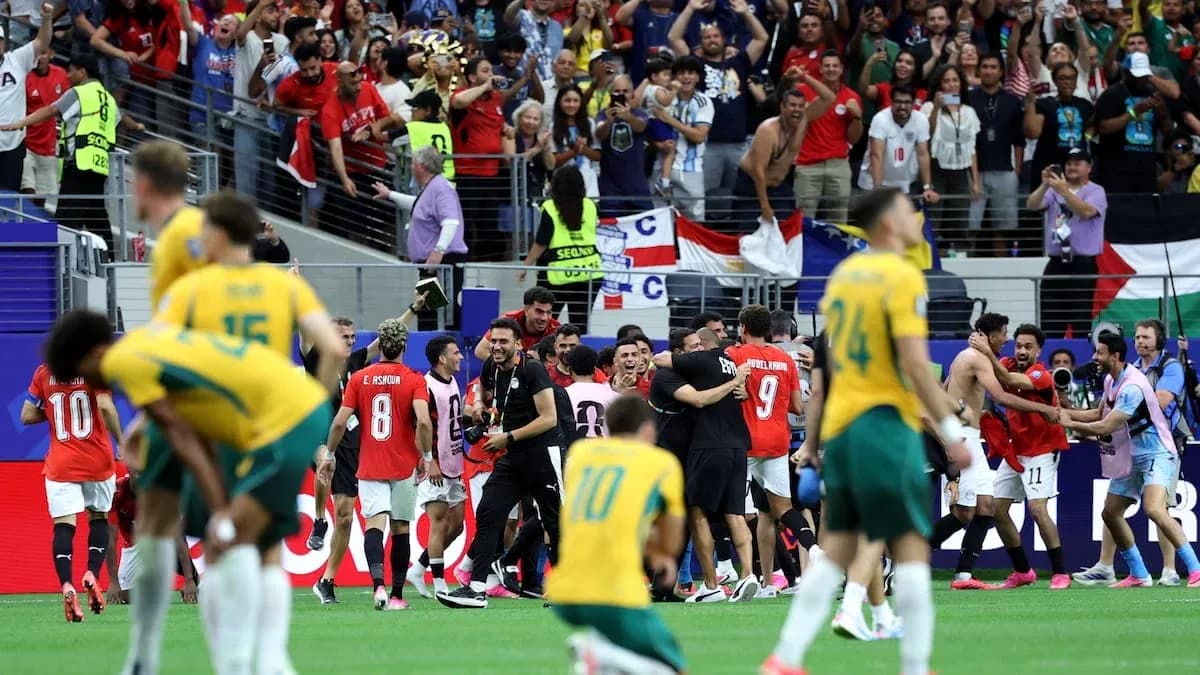
Abdelmaguid followed, unflinching, sending Ryan the wrong way and Egypt into the last eight. Salah dropped to his knees, tears flowing. Australia’s players sank to the turf, their World Cup run ending with the cruelest of margins.
Egypt strike first against the run
The story had begun long before the shootout, with an early Egyptian breakthrough that cut against the pattern of the opening minutes.
Australia almost struck inside five minutes. Cristian Volpato, who chose the green and gold over Italy on the eve of the tournament, rattled the top of the crossbar with a fierce effort that had Mostafa Shoubir beaten. It was a warning and a statement.
Egypt, fresh from their first-ever World Cup win in the group stage – a 3-1 victory over New Zealand – looked edgy at the back. Passes went astray, clearances lacked conviction. The Socceroos, who had scored only twice in the group phase, sensed vulnerability.
Then, almost out of nowhere, Hossam Hassan’s team landed the first blow.
Nestory Irankunda lost track of Emam Ashour at the far post, and Karim Hafez’s cross picked out the midfielder perfectly. Ashour rose, unmarked, and guided his header home after 13 minutes for his second goal of the tournament. A simple finish, a brutal punishment.
The goal changed the entire equation. Australia, a side that had struggled to create, suddenly had to chase the game in front of a crowd of 70,000 at the air-conditioned home of the Dallas Cowboys. Egypt could sit, absorb, and wait for moments to break.
Attrition, injury and a subdued Salah
The first half turned scrappy and physical. Egypt’s coach had warned about Australia’s robust approach, and he was not wrong.
Aziz Behich finally registered Australia’s first shot on target 10 minutes before the interval, but his low drive lacked venom and Shoubir gathered comfortably. In the stands, his father Ahmed – who kept goal for Egypt at the 1990 World Cup – would have approved of the simplicity of the save.
At the other end, Salah, carrying a hamstring strain from Egypt’s previous match, drifted on the fringes. The 34-year-old former Liverpool forward found little space, little rhythm, and even less joy in a bruising, stop-start opening period.
The half ended with another blow for Australia. Jordan Bos, one of the quickest players at this tournament, was left in a heap after a flying challenge from Rabia. The wing-back could not continue and was replaced at half-time by Kai Trewin, a significant loss of pace and thrust on the flank.
Australia hit back as Hany’s nightmare continues
Seconds after the restart, Egypt should have tightened their grip. Omar Marmoush, the Manchester City attacker, slid a close-range effort wide when it seemed easier to score. A let-off that would soon sting.
Australia, still short on fluency but unrelenting in set-piece pressure, forced the mistake they needed. An in-swinging free-kick caused chaos in the Egypt box, and Mohamed Hany, under heavy pressure, could only divert the ball into his own net.
It was his second own goal of the tournament. For Australia, it was a lifeline. For Egypt, a jolt.
The equaliser changed the mood entirely. Both sides could sense the stakes: neither nation had ever won a knockout match at a men’s World Cup. Every tackle, every second ball, every corner suddenly carried a hint of history.
Egypt push, Australia cling on
Salah remained on the margins but began to stitch together moments. Deep into added time at the end of the 90, he helped work an opening that almost broke Australian resistance. Ramy found space and struck cleanly, only for Patrick Beach to spring across his goal with an outstanding save that preserved parity and forced extra time.
Egypt finished normal time the stronger side, their passing crisper, their attacks more coherent. Australia, who had started brightly and then clawed their way back, were now hanging on.
Early in extra time, Salah finally found a glimpse of goal. Cutting in on his weaker right foot, he let fly, but the shot sailed well over. The chance summed up his evening in open play: present, threatening in flashes, but not decisive.
The clock ticked on. Legs grew heavy. The match drifted toward the only conclusion it seemed capable of producing: penalties.
History from the spot
When it arrived, the shootout delivered everything the 120 minutes had promised: drama, heartbreak, and a defining moment for Egyptian football.
Popovic’s late move to bring on Ryan was designed for exactly this stage. Experience. Presence. Aura. Yet the psychological blow of Souttar’s skyward first kick immediately tilted the contest.
Salah, so muted for long spells, stepped up and buried his penalty with ruthless calm. No hint of the hamstring, no sign of doubt. Just a clean, clinical finish.
Herrington’s miss off the bar opened the door. Abdelmaguid walked through it, sending Egypt into a new chapter, their first knockout win at a men’s World Cup secured in the most nerve-shredding fashion.
Australia, who had flirted with history themselves, were left to replay the fine margins: Volpato’s early strike against the woodwork, Marmoush’s miss, Hany’s own goal, the late save from Beach, and finally, the bar that denied Herrington.
Egypt move on, battle-hardened and buoyed by a shootout that could yet define their tournament. Australia go home knowing they stood on the brink of something they have never done before – and let it slip from 12 yards.