Egypt Celebrates Historic World Cup Knockout Win Against Australia
Egypt hold their nerve, then raise two flags: one for home, one for Palestine.
On a tense night in Dallas, Hossam Hassan’s side stepped out of their own history and into the World Cup’s knockout elite, edging Australia 4-2 on penalties after a grinding 1-1 draw. The win delivered Egypt’s first-ever victory in a World Cup knockout match. The scenes that followed stretched far beyond the stadium.
Ashour strikes, Australia respond
The game itself was tight, edgy, and often scrappy. Egypt struck first, and early. In the 13th minute, Emam Ashour found the kind of space that shouldn’t exist in a World Cup knockout tie and punished Australia with a precise header, giving Egypt a lead that instantly changed the tone of the night.
From there, the match became a battle of nerve and territory. Australia pushed, Egypt retreated in phases, then broke when they could. It was never free-flowing. It was never comfortable.
The pressure finally told 10 minutes into the second half. A dangerous Australian attack forced panic in the Egyptian box, and Mohamed Hany, attempting to deal with the threat, turned the ball into his own net. One-one, and suddenly the momentum swung.
What followed was a long, anxious stretch. Egypt tried to reset; Australia sensed vulnerability. Chances were scarce, tension was not. Both sides probed but rarely found clarity in the final third. Extra time brought more fatigue than inspiration, and the match drifted toward the one place where history and heartbreak often collide for African and Asian sides alike: the penalty spot.
Penalties and a breakthrough
When the shootout began, Egypt did what so many teams talk about but few execute: they stayed cold.
Hossam Abdelmaguid stepped up for the decisive kick after Australia faltered from 12 yards. Harry Souttar and Lucas Herrington both missed, and the door opened. Abdelmaguid walked through it, rolling in the winning penalty with a calm finish that belied the stakes.
In that moment, Egypt were through. A last-16 date with Argentina or Cape Verde awaits. For a nation that had never before tasted victory in a World Cup knockout match, this was more than just progression. It was a landmark.
A win dedicated beyond the touchline
Hossam Hassan did not treat it as a purely footballing triumph.
Speaking after the match, the Egypt coach dedicated the victory to Palestinians, invoking their struggle and their suffering as he addressed reporters.
“May God grant them victory, may God have mercy on their martyrs,” he said. “I’m saying to them: I’m dedicating this victory to the Egyptian people and Palestinian people, those kind and honourable people.”
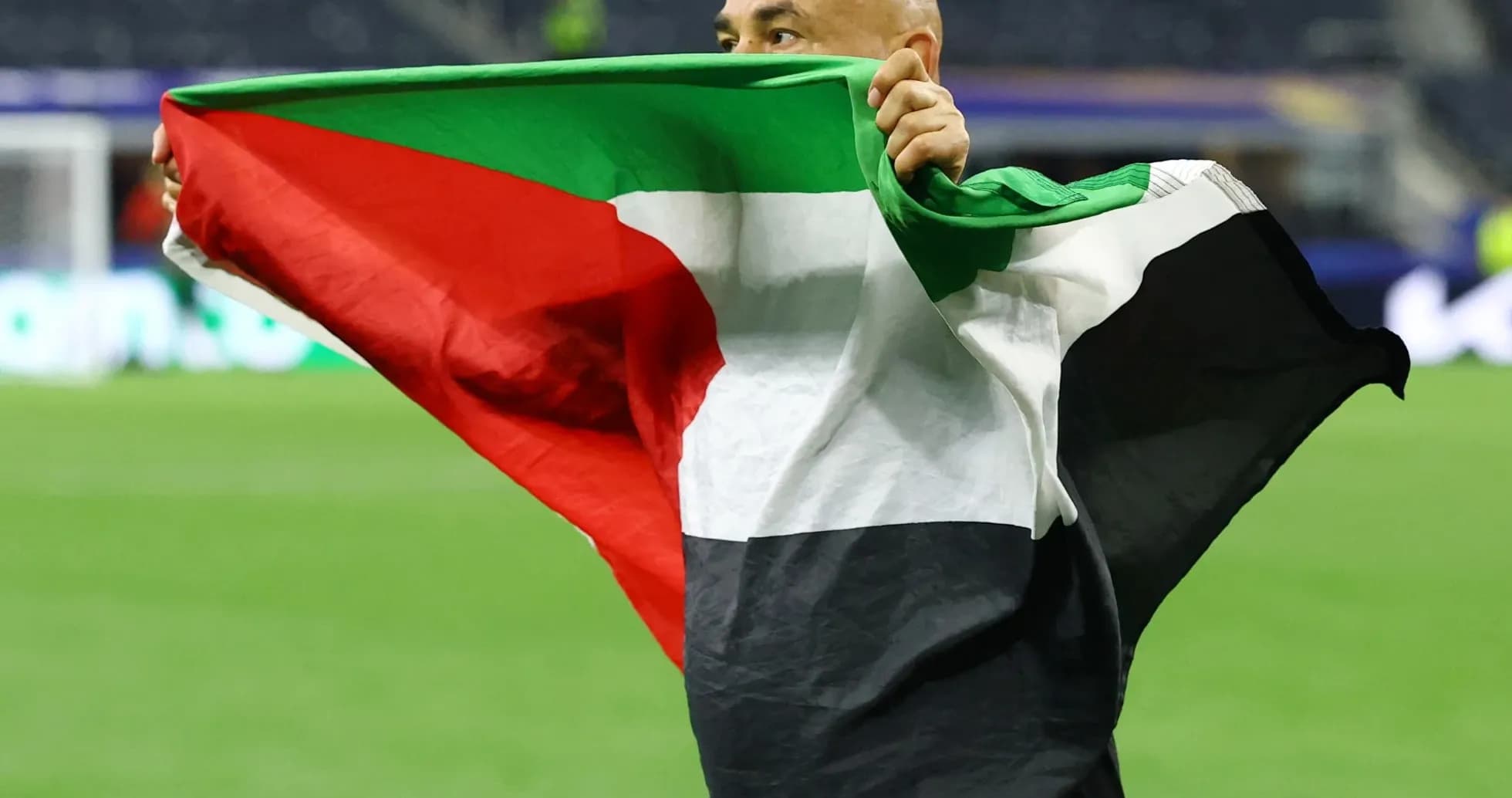
His actions on the pitch matched his words. After the final whistle and the shootout drama, Hassan returned to the field carrying both the Egyptian and Palestinian flags. Around him, his players dropped to the turf in prostration, a collective moment of thanks and release after 120 minutes of strain and a lifetime of waiting for a night like this.
Gaza watches through the rubble
The significance of that gesture was not lost in Gaza, where the World Cup has become a brief window into another world.
Palestinian fans, many of them displaced and living among the ruins of bombed-out neighbourhoods, followed Egypt’s match with an intensity that went far beyond neutral interest. Social media from the besieged strip showed crowds gathered around screens set up against the backdrop of shattered buildings and makeshift tents, children with Egypt flags painted on their faces, adults cheering in the half-light.
“For the first time, I’m following the World Cup with this much excitement,” wrote Gaza-based Tamer Nahed on X. He described thousands emerging from tents and destroyed homes to watch Egypt’s game, a rare collective moment that cut through the daily reality of loss and uncertainty.
“Faces lit up with smiles, cheers filled the air, and it felt as if everyone had decided to give themselves a moment of life despite everything surrounding them,” he wrote.
Clips shared online captured exactly that: people in Gaza watching amid rubble, celebrating Egypt’s win as if it were their own. In many ways, it was.
Flashpoint in Dallas
The night was not without controversy away from the pitch.
Hours before kick-off, members of the Egypt squad were involved in an altercation with police at the team hotel in Dallas, a confrontation that quickly spread across social media. According to the Egypt national team, a Dallas police officer pushed team director Ibrahim Hassan and player Trezeguet as they tried to take a photo with a fan.
The Dallas Police Department later stated that the matter had been resolved at the scene, and the incident did not spill into the stadium or disrupt the match. Still, it added another layer of edge to a day already loaded with emotion.
A new chapter, a heavier shirt
By the end of the night, the football story was clear. Egypt had survived a tight, tactical contest, absorbed the blow of an own goal, and held their nerve from the spot. Their players walked off the Dallas pitch as pioneers for their country, having delivered a first knockout win on the game’s biggest stage.
But this was also a night where sport and politics, joy and grief, collided in full view. Hassan’s twin flags, the celebrations in Cairo and Gaza, the roar after Abdelmaguid’s penalty — all of it wrapped this result in a meaning that will follow Egypt into the last 16.
Next comes Argentina or Cape Verde, a very different kind of examination. The question now is not just whether Egypt can go further, but how far this team, and the people who have attached their hopes to it, are willing to push the limits of what once seemed impossible.