Dusan Vlahovic: A Summer Struggle for the Serie A Star
Every summer has its stragglers. The odd veteran holding out for one last big deal, the youngster waiting on a loan. By late July, most of the serious free agents are gone.
Not this year. Not Dusan Vlahovic.
As August looms, the most valuable free agent on the market is still training alone, still waiting for a phone call worthy of his name and his wage expectations. Eight full Serie A seasons behind him, six straight years of double figures, and yet no badge on his chest.
For a 26-year-old centre-forward with his profile, that is extraordinary.
A CV that should sell itself
Strip away the noise and the numbers are respectable. Four-and-a-half years at Juventus, three-and-a-half at Fiorentina before that. A player who arrived in Italy as a teenager and grew into a hulking No 9 with a highlight reel to match the hype.
He can finish off either foot. He attacks crosses with conviction. He can strike a free kick. He runs in behind, he carries the ball, he pins centre-backs. On paper, this is the modern, multi-purpose striker big clubs spend fortunes trying to find.
Juventus did exactly that. They committed up to €80m for him as he turned 22, beating back interest from Arsenal and betting that they were buying not just goals, but a decade of them.
The reality never quite caught up with the projection.
His best league return in a full Juventus season was 18 goals in 2023-24. Last season he dropped to 10. Across his time in Turin he averaged roughly 15 a season. Good, solid numbers. Not the ruthless, 20-plus machine the fee and the fanfare demanded.
That gap between “good” and “elite” is where his market now stalls.
The player he is, the player he was supposed to be
Vlahovic’s problem is not that he’s failed. It’s that he hasn’t become what people thought he would be.
At Fiorentina, he looked like a coming storm. Raw but relentless, a striker who bullied defenders and finished with cold precision. You could see why clubs projected a future superstar. He seemed to have the frame, the mentality, the timing.
At Juventus, the edges never fully sharpened. His link-up play remained functional rather than refined. His pressing lacked the intensity demanded by Europe’s very top coaches. The goals came, but in streaks rather than in the remorseless flow that defines the best in the world.
He is still young enough to improve, but he is no longer a promise. He is a known quantity. Clubs are no longer paying for what he might be. They are weighing what he is.
And that’s where the money bites.
Wages that scream “superstar”
Last season, Vlahovic was the highest-paid player at Juventus and the best-paid player in all of Serie A. Twenty-two players on lower salaries outscored him.
Those numbers are brutal for any sporting director with a calculator and a budget to protect.
His wage packet reflects the player he was forecast to become. His output reflects the player he is. That mismatch is at the heart of his current standstill.
Juventus, already tightening belts, were never going to keep him at those levels. According to Tuttosport, he wanted around €8m a year, roughly £132,000 a week. For a club trying to reset its finances and refresh its squad, that was a line they would not cross.
Giorgio Chiellini, now a Juventus director and once Vlahovic’s team-mate, put it plainly: with those figures, he would not remain in Italy. If he wanted that salary, he needed a different market.
Big clubs, big doubts
Transfermarkt currently values Vlahovic at around £30m, making him the standout name among unattached players. Yet the phone is not exactly ringing off the hook.
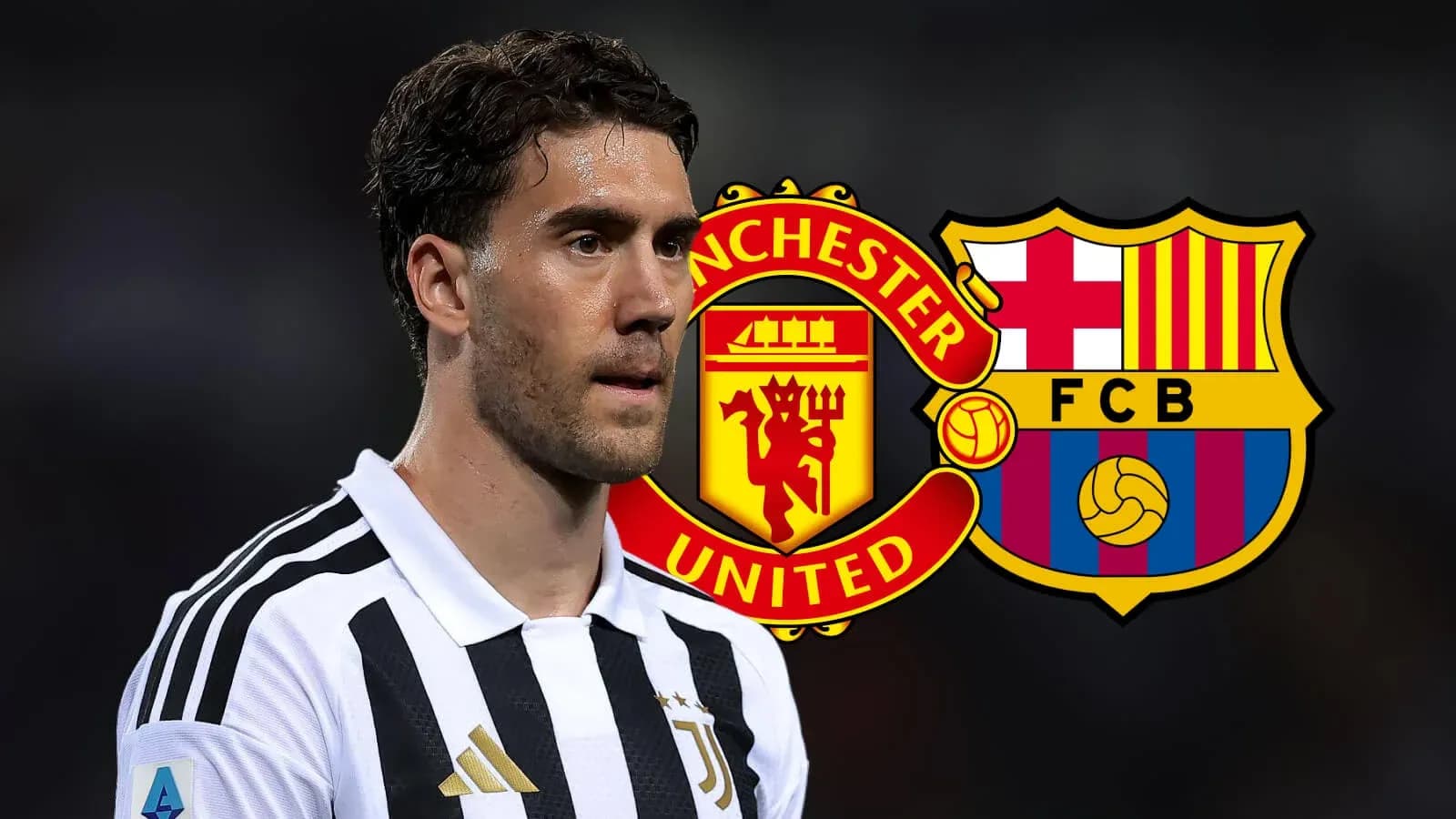
Manchester United have been linked. Barcelona’s name has been floated. Both need a striker, both have looked at far more speculative options in recent years. Yet neither has moved beyond the realm of “interest” and “discussions”.
This is the hesitation at the top of the game. The very best clubs want a sure thing. They want the numbers to scream “elite” before they commit big wages and a key role. With Vlahovic, the data and the eye test both say the same thing: dangerous, but not decisive enough, not often enough.
Barcelona, wrestling with their own financial constraints and desperate for a reliable No 9, had the chance to explore a deal. Even then, the response was cautious. They see the upside. They also see the cost if he does not quite hit the ceiling once promised.
Drop down a rung and the picture is not much clearer. Clubs like Manchester United, ambitious but currently outside the absolute elite, have to juggle risk and reward even more carefully. They cannot afford another big earner who flatlines just below world-class.
So the market circles him, intrigued but wary.
Pride, compromise and the clock
There is, of course, a simple solution. He can lower his demands.
Reports suggest he is prepared to do exactly that – but selectively. He would accept less from a Barcelona than from a Besiktas, for example. The logic is obvious: trade a portion of salary for the stage and the status of a superclub. For the chance to compete for the biggest prizes.
From the club side, though, a different calculation kicks in. If they compromise on wages, are they also compromising on quality? Are they locking themselves into a high-cost, medium-return striker while waiting for the next generation to emerge?
This is where Vlahovic’s profile should work in his favour. There are only so many truly elite strikers in the world, and even fewer that clubs are willing to sell. When that market tightens, the “good but not great” forwards become invaluable.
As pre-season rolls into its final weeks and friendly matches start to expose holes in squads, panic usually follows. A misfiring forward line, an injury in attack, a board under pressure – that is when a free agent with his record and age bracket suddenly looks a lot more attractive.
He has one key advantage over every contracted striker: he can sign after the window closes. Theoretically, he can wait out the market, watch who blinks first, and walk through the door as the late solution.
But that comes with a cost of its own. Time lost, rhythm lost, a season that starts without him.
A career at a crossroads
For a striker who should be entering his prime, drifting into August without a club would be more than an oddity. It would be a warning.
Vlahovic stands at an awkward crossroads. Too good to be ignored. Not quite convincing enough, at his current price, to be embraced by the clubs he wants most. His next contract will define the next phase of his career: superstar salvage project, or high-level journeyman?
He can cling to the salary that once matched the predictions, or he can bet on himself, take a step down in pay and a step up in responsibility, and try to prove that the early forecasts were not wrong – just premature.
The market has made its position clear. Now the question is simple: how badly does Dusan Vlahovic want to rewrite the story of the player he became?