
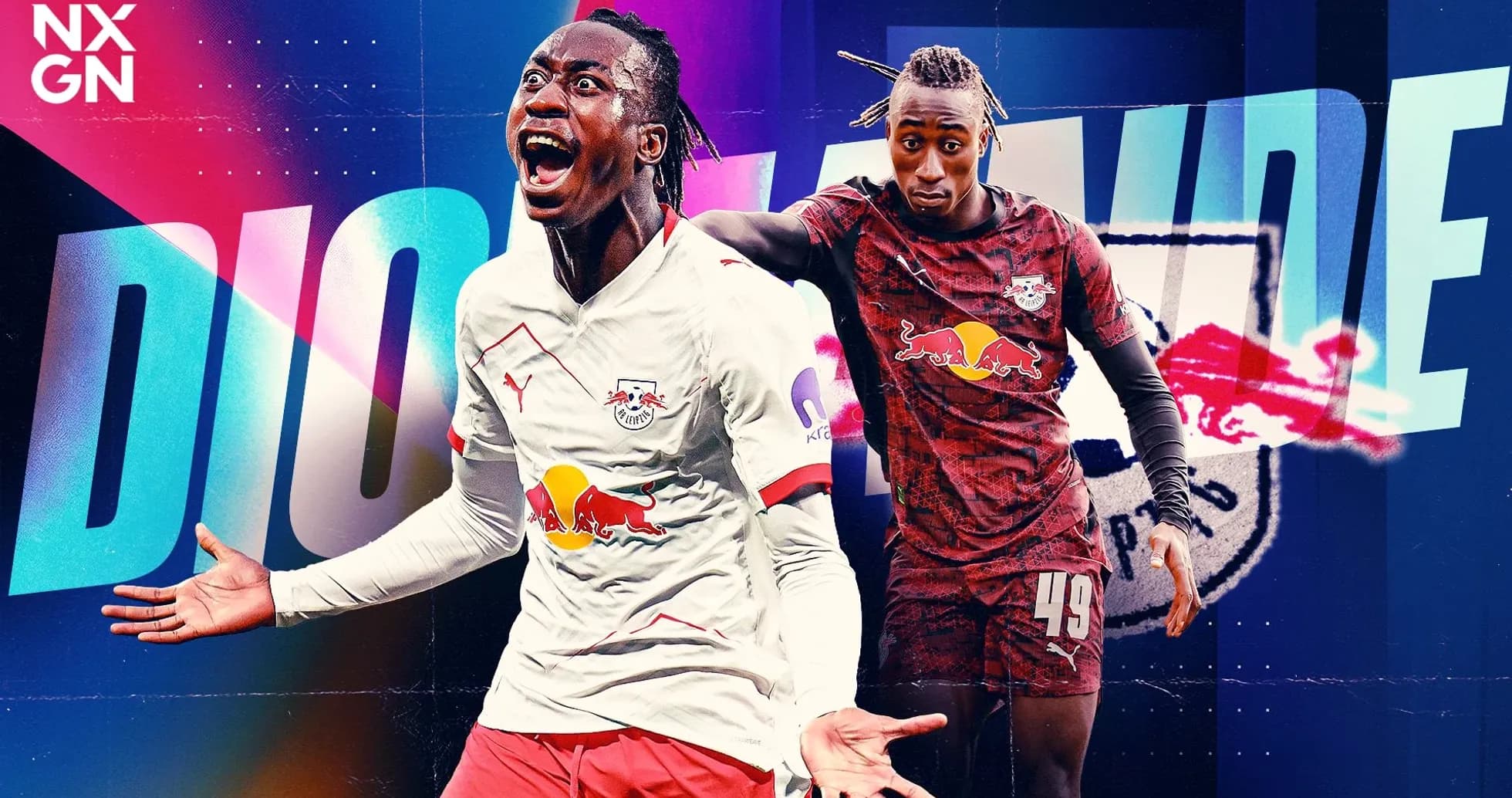
Diomande: The Vertical Threat Madrid Wants to Unleash
Real Madrid have signed wingers before. They have signed sprinters, dribblers, touchline huggers and inverted chaos merchants. Diomande is something else again: a straight-line threat with numbers that make even the Bundesliga look too small for him.
Marca’s breakdown of his game strips away the hype and leaves a clear picture. This is not Vinicius Júnior 2.0. Diomande doesn’t glide between the lines or lull defenders with pauses and feints. His defining trait is impact. Vertical, violent, constant.
At the last World Cup he was clocked at 34.7 km/h. That still sits just behind Kylian Mbappé’s 37.6 km/h, but the gap feels smaller when you see how early he hits top speed and how long he sustains it. When he opens his stride, back lines don’t reorganise. They panic.
The numbers from his last Bundesliga season are even more telling. Diomande completed 118 successful dribbles from 213 attempts. Almost double the total of the league’s next-best dribbler, Michael Olise, who finished with 65 from 149. That isn’t a marginal edge; it’s domination.
Right Wing: The Relentless Engine
Diomande is naturally a right-sided player and Leipzig used him that way. He logged 1,591 minutes on the right, compared to just 478 on the left. The pattern on that flank is clear: receive wide, stay high, stretch the pitch.
Out there, he often takes the ball to feet near the touchline. He doesn’t immediately charge into traffic. He draws his marker, weighs the picture, and if the opening isn’t there, he resets and goes again. It’s a calculated form of aggression.
On his natural side, he looks for the lane down the wing, the byline, then the cut-back. He beats defenders more with power than subtlety: a shove of the shoulder, a burst of acceleration, a sudden change of pace. Less trickster, more battering ram with a sprint start.
His diagonal runs inside are less refined. He doesn’t have the natural left-footed precision of a player like Olise when he drives into central pockets. His left foot is still more tool than weapon. It has produced goals – often when he shifts the ball at the last second on the edge of the box – but it’s not yet the foot that defines him.
What it does give him is a way out. Against deep, compact blocks that close the outside lane, he has developed a kind of “escape route”: dragging defenders across the pitch, then attacking the front zone or the weak side with a driven cross. It’s not artistry, it’s problem-solving at high speed.
The data on the right side underlines that constant threat. Per 90 minutes there, Diomande:
- Attempts and completes more dribbles (4.41 vs 3.23 on the left)
- Swings in more crosses (0.91 vs 0.67)
- Plays more passes into the box (2.21 vs 1.48)
- Shoots more often (1.7 vs 1.48)
- Generates higher expected goals (0.21 vs 0.16)
He also loses the ball more frequently (2.21 vs 1.48), a natural by-product of a winger who keeps forcing the issue. On the right, he is a volume machine: repeat actions, repeat duels, repeat incursions.
Left Wing: The Chaos Creator
Shift him to the left and something changes. Not in his body, in his mindset.
He still starts wide, but he doesn’t live on the touchline. The ball finds him a little less often, yet his influence spikes in the most dangerous area of the pitch. He records more touches inside the opposition box on the left – 7.8 per 90, compared to 6.51 on the right.
Out there he stops obsessing over the outside lane. He doesn’t lean as heavily on raw strength to bulldoze past his full-back. His right foot becomes the key, allowing him to cut inside to shoot or cross. The movement feels more instinctive, more direct, less predictable.
You can see the difference in how he attacks defenders. He trusts his dribbling more. He commits earlier. He looks for the shot.
Two metrics jump off the page. On the left, his expected goals rise from 0.84 to 1.17, and his expected assists from 0.21 to 0.43. Same player, different flank, bigger end product.
The right wing turns him into a generator of waves – constant balls into the area, constant crosses, constant surges. The left wing turns him into something more dangerous: a chaos agent who decides games from central spaces.
Space Hunter Without the Ball
For all the focus on his dribbling, one pattern keeps repeating when Diomande plays on the left: his movement away from the ball.
He has learned to turn tight spaces into launchpads. He often receives with his back to goal in crowded zones, or in those awkward pockets where defenders love to nip at ankles. Instead of holding it and inviting contact, he releases quickly – a bounce pass, a one-two – then explodes into the gap behind.
Once he’s in full flight with open grass in front of him, defenders stop thinking about the ball. They start thinking about how to foul him without seeing red.
That instinct for space doesn’t vanish when he returns to the right. It just looks different. On either flank, the same trait stands out: he doesn’t switch off when he’s not on the ball. He’s constantly probing for the next gap to attack.
Defensive Edge and Counterattacking Threat
What completes the profile – and will interest Real Madrid as much as his attacking metrics – is how hard he works without the ball.
His defensive intensity barely changes whether he lines up right or left. He presses with real bite and, crucially, with timing. When possession is lost, he doesn’t jog back into shape; he hunts.
The numbers in Germany back that up. Among forwards with at least 1,000 minutes in the Bundesliga, Diomande leads the league in ball recoveries with 148. He sits second in pass interceptions with 16 and fourth in successful tackles with 19. Those are midfielder’s figures from a winger’s starting position.
At set pieces he keeps things simple, holding his zone rather than attacking the ball. The moment his team win it back, though, he comes alive. His first thought is transition.
On the counter he often takes up central positions, not pinned to either touchline. That’s where his dribbling and acceleration become lethal. He loves to dart into the space behind the defence from off the ball, arriving at full tilt to finish or square.
It’s a style that carries echoes at the Bernabéu. Under José Mourinho, Madrid built a ruthless counterattacking machine around Cristiano Ronaldo and Ángel Di María charging into open field. Diomande has the raw tools to attack those same channels, to rip into those same vacant corridors.
The only real question for Carlo Ancelotti and his staff now is simple and tantalising: do you unleash that vertical chaos from the right, where he overwhelms teams with volume, or from the left, where he walks straight into the heart of the game?



