Dinamo Zagreb's Tactical Masterclass in Extra-Time Win Over FC Thun
Dinamo Zagreb’s 3-2 extra‑time win over FC Thun at Stadion Maksimir was a tactical siege that only broke late, after 120 minutes of near‑constant Croatian pressure against a compact Swiss block reduced to ten men. The 2nd Qualifying Round tie in the UEFA Champions League finished 2-2 in normal time (0-2 at half-time), with Dinamo overturning a disastrous start through structural tweaks, aggressive use of width and a sustained territorial stranglehold.
Thun's Strategy
Thun’s 4-4-2 under Luca Privitelli Gian was set up for deep containment and vertical punches. The front pair of B. Labeau and F. Dursun were tasked with pressing triggers rather than high pressing: they jumped only when Dinamo’s centre-backs played into full-backs or into the single pivot. Behind them, the flat midfield four stayed narrow, with N. Zoukit and V. Matoshi tucking in to congest the central lane and protect the half-spaces.
That plan worked brutally well in transition early on. Thun had just 24% possession but turned their limited ball into maximum damage: 8 total shots, 6 inside the box, and 3 on goal, scoring twice from those situations. The first goal at 4’ from B. Labeau came from a quick vertical release, exploiting Dinamo’s high full-backs. The second, at 22’, from M. Burki, underlined how dangerous Thun were on set or second-phase moments despite having only 1 corner all night. With only 231 total passes (134 accurate, 58%), Thun effectively abandoned sustained build-up in favour of direct clearances and compressed, low‑block defending.
Dinamo's Approach
Mario Kovacevic’s Dinamo started in a 4-1-4-1 with J. Misic as the single pivot behind a line of four creative midfielders and D. Beljo as the lone striker. The structure was aggressively tilted towards ball dominance: Dinamo finished with 76% possession, 702 passes (618 accurate, 88%), and a massive 29 total shots. The pattern was clear: centre-backs and Misic recycling, full-backs high and wide, and the four advanced midfielders rotating between pockets to pin Thun deep.
Yet the first half exposed a key imbalance: Dinamo’s high line and ambitious full-backs left them vulnerable to Thun’s early transitions, and their shot quality lagged behind volume. By the break they trailed 0-2 despite already controlling territory and tempo. Kovacevic responded decisively at half-time, withdrawing left-back Bruno Goda (already booked for “Foul”) for M. Perez Vinlof. This was less about punishment and more about injecting a more aggressive overlapping profile to stretch Thun’s compact 4-4-2.
Tactical Evolution
From there, Dinamo’s tactical evolution hinged on three levers: central overloads, relentless wing service, and a calculated risk in rest defence. Misic increasingly stepped higher to form a 2-3-5 in possession, with both full-backs advanced and the “4-1-4-1” morphing into a de facto front five. The substitutions on the hour – L. Kacavenda for G. Vidovic, F. Topic for M. Lisica, and later A. Hoxha for M. Orsic – transformed the attacking line. Kacavenda attacked the right half-space, Topic provided fresh vertical runs and combination play, and Hoxha offered direct 1v1 threat from wide areas.
The statistical footprint of this shift is stark. Dinamo generated 18 shots inside the box out of 29 total, with 7 blocked and 6 on target. Thun’s penalty area was under siege, and the Swiss side were forced ever deeper, with their block collapsing to the edge of the six‑yard box for long spells. Fourteen corner kicks for Dinamo versus Thun’s single corner capture the territorial imbalance.
Discipline and Game State
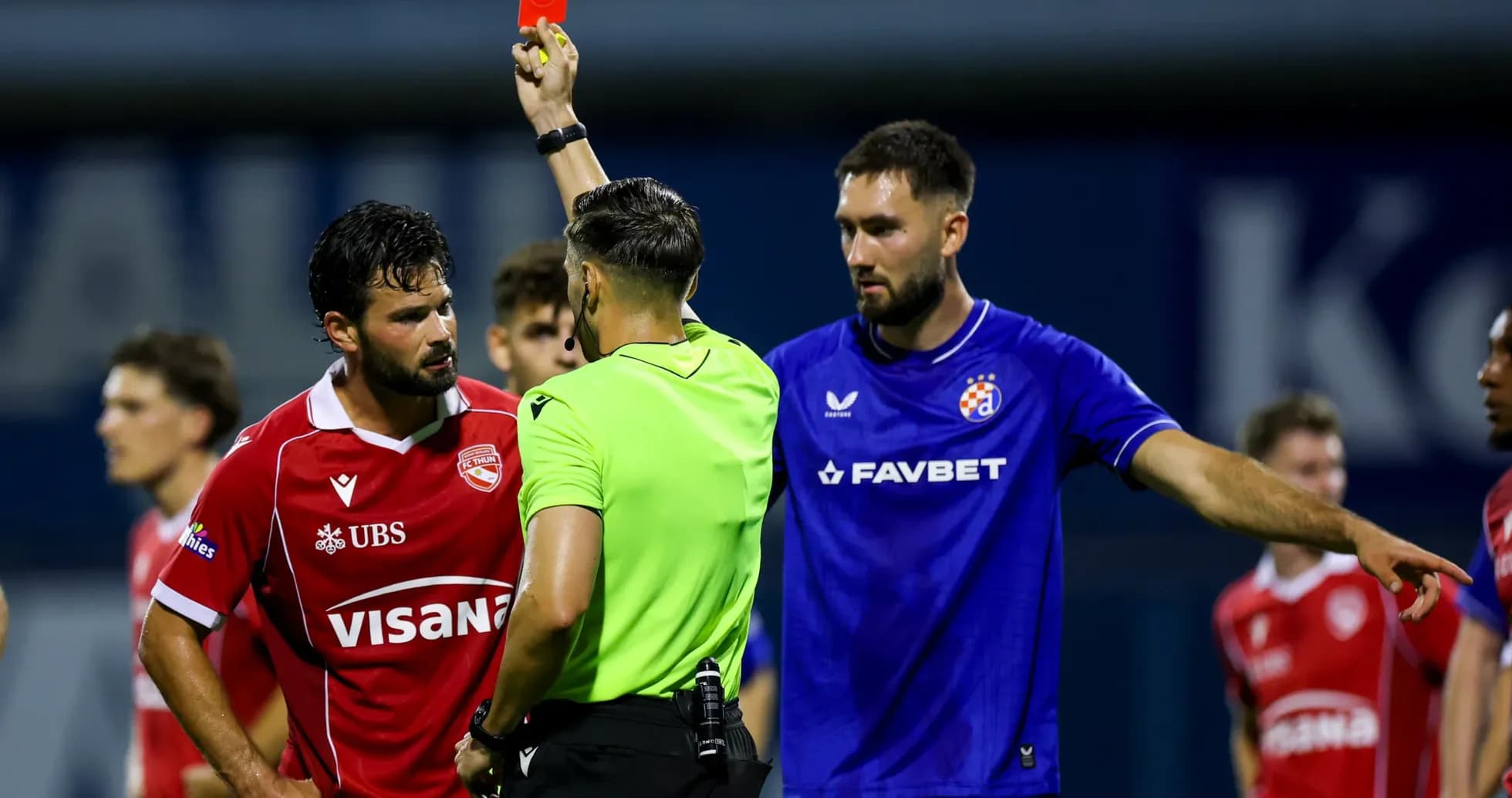
Discipline and game state further tilted the tactical landscape. Dinamo accumulated 5 yellow cards (Miha Zajc, Bruno Goda, Josip Misic, Fran Topic, Arber Hoxha), a reflection of counter‑pressing aggression and frustration as they chased the game. But the decisive disciplinary moment came for Thun: a VAR “Card upgrade” review on Marco Bürki at 66’ was followed by a straight red at 67’ for “Professional foul last man”. Down to ten men, Thun’s 4-4-2 compressed into a 4-4-1, with the forward line sacrificing depth to keep central compactness. Their already limited attacking output shrank further; they finished with just 5 shots off/on goal combined outside the box and were largely pinned.
Equalizer and Extra Time
Kovacevic exploited the numerical advantage by pushing his centre-backs almost to the halfway line and allowing Misic to play as a deep playmaker in Thun’s half. The equaliser at 78’ from Kacavenda, assisted by Topic, was the logical product of these positional overloads: Dinamo’s interior rotations finally dragged Thun’s narrow midfield out of shape, opening the seam between full-back and centre-back.
In extra time, fatigue and structure decided the contest. Thun, with 13 fouls and heavy defensive load, were hanging on. Their late substitutions – C. Ibayi, L. Dahler, and L. Stewart – were primarily about fresh legs to maintain the block rather than changing shape. Dinamo, by contrast, continued to add height and energy, with S. Radeljic coming on for Misic at 120+2’ to help see out the final minutes in a more physically robust back line.
In goal, I. Filipovic (Dinamo Zagreb) had a paradoxical evening: only 1 recorded save but 2 goals conceded, underlining how ruthlessly efficient Thun’s early chances were and how little they created once forced into a deep block. At the other end, N. Steffen (FC Thun) made 4 saves under constant bombardment; combined with 7 blocked shots by his defenders, Thun’s rearguard effort was immense but ultimately unsustainable over 120 minutes.
Statistical Overview
Statistically, Dinamo’s dominance was overwhelming: 76% possession, 702 passes at 88% accuracy, 29 shots, 18 inside the box, and 14 corners. Thun’s 24% possession and 231 passes at 58% accuracy reflected a game plan built entirely around early transitions and then survival. The 3-2 final scoreline after extra time, with Dinamo overturning a 0-2 deficit, is less an upset of the numbers than a delayed alignment: the home side’s structural superiority, squad depth, and tactical adjustments finally converted volume and territory into progression in the 2nd Qualifying Round.