
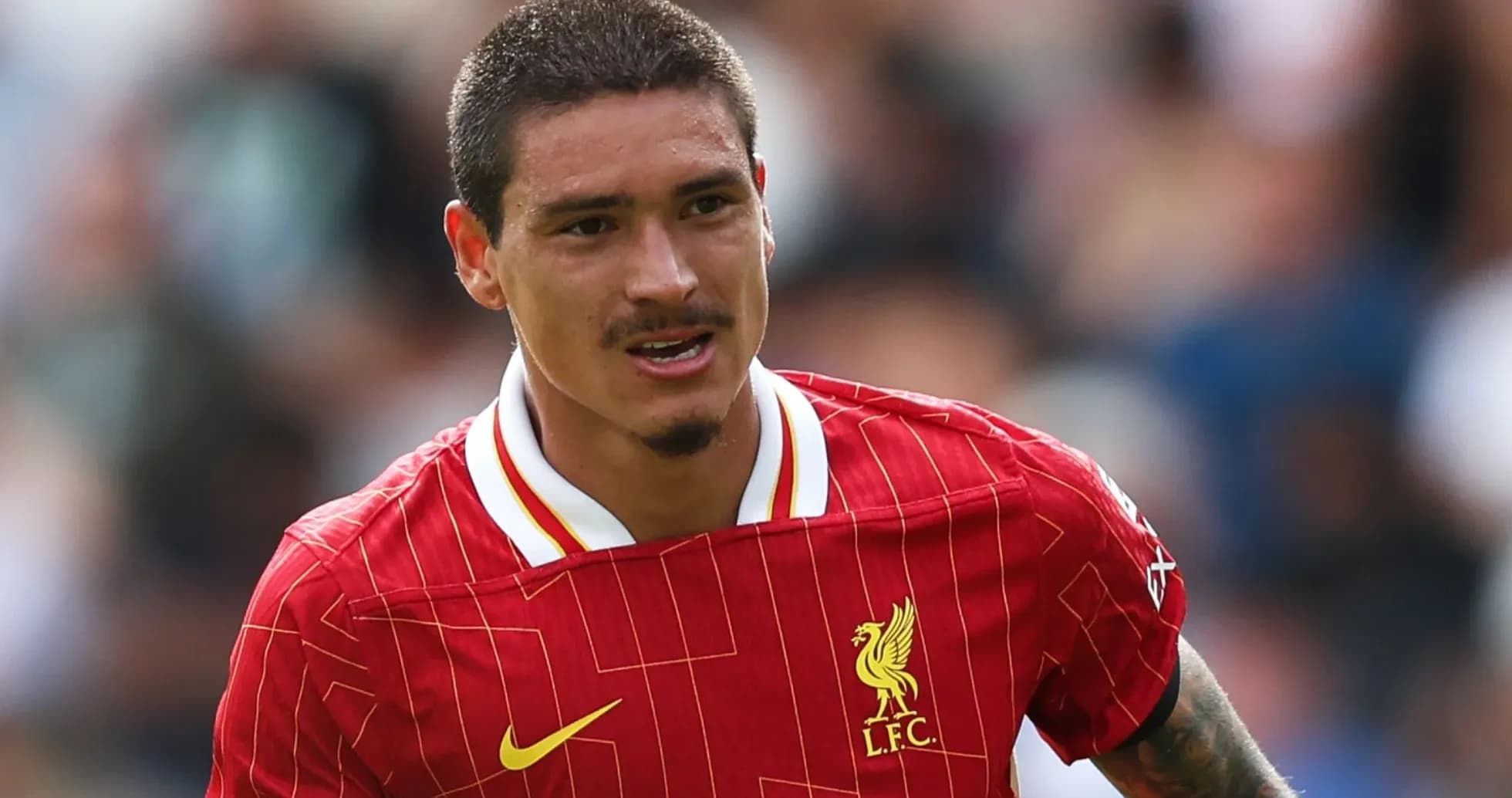
Darwin Nunez: A Liverpool Return Under Andoni Iraola?
When Liverpool were at full volume under Jurgen Klopp – all pressing, pounding drums and “heavy metal football” – Darwin Nunez was supposed to be the next big soloist. A £64 million signing from Benfica in 2022, the raw, restless Uruguayan arrived as the chaos agent who would terrorise defences and extend an era of trophies.
He never quite did.
Forty goals in 143 games is respectable, but Nunez always lived on the fringes of true adoration at Anfield. The crowd admired his work-rate, his wild energy, his refusal to play within the lines. He became a cult figure, not a cornerstone. A striker people talked about as much for what he might become as for what he actually delivered.
By the summer of 2025, the story had moved on. Nunez followed the money and the star power, heading to Saudi Arabia to join Cristiano Ronaldo and a growing cast of European exiles. The move to Al-Hilal promised a fresh start and a lucrative contract. Instead, it has turned into a dead end.
Foreign-player limits have seen him dropped from Al-Hilal’s domestic squad. He has been told he can find a new club. Suddenly, the question hangs in the air: could the Liverpool story really have another chapter?
Barnes draws a line under the Klopp era
For John Barnes, the answer is blunt. If Liverpool’s new head coach Andoni Iraola does not want Nunez, there is no romance to be found in a reunion.
“Not if Iraola doesn't want to play in that way,” the Liverpool great told GOAL, speaking in association with viagogo’s ‘World Cuts’ campaign. “If he says, ‘I want to play in that way’, which Darwin Nunez will fit, then maybe so. But if he says, ‘I don't want to play in a chaotic fashion’, then Darwin Nunez is not meant to come back.”
That word – chaotic – cuts to the heart of it. Nunez is a striker who thrives in broken play, in games that stretch and fray. Klopp’s Liverpool could carry that kind of volatility. They fed off it. Iraola may want something cleaner, more controlled.
And Barnes is clear: this is no longer Klopp’s club.
“It's not Jurgen Klopp. If Jurgen Klopp was there, he may say we want him back,” Barnes said. “Then maybe that would be the situation. In fact, he left when Jurgen Klopp was there anyway. So I don't know what the situation is with him.”
The point lands. Nunez departed on Klopp’s watch. The idea that his path back is somehow tied to the German’s legacy doesn’t stand up to scrutiny.
Barnes sees a wider issue at play – a fanbase and a club that must stop treating Klopp’s reign as a template every successor must copy.
“What we have to do, the new manager, however he wants to play, quick, slow, chaotic, non-chaotic, slow in possession, dynamic, heavy metal, we have to do what the manager wants and back him,” he said. “We can't live on the Jurgen Klopp legacy and say we have to go back to that.”
Non-negotiables, Arteta and the patience test
That stance even puts him at odds with one of Liverpool’s greatest modern icons.
“So Mo [Salah] was wrong in terms of what he said about non-negotiables, we have to play in this particular way,” Barnes insisted. “We have to give the manager his chance and say, however he wants to play, he's going to pick the players and we're going to back him.”
To underline his argument, Barnes points across to north London. Mikel Arteta’s Arsenal project did not explode into life. It stumbled, then gathered pace.
“[Mikel] Arteta finished eighth in his first year, eighth in his second year, fifth in his third year. They backed him. You can see the outcome,” Barnes said.
Then comes the line that should make every boardroom wince.
“Owners and chief executives and hierarchy don't sack managers, fans do. And the fans, unfortunately, lost faith in Arne Slot. So the decision had to be taken.”
Slot’s short-lived tenure is now another cautionary tale. The next man, Iraola, will walk into a club that has already burned through one post-Klopp experiment.
“Now if Iraola loses two or three matches in the first month, are we then going to sack him?” Barnes asked. He doesn’t need to mention Manchester United for the parallel to be obvious, but he does anyway.
“Because when Man United got David Moyes, who's a good manager, went to Man United, because he didn't do what Fergie did, they got rid of him. Then Louis van Gaal, ‘Fergie would have done it this way’, they got rid of him. Jose Mourinho, ‘Fergie would have done it this way’.”
The warning is stark. If Liverpool cling to Klopp’s methods as a rulebook, they will trap every successor in a comparison they cannot win.
“If you're going to hold on to Jurgen Klopp’s legacy, we're not going to get a manager who is going to come to Liverpool and be successful,” Barnes said. “Forget about that. Whichever manager comes in, we back him in whichever way he wants to play – slow, fast, quick, heavy metal, chaos, whatever. He makes the decisions, not the legacy of the past.”
Transfers, gaps and a different kind of solution
The summer has already stripped Liverpool of heavyweight names. Mohamed Salah, Ibrahima Konate and Andy Robertson have all left as free agents. Goals, leadership, experience – all gone in one sweep.
Replacements feel inevitable. Barnes is not convinced that a shopping spree is the cure.
“When Arne Slot came, we signed [Federico] Chiesa and [Wataru] Endo, who didn't play and we won the league. So is the solution to sign players?” he asked.
Liverpool have already had their big-money experiment.
“We signed four players, £400 million, but that didn't work. Is the solution to the problem signing players? We have enough players. We have good enough players. Now, if we need a centre-back, we get a centre-back.”
This is not a call for inertia, but for clarity. Sign what you truly need, not what looks good on a balance sheet or in a headline.
“I don't see the solution to this problem being signing players,” Barnes said. “If we sign a player and we talk about [Yan] Diomande coming, what's going to happen to [Rio] Ngumoha? We're going to set him back.”
That line will resonate inside Kirkby. Young talents like Ngumoha represent the next cycle. Block their path and the club risks repeating old mistakes.
“So for me, we've got enough players now,” Barnes concluded. “If we can get better players and the manager wants more, fine. But for me, I think the players we have are good enough. We have to trust them. We have to trust the manager and get on with it.”
Nunez at a crossroads
And so Nunez waits. Out of Al-Hilal’s domestic squad, cleared to move, his future hangs in the balance while he turns out at the 2026 World Cup, now sporting braided hair and the same restless stride.
The romance of a Liverpool return will always tempt some. The reality, as Barnes spells out, is harsher. Any decision on Nunez will be Iraola’s, shaped by his football, not by nostalgia for Klopp or sympathy for a striker marooned in Saudi Arabia.
Liverpool’s next era will be defined by who they choose to follow, not who they choose to remember. Whether Nunez is part of that or just a vivid, chaotic footnote is about to be decided.



