
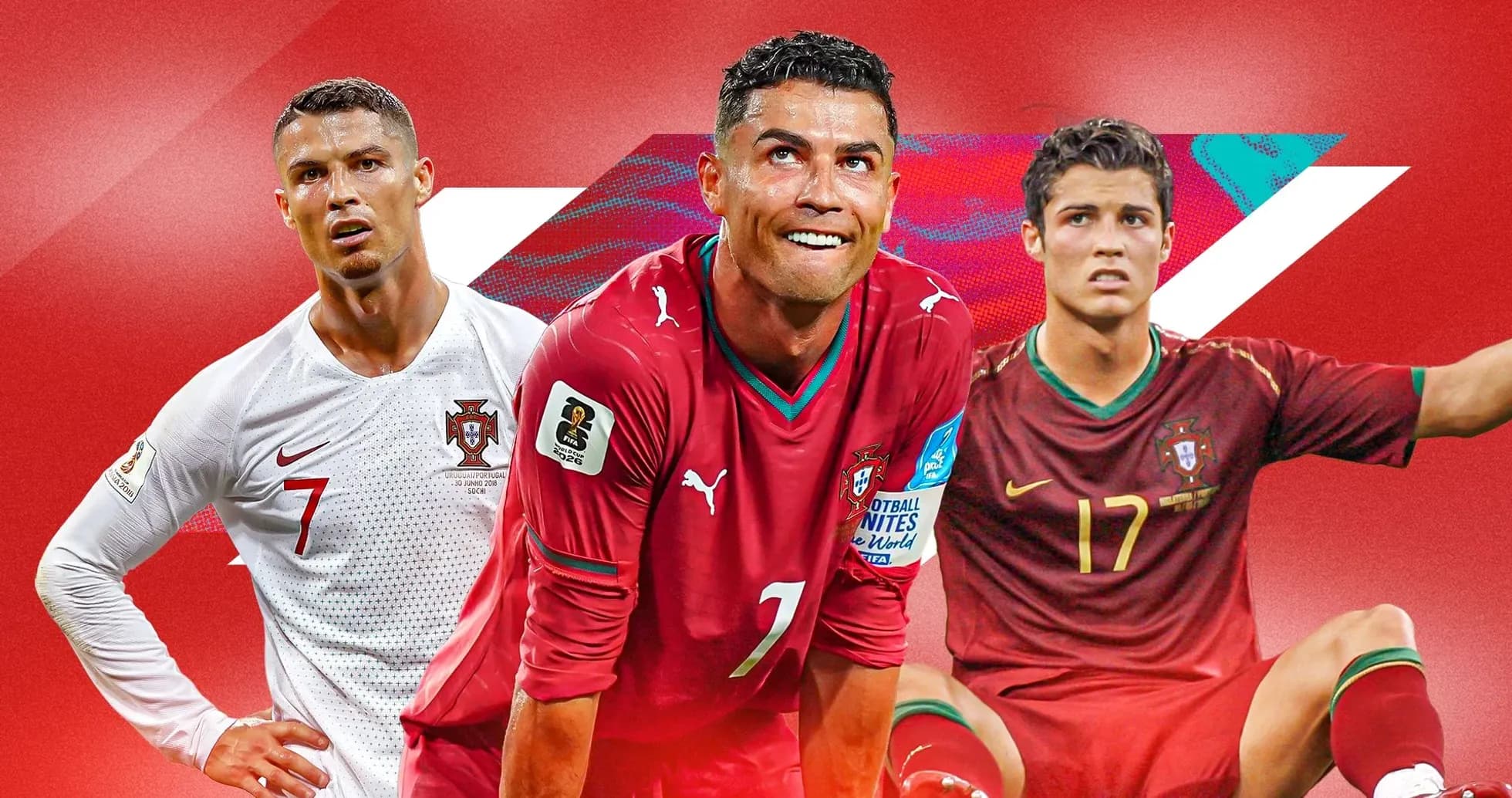
Cristiano Ronaldo's World Cup Journey: Chasing the Unfinished Dream
Cristiano Ronaldo has spent two decades chasing the same ghost.
For club, he has done it all. For Portugal, he has lifted the European Championship and a Nations League. Yet the World Cup, the stage that made and then scarred him, still feels like an unfinished argument between a phenomenon and his own mythology.
The boy who arrived with a wink
It began in 2006, with a penalty against Iran that made him Portugal’s youngest World Cup scorer. Just 21, still a whir of stepovers on the wing rather than the penalty-box predator he would become, he finished that tournament with just the one goal. Nobody panicked. Nobody thought that would be the pattern.
Germany 2006 did not define him with his feet, but with his face.
In the quarter-final against England, Wayne Rooney saw red for a foul on Ricardo Carvalho. Ronaldo’s reaction – the sprint to the referee, the protests, the infamous wink towards the Portugal bench – turned him into a villain in English eyes overnight. Every touch in the semi-final against France drew a cascade of boos.
Steven Gerrard was livid. He accused Ronaldo of being “bang out of order”, saying he would be “absolutely disgusted” if a club team-mate behaved like that. Frank Lampard echoed the anger, pointing out that Ronaldo and Rooney were supposed to be on the same side at Manchester United.
Ronaldo insisted he had done nothing wrong. FIFA’s technical study group took a different view. In a nod to sportsmanship, they swerved the controversy and handed the young player of the tournament award to Lukas Podolski. Holger Osieck, the group’s head, admitted they were critical of Ronaldo’s behaviour, stressing that players had to be role models.
Ronaldo left his first World Cup with one goal, a semi-final exit and a reputation split down the middle: rising superstar, or ruthless schemer?
Captaincy, criticism and a lonely walk in South Africa
By 2010, he had become Portugal’s captain and undisputed talisman. The expectations had grown heavier; the goals did not keep pace.
His only strike in South Africa came in a 7-0 demolition of North Korea, a scruffy sixth in a game that did little to answer the questions around him. It was his first international goal in 16 months. When Portugal fell 1-0 to eventual champions Spain in the last 16, the disappointment cut deep.
“I feel completely disconsolate, frustrated and an unimaginable sadness,” he admitted. The rawness of that emotion spilled into controversy. Cameras caught him after the defeat saying, “How can I explain this? Ask that question of Carlos Queiroz.”
At home, the line landed badly. It sounded like a captain deflecting blame. Ronaldo later tried to cool the storm, explaining that Queiroz was about to hold a press conference and insisting he meant no disrespect.
“I am a human being, and like any human being I suffer and I have the right to suffer alone,” he said. “I know that I am the captain, and I have always assumed and will assume my responsibilities.”
Queiroz’s reply was pointed. He would not tolerate anyone putting himself above the national team. “Portugal needs Ronaldo, and Ronaldo needs the national side,” he said, adding that if the shirt unnerved some players, they had no place there.
The bond between superstar and seleção felt strained. The World Cup dream, still in its early chapters, was already complicated.
Brazil: the body betrays the superstar
Four years later, Ronaldo dragged Portugal to Brazil almost single-handedly. His four goals across two play-off games against Sweden effectively booked their ticket. He arrived insisting he was “100 percent fit” despite nagging knee and thigh problems. The pitch told a different story.
Against Germany in the opening game, he was a shadow. Portugal were thrashed 4-0. He produced a late assist for Silvestre Varela against the United States, then an 80th-minute winner against Ghana, but the damage was done. Third in Group G. Out before the knockouts.
For a player who had built a career on devouring chances, the misses in Brazil felt jarring. Critics circled. Coach Paulo Bento tried to shield him.
“I don’t think it’s fair to make things individual,” Bento said. He took the blame himself, stressing that a series of collective errors had cost Portugal and refusing to single out any player. Cristiano, he pointed out, was usually “really effective” but simply could not produce this time.
The numbers were modest. The scrutiny was not.
Russia: the hat-trick and the familiar wall
In 2018, in Russia, Ronaldo started like a man determined to rewrite the script.
Spain, Sochi, a classic. Ronaldo scored a hat-trick in a 3-3 thriller, including his first free-kick goal at a major tournament, whipped into the top corner in the 88th minute. It was a personal milestone and a statement that, even at 33, he remained one of the game’s most decisive forces.
He was jubilant afterwards, keen to highlight the team’s display against one of the favourites. Portugal had led twice and been pegged back; a point felt fair, he argued. He insisted the group was strong, ambitious, ready to go deep.
They did not.
Portugal reached the last 16 but fell 2-1 to Uruguay. Ronaldo did not score. He did not assist. The knockout-stage drought continued, and the question that had always hovered – could he truly dominate a World Cup when it mattered most? – grew louder.
At 33, many wondered if this was his last appearance on the biggest stage. Ronaldo refused to be drawn on his future, but spoke with conviction about the team he would leave behind: talented, ambitious, and still among the world’s best.
The World Cup, though, had once again closed its door on him early.
Qatar: the fall, the fury and the tears
Qatar was supposed to be the last great push. It became something else entirely.
Ronaldo arrived with a point to prove after his acrimonious split from Manchester United. The World Cup was the one trophy missing from his collection. He wanted to silence doubters, to end the debate.
He scored from the spot in the opening win over Ghana, becoming the first man to net in five World Cups. The story should have built from there. Instead, it unravelled.
His performances dipped. He reacted furiously when substituted in the group-stage defeat to South Korea. Fernando Santos, unimpressed, made the bold call to drop him for the last-16 clash with Switzerland.
Portugal responded with their best performance of the tournament. Gonçalo Ramos, Ronaldo’s replacement, hit a stunning hat-trick in a 6-1 win. The optics were brutal: the old king on the bench, the new blood running riot.
Reports emerged that Ronaldo had threatened to leave the camp after being dropped. He denied it in a social media post, insisting his dedication to Portugal had “never wavered” and that he would never turn his back on his team-mates or his country.
Morocco ended Portugal’s run in the quarter-finals. Ronaldo, brought on from the bench, could not change the game. At the final whistle, he walked straight down the tunnel in tears. His only goal in the tournament had come from the spot. The knockout-stage wait went on.
On Instagram, he sounded like a man saying goodbye to a dream. Winning the World Cup for Portugal, he wrote, had been the biggest and most ambitious target of his career. Across five tournaments in 16 years, he insisted he had given everything, never shying from a fight. “Unfortunately,” he concluded, “that dream ended yesterday.”
The consensus hardened: this was the end at the very highest level. The World Cup had beaten him.
“I’m back”: one more roll of the dice
Yet Cristiano Ronaldo has built an entire career on ignoring consensus.
Just seconds after Portugal demolished Uzbekistan 5-0, he turned to a nearby camera and roared: “I’m back! I’m back!” The old defiance was still there. The legs were 41 now, the club shirt Al-Nassr yellow rather than Real Madrid white, but the hunger had not dimmed.
Caution, though, lingered. He had struggled in the opening draw against DR Congo. Uzbekistan, ranked 60th in the world, were hardly the sternest test. Two goals did not erase the doubts; they merely postponed them.
Then came Colombia. A step up in class. Ronaldo laboured, Portugal failed to find a way through, and a 0-0 draw in Miami allowed the South Americans to pip Roberto Martinez’s side to top spot in Group K.
The consequence is a path strewn with danger. Portugal now run into a Croatia team led by Luka Modric, a generation clearly beyond its peak yet still laced with experience and craft. They are old, but they know how to suffer, how to manage moments. The same description fits Ronaldo.
At 41, he has already proved he can still score at a World Cup. That, on its own, no longer moves the needle. The hole in his World Cup record remains the same: no goal in the knockout rounds. Not in 2006. Not in 2010. Not in 2014. Not in 2018. Not in 2022.
All those years. All those goals. None when the margins are thinnest.
Now comes Croatia. Another chance. Perhaps the last.
The stage is familiar, the stakes unchanged. For a player who has spent his life bending football to his will, one question hangs over everything: can Cristiano Ronaldo, finally, break the one World Cup barrier that has always refused to move?



