
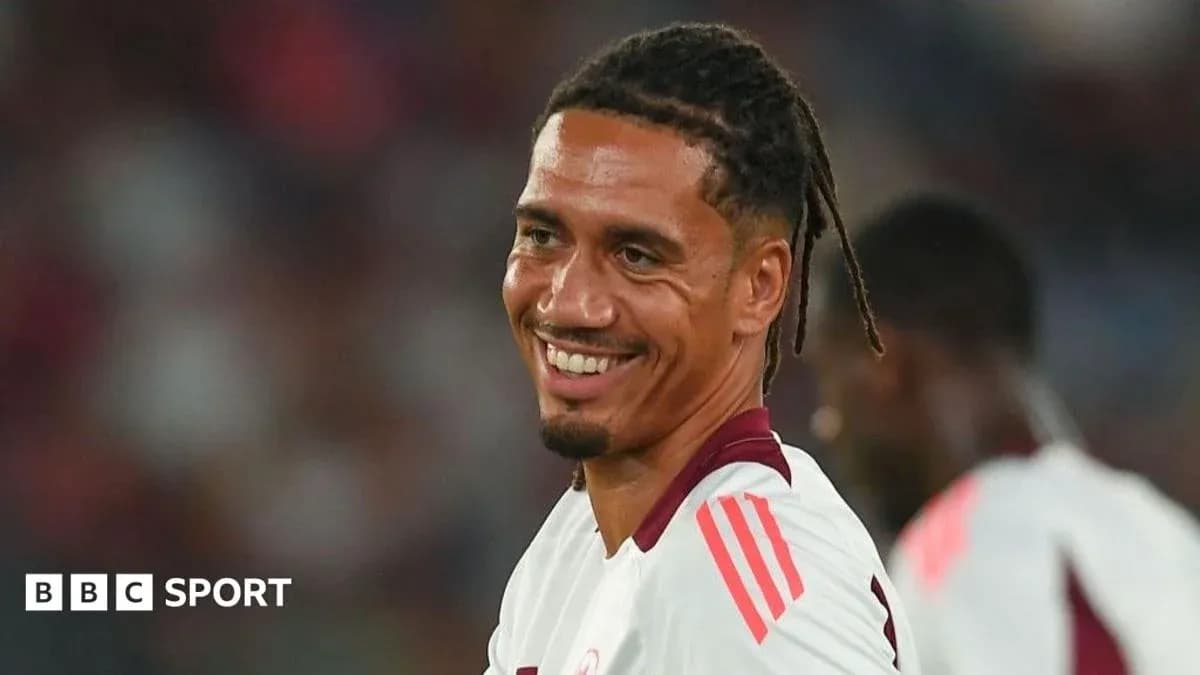
Chris Smalling: From Non-League to Champions League Glory
Chris Smalling never really sounded like a footballer who would drift quietly into retirement.
Within minutes of talking, it becomes obvious why. This is a man who went from non-league Maidstone to a Champions League final inside three years, built a 580-game club career across three countries, played under Sir Alex Ferguson and Jose Mourinho, won trophies with Manchester United and Roma, and collected 31 England caps. Now 36, he is back in the north west of England with his family, weighing up the next move.
He has plans for life after playing. They can wait. The priority is simple: find a new club.
“I know my body now better than when I was 26 and that's shown in the games I'm playing,” he says. The way he talks about it, longevity is less about luck and more about obsession.
He remembers Ferguson pushing details years ago – Ryan Giggs doing yoga, marginal gains before they were branded as such. Those lessons stuck.
“When you get beyond 30, each year is precious in terms of enjoying playing and being passionate about football,” he says. “Actual training is a very short time. The longevity and recovery starts very early in terms of what I'm eating and doing between sessions, even down to my supplements now.”
Clubs test blood in pre-season and hand out tailored plans. Smalling went further. Genetics testing. Deep data on how his body works. “A lot of my supplements were changed because of that,” he explains. It sounds more like a high-performance lab than the stereotype of a veteran defender easing through the final years.
Last season he was ever-present for Al-Fayha in the Saudi Pro League. He is proud of that. Not as a final pay cheque, but as proof the legs, and the hunger, are still there.
Eighteen years earlier, none of this was on the horizon.
“It wasn't even plan D,” he says, looking back to those Maidstone days. He was set to study financial economics at university, A levels already in his pocket, scouring for non-league clubs near Leicester so he could keep playing on the side. Football was a passion, not a pathway.
Then, late in the summer, Fulham called.
The chance was slim. He knew it. But he also knew he had to throw everything at it. One practice game later, Roy Hodgson summoned him into his office and offered him a contract.
“It wasn't even a full week,” Smalling remembers. “I didn't have any time to get my head around it. I was just in total shock.”
That whirlwind would become a theme with Hodgson. Ten days into 2010, Smalling travelled with Fulham to Blackburn for a Premier League game. He didn’t get on the pitch in the 2-0 defeat. The important moment had already happened.
“There had been a lot of talk about other clubs but not Manchester United,” he says. “Roy pulled me off the coach, said Fulham had accepted a bid and Sir Alex was coming to the hotel in 45 minutes.”
He rang his mum. Then he sat alone in his room, running through imaginary questions for the greatest manager of his generation, knowing he was about to step into a different world.
“Literally, we were there for about at least a couple of hours,” Smalling says of that first meeting with Ferguson. “He was so calming and reassuring.
“Even I was doubting it because they had all these great centre-backs. I wanted to develop and wondered 'how do I fit in?'.
“He told me I would get a chance and he believed in me.
“To be able to share the dressing room and the pitch and have conversations with him, is just incredible.”
That human touch, he insists, is what separates the elite managers from the rest. Not just the tactics, not just the speeches, but the way they look players in the eye and make them believe.
From the outside, his relationship with Mourinho has often been reduced to a single moment – the public criticism in November 2016, when the Portuguese questioned his willingness to play through injury. Smalling’s version is very different.
“For United or Roma, Jose picked me for most games because we had a good relationship and he trusted me,” he says. The point, for him, lies in what Mourinho and Ferguson could do to a dressing room.
“It's very easy to influence younger players but the beauty of Sir Alex and Jose is that they were able to create that belief in senior players,” he explains. “A lot of managers can give good team talks but if you look at some eye-to-eye, see the passion and real belief that 'it's going to happen' senior players follow and the rest lock in. That's the beauty of top-class manager.”
The broken toe story under Mourinho underlines it. Smalling was having injections to get through games, driven by the mentality his manager had instilled.
“In that situation, I was having injections in broken toe because he had created that mentality in me that I could do anything, even if, maybe, I shouldn't,” he says. Eventually, he hit the limit of how many injections he could take. He had to stop in a warm-up. Mourinho was disappointed.
“It gave me even more belief because it was easy to choose another centre-back but he wanted me.”
They still keep in touch. Smalling messaged him good luck when Mourinho took over at Real Madrid this summer. But he has no intention of following him into the dugout.
“I don't think it will be my route,” he says. “I'm quite comfortable with the next stage.”
That next stage is already taking shape. He is working on an education programme for young players with the Global Institute of Sport, one of three or four projects bubbling in the background. The aim is to give the next generation tools he had to learn on the fly.
For now, those projects sit in second place. “Once my football career comes to an end, I can put more time to them but at the minute it's all focused on playing because I have that passion and drive and physically my stats are good.”
Any club that signs him will get more than a centre-back.
At Al-Fayha, he helped drive off-field standards, pushing to upgrade the gym to what he believes an elite modern professional needs. He talks about it with as much pride as any tackle. It fits a pattern he sees across his career – leaving a positive mark, not just on the pitch but inside the building.
He thinks back to the fork in the road, the offer he turned down.
“It would have been the safer route,” he admits of the university place. That first year at Fulham hardly screamed security either. “In that first year, I was not earning a lot of money. I was playing for the reserves and the 19th man for the first team, travelling around but not quite on the bench. There was no guarantee I was going to earn more money.”
Then came United. A four-year contract. After the first year, a new one. Another a year later. Another 18 months after that. Each one a reward, but also a reminder.
“There was always this carrot. I never took anything for granted.”
He still doesn’t. The body has been mapped. The diet is tuned. The projects are lined up. All that’s missing now is the next badge on the shirt – and one more chapter in a career that was never meant to get this far.



