Chivas Dominate Pumas 3-0 in Liga MX Showdown
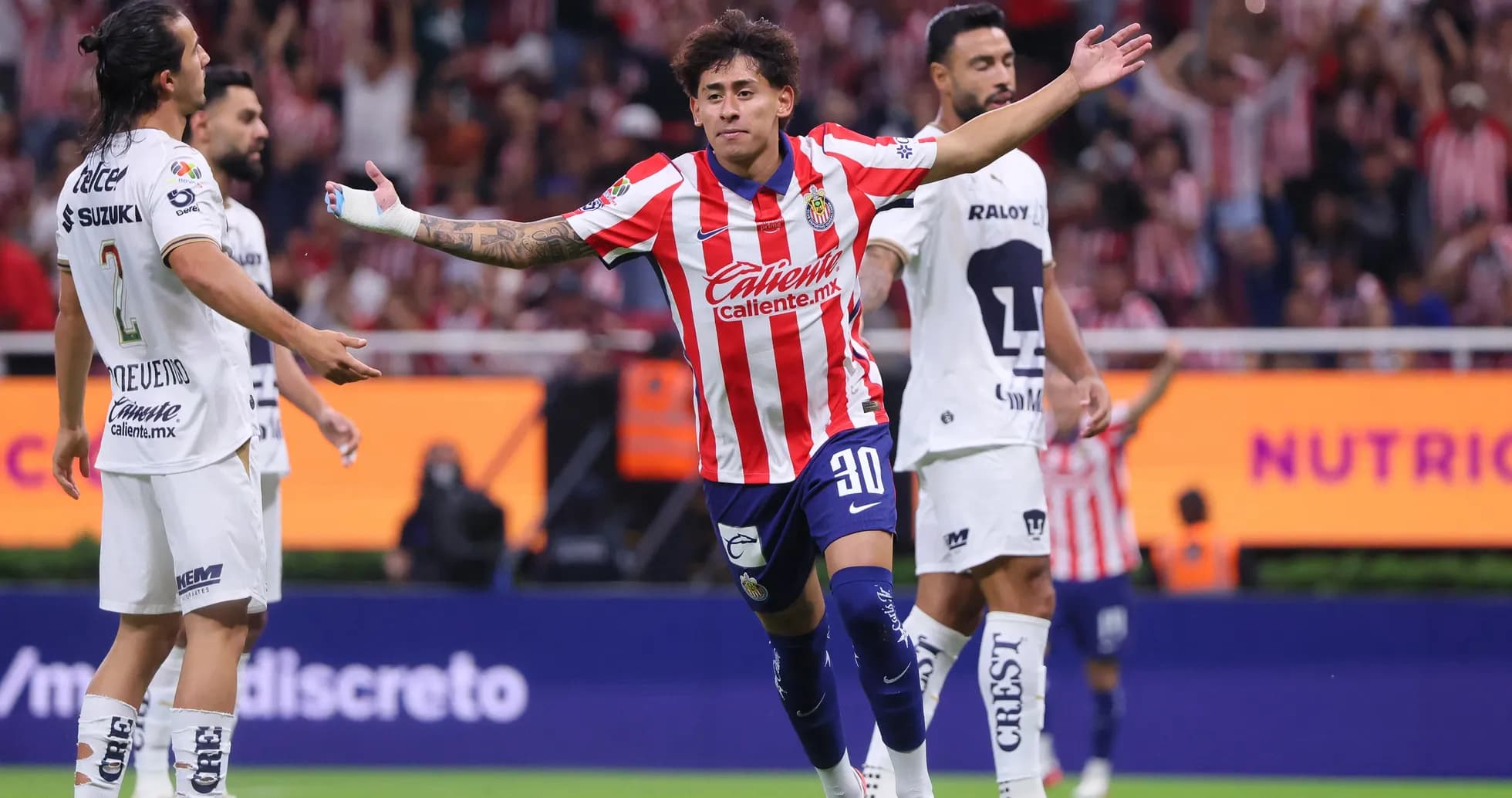
The lights at Estadio Akron had barely cooled by the time the table told the full story. Guadalajara Chivas, already setting the pace in Liga MX Apertura, underlined their status with a commanding 3–0 home win over U.N.A.M. – Pumas in Apertura Round 8, a result that fit almost perfectly with the season’s statistical script.
I. The Big Picture – Chivas’ structure vs Pumas’ fragility
Heading into this game, Chivas were top of the table with 17 points from 8 matches, built on 5 wins, 2 draws and just 1 defeat. Their overall goal difference of 9 came from 15 goals scored and 6 conceded, a balance that echoed in their underlying averages: 1.9 goals scored per match in total and only 0.8 conceded. At home, they had been even more assertive, averaging 2.3 goals scored and 1.0 conceded across 4 matches.
Pumas arrived in Zapopan in 11th place, a mid-table side still searching for a stable identity. Their overall record of 3 wins, 2 draws and 3 defeats came with 11 goals scored and 12 conceded, a goal difference of -1. On their travels they had been high-variance: 2 away wins and 2 away defeats, scoring 7 and conceding 7, for an away average of 1.8 goals scored and 1.8 conceded.
Both managers mirrored each other on the board: Gabriel Milito and Esteban Solari sent their sides out in a 3-4-2-1, but the systems behaved very differently once the ball rolled. For Chivas, the back three of L. Romo, D. Campillo Del Campo and D. Aguirre formed a secure base behind an aggressive midfield line of R. Alvarado, O. Govea, F. Gonzalez and H. Camberos, with S. Sandoval and R. Marin supporting Á. Sepúlveda up front. It was a shape that leaned into Chivas’ season-long strengths: verticality from the flanks and volume in the final third.
Pumas’ 3-4-2-1, with K. Navas behind a defensive trio of R. López, Nathan Silva and R. Duarte, and a midfield band of U. Antuna, V. Arteaga, P. Vite and P. Bennevendo, was designed to transition quickly into a front three of R. Morales, L. Herrera and Juninho. On paper, it suited their away numbers – 7 goals scored on their travels – but it also exposed a defence already conceding 1.5 goals per match in total and 1.8 away.
The 1–0 half-time scoreline in favour of Chivas felt like a continuation of their season arc: control, pressure, and patience. By full-time, the 3–0 margin simply aligned the match with the broader data: the best attack and one of the stingiest defences in the league against a Pumas side that too often lives on the wrong side of chaos.
II. Tactical Voids – Discipline and risk
With no official absentees listed pre-match, both coaches had their core tools available. The real voids were structural and psychological.
Chivas’ disciplinary profile this season has been intense but largely controlled. Their yellow cards tend to cluster in the 46–60 and 76–90 minute windows, each accounting for 28.57% of their cautions, signalling a side that tackles aggressively right after the restart and then again in the closing stretch. The single red card shown to Á. Sepúlveda this season underlines the edge in their front line, but also the risk: the same forward who starts as the tip of the 3-4-2-1 can tilt the emotional balance if provoked.
Pumas, for their part, have lived dangerously in their own way. Their yellow cards spike late, with 27.27% of their cautions arriving between 76–90 minutes and another 18.18% from 91–105. That late-game indiscipline dovetails uncomfortably with a side that concedes 1.5 goals per match overall and has only 1 clean sheet in total. The red card shown to P. Bennevendo this season is a warning sign when he is asked to operate as a wide midfielder or wing-back in a back three: his role demands aggression, but his history shows how quickly that can tip into numerical disadvantage.
III. Key Matchups – Hunter vs shield, engine room vs enforcer
The headline duel coming into the fixture was the clash of attacking leaders. For Chivas, R. Alvarado has been one of the league’s standout performers: 3 goals in total, 8 shots with 6 on target, and a creative profile of 14 key passes and 386 total passes at 89% accuracy. Operating nominally as a midfielder in the line of four, he effectively becomes a roaming playmaker between the lines, linking with R. Marin and Á. Sepúlveda.
Opposite him, Pumas leaned heavily on Juninho, their top scorer with 4 goals from 10 shots and a 7.03 average rating. His movement from the central forward slot in the 3-4-2-1 is designed to open lanes for R. Morales and L. Herrera, but against a Chivas defence conceding just 0.5 goals on their travels and 1.0 at home, his margin for error was thin.
The “engine room” battle revolved around O. Govea and F. Gonzalez for Chivas against P. Vite and V. Arteaga for Pumas. Vite, in particular, is a double-edged presence: 1 goal, strong passing at 87% accuracy and 11 tackles with 9 interceptions, but also 3 yellow cards, making him one of the league’s most-booked midfielders. His task was to disrupt Chivas’ rhythm without drifting into the kind of reckless challenge that has already defined parts of Pumas’ campaign.
Out wide, the interplay between H. Camberos and R. Alvarado for Chivas against U. Antuna and R. López for Pumas was crucial. López brings 2 assists and 11 key passes, plus 17 tackles and 8 interceptions, but he was asked to manage both the defensive load and progressive passing from the right of a back three – a demanding assignment against a home side averaging 2.3 goals per match at Estadio Akron.
For Pumas, R. Morales arrived as one of Liga MX’s premier creators: 2 goals, 3 assists, 10 key passes and 15 shots. His duel with the Chivas back three, especially the aerial and ground duels with L. Romo, was framed as a potential equaliser to Chivas’ territorial dominance. Yet with Pumas having failed to score in 4 matches overall this season, his influence was always likely to be sporadic rather than sustained.
IV. Statistical Prognosis – Why 3–0 felt inevitable
Even without explicit xG values, the pre-match numbers pointed towards a Chivas win by multiple goals. Their home scoring average of 2.3, combined with Pumas’ away concession rate of 1.8, suggested a home tally in the 2–3 goal range. At the other end, Pumas’ away scoring average of 1.8 ran into a Chivas defence conceding only 1.0 at home and boasting 4 clean sheets in total this campaign.
Layer in the psychological and disciplinary trends – Chivas’ ability to sustain intensity across 90 minutes, Pumas’ late-game yellow card spikes and their single clean sheet – and a scenario emerged in which the league leaders could apply steady pressure, force mistakes, and gradually pull away.
The final scoreline of 3–0, with Chivas leading 1–0 at half-time before closing the match out in the second period, was less a surprise than a crystallisation of the season’s underlying patterns. The leaders played like leaders: structured, ruthless, and emotionally controlled. Pumas, for all their individual quality in Juninho, R. Morales and P. Vite, again found themselves caught between ambition and instability – a side that can hurt opponents in moments, but too often cannot protect itself over 90 minutes.