Chelsea and Hull City Clash in Premier League Draw
Stamford Bridge under a grey September sky, Round 4 of the Premier League, and two early‑season stories collided. Chelsea, reshaped under Xabi Alonso, came in as the division’s entertainers: 10 goals scored and 9 conceded overall from just 4 matches, a goal difference of 1 and a place in 5th. Hull City arrived as the surprise steel of the campaign, 3rd in the table with 8 points, a goal difference of 3 and the best defensive record in the league so far: only 2 goals conceded overall.
The 2–2 draw that followed felt like a collision of philosophies as much as a meeting of systems. Chelsea’s 4-2-3-1, all angles and rotations, against Hull’s 5-4-1, a disciplined, layered block built to suffer and then strike.
Alonso’s selection told its own story. With M. Caicedo, E. Emegha, J. Henderson and M. Palestra all missing through injury, Chelsea’s spine had to be reimagined. E. Martínez in goal sat behind a back line of W. Fofana, L. Colwill, J. Hato and Pedro Neto – nominally a defender but used here as an advanced full-back. In front of them, R. James and R. Lavia formed a double pivot that was as much about progression as protection, while M. Gusto, C. Palmer and M. Rogers supported Joāo Pedro as the lone forward.
Hull’s absentees were just as significant but of a different flavour. I. Ansah, J. Butland, D. Gyabi, C. Hughes, E. Matazo and H. Morita were all ruled out, trimming S. Jakirović’s options but not his identity. K. Tzolakis kept goal behind a pure back five of L. Coyle, S. Ajayi, J. Egan, N. Mendy and R. Giles. Ahead of them, M. Belloumi, M. Crooks, R. Slater and E. Stroud formed a narrow, hard‑working midfield box behind O. McBurnie, the lone reference point up front.
Heading into this game, the numbers framed the tactical tension. At home, Chelsea were averaging 3.0 goals for and 2.5 against, a wild 5.5 goals per match at Stamford Bridge. They had yet to keep a clean sheet at home or away and had failed to score in none of their league games. Hull, by contrast, had built their early surge on control and resistance: on their travels they averaged 1.5 goals for and 1.0 against, and overall they had kept 3 clean sheets from 4, conceding 0.5 goals per game.
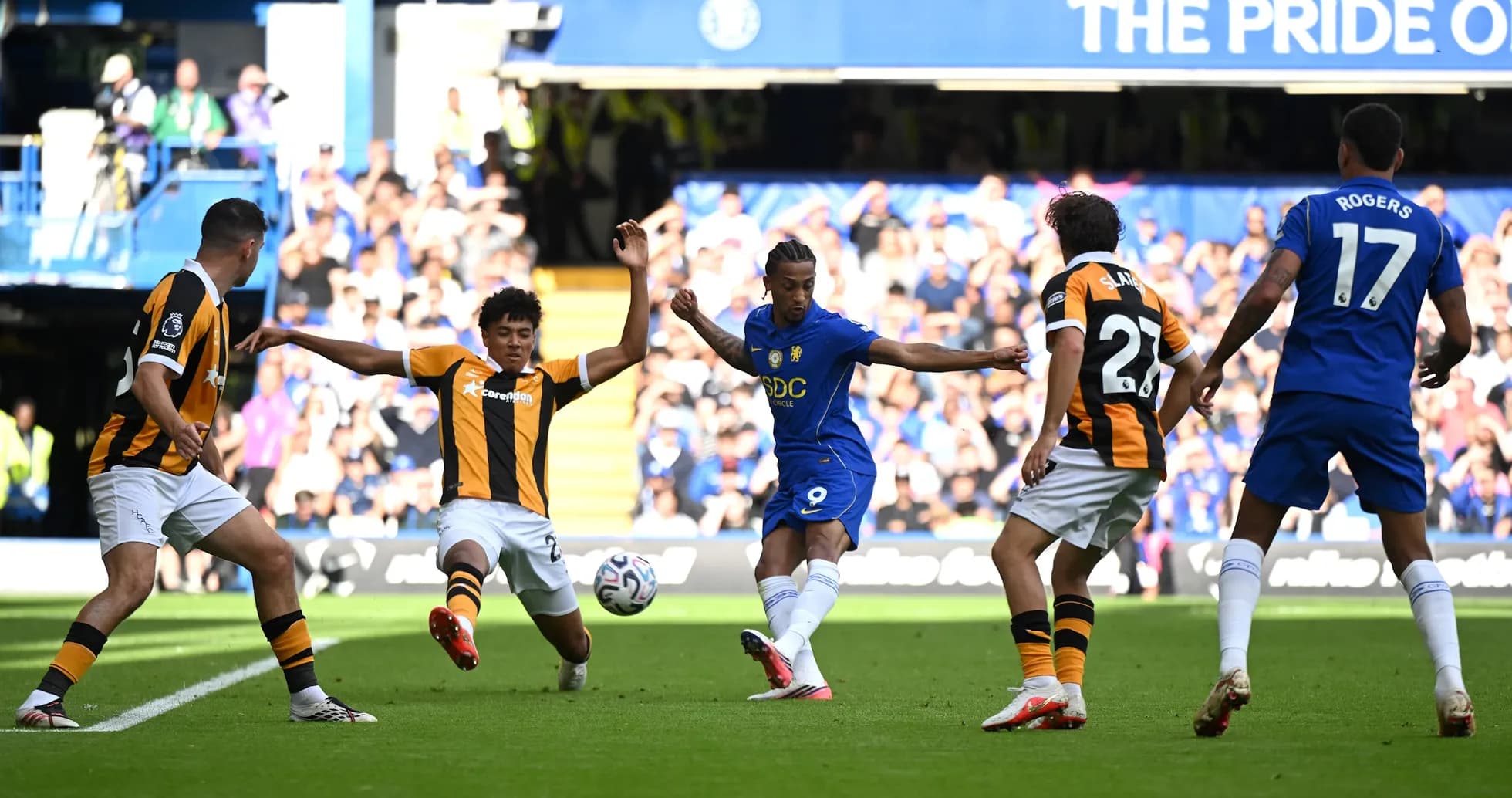
The opening 45 minutes reflected those underlying trends. Chelsea’s structure with the ball resembled a 2-3-5: Hato and Colwill often split, Lavia dropped between them, and James stepped up alongside Gusto and Palmer to form a fluid midfield line. Rogers and Pedro attacked the half-spaces, trying to drag Hull’s back five into uncomfortable decisions.
Yet Hull’s 5-4-1 was built exactly for this kind of storm. Coyle and Giles stayed tight to their centre-backs, the line rarely breaking, while Crooks and Slater pinched in to deny Palmer and Rogers the pockets they crave. Belloumi, whose season to date had already yielded 2 goals and 1 assist, played the dual role of out-ball and presser, shuttling between Lavia and the Chelsea centre-backs.
Discipline was a key sub-plot. Chelsea’s season-long card profile showed a spread of yellows across the match, with notable spikes in the opening 0–15 minutes (33.33%) and late on between 76–90 minutes (22.22%). Hull’s bookings tended to flare just after the restart – 30.77% of their yellows arriving between 46–60 minutes – and again in the 61–75 and 91–105 windows (15.38% each). It was no surprise, then, that the midfield battle became increasingly scrappy as Chelsea chased and Hull protected.
Within that chaos, certain duels defined the narrative.
The “Hunter vs Shield” confrontation was Joāo Pedro against Hull’s collective defence. Heading into this game, Pedro had 3 goals and 3 assists overall, with 8 shots (4 on target) and 61 duels contested, winning 34. He thrives on contact, on rolling defenders and combining quickly around the box. Hull’s response was structural: Ajayi and Egan took turns stepping out to engage him, while N. Mendy covered space behind. The plan was not to win every duel, but to deny Pedro the time to turn and feed runners like Rogers and Palmer.
Rogers, too, arrived as one of the league’s early stars: 3 goals and 1 assist overall, 10 key passes and 12 dribbles attempted, 6 successful. His matchup against Coyle and the right side of Hull’s block was an “edge of the box” war. Every time Rogers drifted infield, Crooks shaded across, adding a second layer of resistance. Hull accepted that he might receive between the lines; the aim was to ensure he did so facing his own goal.
In the “Engine Room”, the duel between Lavia and Hull’s central pair of Crooks and Slater was pivotal. Lavia’s role as Chelsea’s metronome was to break Hull’s first line and find Palmer or Hato between midfield and defence. Crooks, already on 2 yellow cards this season, patrolled aggressively, using his 6 tackles and 2 blocks to disrupt rhythm. Slater, more understated, closed passing lanes and tracked James’s underlapping runs.
On the other side, Hull’s creative heartbeat was Belloumi. His 2 goals, 1 assist, 10 tackles and 9 interceptions overall made him both creator and destroyer. Up against Hato and James when drifting inside, he looked to exploit Chelsea’s one clear systemic weakness: transition defence. With Chelsea conceding an average of 2.3 goals overall and 2.0 on their travels, their high line and adventurous full-backs have left space to attack. Hull’s plan was simple: soak pressure, then release Belloumi and McBurnie into those gaps.
McBurnie himself brought edge and risk. With 2 yellow cards and a place among the league’s leading offenders, his duel count (74 overall, 36 won) framed him as the archetypal battering ram. Against Colwill and Fofana, his job was to pin, foul, and generally make the game messy. In a match where Chelsea’s early and late yellow-card spikes were known, drawing fouls in those phases was part of Hull’s tactical script.
From the bench, the profiles hinted at alternative game states. For Chelsea, J. Bynoe-Gittens and Estêvão offered directness if they needed to chase, while M. Lacroix and Pep Chavarría could have stiffened a fragile back line. Hull’s options – S. Thomas, M. Cho and R. Vaz – suggested pace for tired legs, while L. Gourna-Douath and T. Iroegbunam would have been the choices to reinforce a lead.
Statistically, the draw felt like the meeting point of two truths. Chelsea’s attacking volume – 2.5 goals scored on average overall – once again found a way through a defence that had previously conceded just 0.5 goals per game. Hull, meanwhile, preserved their unbeaten start, showing that their 5-4-1 is not a passive low block but a springboard.
From an xG and defensive solidity perspective, the prognosis for both remains distinct but encouraging. Chelsea’s inability to keep a clean sheet, coupled with high home-scoring numbers, suggests their season will continue to be defined by high-variance, chance-rich contests. Hull’s compactness, three clean sheets overall and disciplined 5-4-1 shape underpin a more controlled, marginal‑gains campaign.
If Chelsea can tighten the space behind their full-backs without blunting the influence of Palmer, Rogers and Joāo Pedro, they have the attacking talent to climb from Europa League territory toward something more. Hull, if they maintain this defensive platform and keep Belloumi fit and free, will remain one of the league’s most awkward, structurally sound assignments – the kind of side no one enjoys facing, especially on their travels.