
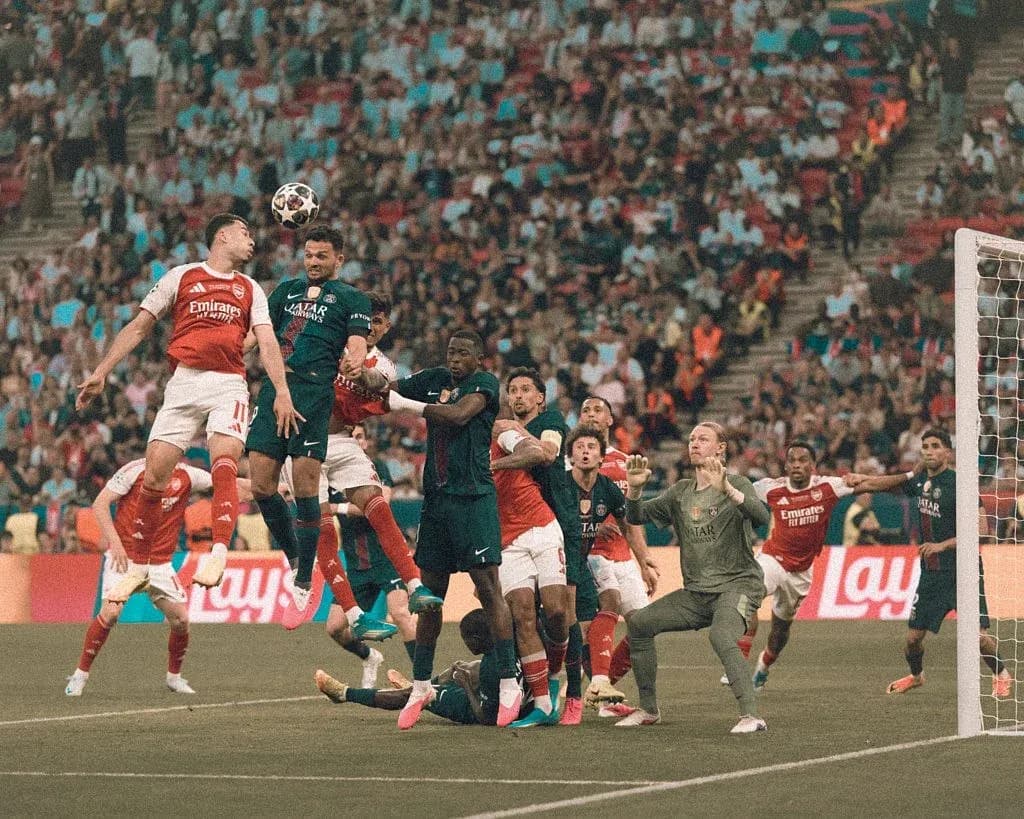
Champions League Final: PSG Wins, Arsenal's Brand Impact Surges
On a warm night in Budapest, as PSG clung to their Champions League crown in a penalty shootout thriller against Arsenal, the real story of the final wasn’t just on the pitch. It was in living rooms, on phones, in crowded bars, and on streams that broadcasters would rather not talk about.
PSG won the trophy. But the numbers show something else entirely won the night.
A final watched in secret
The Champions League final drew a combined audience of 33.7 million across the UK, France, Hungary and the United States. Impressive. Yet that headline figure barely scratches the surface.
The shock came from Britain.
In the UK alone, 16.2 million people watched the game via illegal streams. Not pay-TV, not official platforms. Pirated feeds, clicked and shared in group chats and on forums, dwarfing the 12.9 million who tuned in through official channels across all four measured markets combined.
The match wasn’t free-to-air in the UK. Fans simply refused to accept that. When the biggest club game in Europe went behind a paywall, millions went looking for another way in — and found it.
The UK delivered the biggest audience of the night at 19.4 million. Of those, just 3.0 million watched on TNT Sports and HBO Max, with around 200,000 estimated to have seen it out of home. The rest slipped through the cracks of the legal broadcast ecosystem.
France, where PSG’s defence of the title gripped a nation, contributed 9.5 million viewers via M6 and Canal+. In the US, where football continues to ride a World Cup-fuelled surge, 4.8 million watched across CBS, Univision and Paramount+.
And that was only the start of it.
Streets, pubs, and a packed Puskás
The Champions League final has long since outgrown the idea of being just a TV event. This one proved it again.
YouGov estimates that just under 500,000 Arsenal and PSG supporters watched from bars and pubs across London and Paris, turning city streets into rolling fan zones. Inside Budapest’s Puskás Aréna, 61,035 spectators saw the drama unfold in person, the stadium crackling with the tension of a final that went all the way to penalties.
From the stands to the streets to the millions huddled over laptops and phones, this was a match consumed in every way modern football can be consumed. Legal or not.
Arsenal lose the trophy, Emirates win the screen
On the scoreboard, Arsenal fell short. On screen, they dominated.
YouGov Sport’s Brand Exposure analysis shows Arsenal’s front-of-shirt sponsor, Emirates, enjoyed 2 hours and 52 minutes of on-screen time, with a Brand Impact Score (BIS) of 3.54. PSG’s shirt sponsor recorded 1 hour and 54 minutes and a BIS of 3.25.
In simple terms: Arsenal players were in the shot more often, and when they were, their sponsor’s logo carried more weight.
Attacks, last-ditch tackles, anguished reactions, slow-motion replays — all the moments that broadcasters linger on. Across the night, those moments featured Arsenal more frequently. Close-ups stayed longer. Replays returned to the same faces. The drama of the underdog pushing the holders to the brink gave Emirates the kind of exposure money alone can’t script.
The detail matters. Emirates posted a higher BIS than Qatar Airways (3.54 vs 3.22), thanks to a slightly larger logo, stronger central positioning on screen, more frequent “solus” appearances without competing brand clutter, and longer average exposure durations. Each appearance worked harder.
The result: the losing side’s shirt sponsor came out ahead on impact.
For brands, it’s a sharp reminder. In a final like this, the more compelling story isn’t always told by the winner’s parade. Sometimes, the team that walks past the trophy leaves with the bigger commercial return.
Forty-two billion impressions for one match
The final whistle in Budapest didn’t stop the numbers. It just moved them online.
Across 30–31 May, the Champions League final sparked more than 40,500 social media posts, 13,700 videos and 24,500 online articles. Those pieces of content carried an estimated 42 billion potential impressions, 1 billion video views and 10 billion in potential readership.
PSG, champions on the pitch, also ruled the digital arena.
The French club generated 8.6 billion impressions and 418.6 million video views across its official social channels. Arsenal, despite a powerful run to the final and a huge global fanbase, recorded 3.7 billion impressions and 49.7 million video views.
PSG simply pushed out more content and pushed it harder. That volume translated into reach, extending the glow of victory far beyond Budapest, far beyond the night itself.
When fans become brand advocates
The impact for sponsors didn’t stop at logo time or social reach.
Using YouGov BrandIndex, Recommendation levels for Emirates among Arsenal supporters in the UK and Qatar Airways among PSG supporters in France were compared with those of the general population. In both cases, club fans were significantly more likely to recommend the sponsor than non-fans.
That’s not just awareness. That’s allegiance.
Around the time of the final, Emirates saw an uptick in Recommendation among Arsenal supporters. Qatar Airways, by contrast, held consistently strong Recommendation levels among PSG fans throughout the measured period.
Multiple factors can nudge brand perception — form, transfers, pricing, wider campaigns — but the pattern is clear: the bond between club and sponsor runs deeper among fans than in the broader market. When the team matters to you, the logo on the shirt starts to matter too.
YouGov Sport’s BIS-X framework tries to capture exactly that: not only how often and how well a logo appears on screen, but how fan sentiment and brand health amplify the value of that exposure. In this final, the stronger uplift in Recommendation among Arsenal supporters hints that Emirates may have gained twice — from the sheer volume and quality of visibility, and from the emotional surge of fans rallying behind both club and sponsor.
Beyond counting eyeballs
Strip this final down to a single number — 33.7 million viewers, 16.2 million illegal streams, 42 billion impressions — and you miss the real story.
Modern sponsorship lives at the intersection of all of it: audience size, exposure quality, social noise, and what fans actually feel about the brands on their shirts. Logo counts alone can’t explain why a losing finalist’s sponsor walks away with the bigger win, or why a fan is suddenly more likely to recommend an airline after a heartbreaking night in Budapest.
The 2026 Champions League final showed the sport at its most modern: a global spectacle fractured across platforms, pirated by millions, dissected in real time, and monetised in ways that would have been unthinkable a decade ago.
PSG kept the trophy. Arsenal’s sponsor stole the spotlight. And as illegal streams surge and fan sentiment grows more powerful, one question hangs over the next final: who will really own the night — the club, the broadcaster, or the brand on the shirt?



