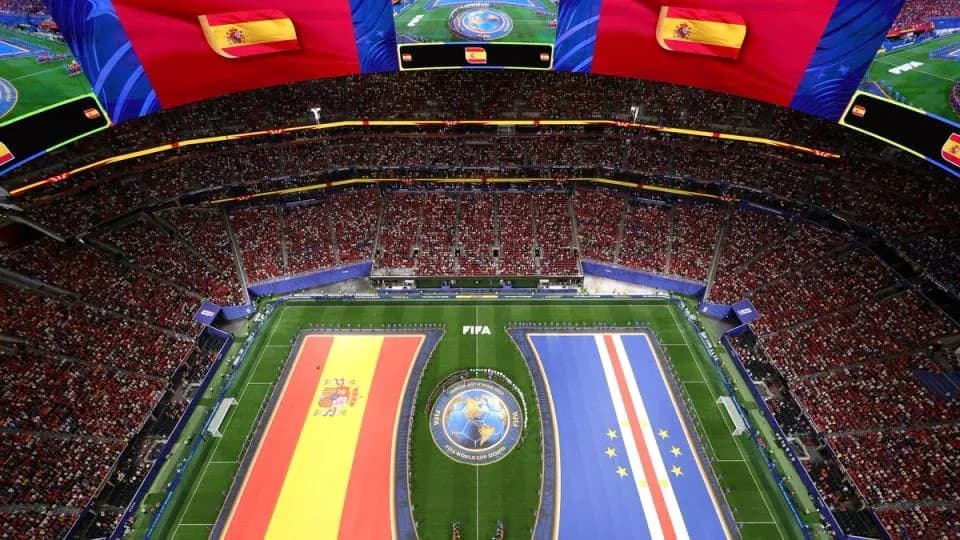
Cabo Verde Stuns Spain in World Cup Draw
Spain were supposed to stroll it. Instead, they walked into a wall painted blue.
On the pitch, World Cup debutants Cabo Verde tore up the script with a fearless, disciplined performance to hold the reigning European champions to a 0-0 draw on Monday. Off it, the result detonated through the crypto betting world, rewriting fortunes in a matter of hours.
The bookmakers had made it look like a mismatch from another sport: Spain at 1:10, Cabo Verde written off as little more than background noise. No household names. No big-club stars. Just a tight, stubborn unit and a 40-year-old goalkeeper, Vozinha, who refused to blink.
By full-time, he was player of the match. Spain were rattled. And Polymarket, the crypto-based predictions platform, had just witnessed one of the wildest swings of the tournament.
A $4 million gamble that hit like a thunderbolt
The standout winner operated under a simple pseudonym: “fishalive”. A brand-new wallet, created this month, walked straight into one of the most lopsided markets of the World Cup and bet against the giants.
Two clear positions. First, Spain would not win the match. Second, Cabo Verde would stay within 2.5 goals – a spread bet that effectively backed the underdogs to avoid a heavy defeat.
The bet was bold, but the logic was brutal once the whistle blew. Spain huffed and probed. Cabo Verde held their shape, then held their nerve. When the game finally ended goalless, both of “fishalive’s” wagers cashed.
On-chain data reviewed by CoinDesk shows the wallet redeemed about $4.7 million on the Spain-not-to-win market and another $8.5 million on the spread. Starting from roughly $4 million, the account walked away with a one-day profit of around $9 million.
One night, two calls, life-changing numbers.
The other side of the miracle
For every miracle story in betting, there is someone on the wrong end of the same moment.
In this case, that was a trader posting under the name “betoor619”. Where “fishalive” leaned into chaos, “betoor619” backed certainty – or what looked like it.
With Spain priced at around 92% to win, “betoor619” staked almost $1.1 million on the favourites. The upside? Just about $85,000 if Spain did the expected and took all three points. The kind of thin margin that comes with betting on what the market sees as a near-certainty.
The risk finally snapped into focus once Cabo Verde refused to fold. Every missed chance, every blocked shot, every save from Vozinha turned that “safe” bet into a slow-motion car crash.
When the final whistle went, the loss was brutal: close to $1 million gone in a single match. Polymarket trading history tied to the account shows that, until then, “betoor619” had never won or lost more than $9,000 on a single event. This was a step up in stakes – and a painful one.
Polymarket’s biggest World Cup shock
Cabo Verde’s draw did not just shake a single game; it ripped through one of Polymarket’s busiest markets of the tournament.
Around $64 million traded on the Spain match alone, according to figures reviewed by CoinDesk. For a platform that lives on sharp edges and probability curves, this was the kind of result that tests every assumption.
Polymarket runs as a prediction market, where users buy and sell shares in real-world outcomes, with prices reflecting implied odds. Settlement is in USDC, a dollar-pegged stablecoin, on a public blockchain. No betting slips. No traditional bookmakers. Just wallets, pseudonyms, and a live market constantly repricing the world in real time.
That anonymity has drawn political heat. Lawmakers have criticised the platform for allowing traders to operate via crypto wallets and screen names, sidestepping the kind of background checks and identity verification that regulated sportsbooks routinely demand. Yet the flow of money keeps growing.
The World Cup has only amplified that surge. Polymarket’s market on the eventual tournament winner has already attracted about $2.4 billion in trading volume, making this World Cup its biggest event since last year’s U.S. election and pushing it past the roughly $1.4 billion wagered on this year’s Super Bowl.
On Monday night, though, all that global volume narrowed to one game, one underdog, one goalkeeper, and a handful of traders who either read the moment or misjudged it badly.
Spain will move on, wounded but alive in the tournament. Cabo Verde leave with a point, a story for the ages, and a 40-year-old keeper who just shook up both a World Cup and a billion-dollar prediction machine.
The odds will reset. The markets will move. But after a night like this, who still believes in “near-certain” outcomes?