
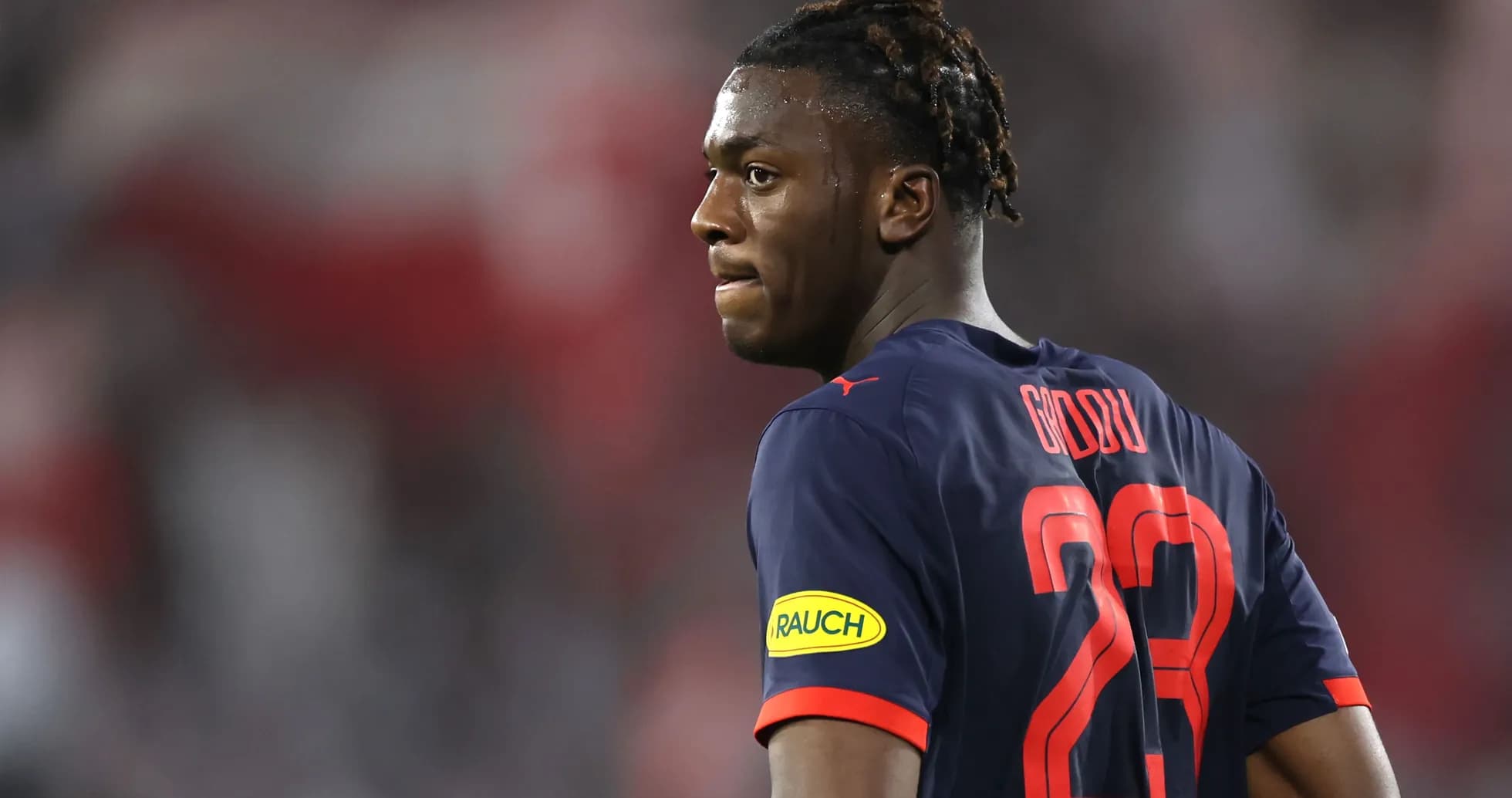
BVB's Bold Bet on Jo Gadou: A New Defender for Dortmund
In a market obsessed with ready-made stars, Borussia Dortmund have gone the other way. They’ve handed the keys to their back line to a 19-year-old who still hasn’t ironed out the rashness from his game.
Jo Gadou has been on the radar of Europe’s elite for years. BVB first tried to prise him away in the summer of 2023, when he still had two years left on his youth deal at Paris Saint-Germain. Twelve months later, Bayer Leverkusen came close, only to fall just short. As recently as March, then-sporting director Sebastian Kehl made the trip to Vienna’s Allianz Stadium just to watch him.
Dortmund didn’t stumble into this one. They’ve been waiting.
From PSG’s Shadows to Salzburg’s Spotlight
At 1.95 metres, Gadou looks every inch the modern centre-back: long stride, huge frame, quick enough across the ground to live on the front foot. Michael Unverdorben, deputy head of sport at Salzburger Nachrichten, doesn’t bother with understatement. Compared to Dayot Upamecano at the same age, he says Gadou is “already further along”, and calls him “certainly Salzburg’s best centre-back… strong in the tackle and in the air, and has everything a defender of international calibre needs.”
Salzburg paid like they meant it. In 2024, the Austrians broke their own transfer record for a 17-year-old, wiring €10 million to Paris. Only Karim Adeyemi had cost them more at that age, and only by €100,000 back in 2018.
The move came at a crossroads for Gadou. He had just won the U19 league title with PSG and trained regularly alongside Kylian Mbappé, but the pathway was blocked. Three first-team call-ups, no debut. Marquinhos, Lucas Beraldo and later Willian Pacho guarded the door. Luis Enrique, by all accounts, never fully bought in, even as the Guardian listed Gadou among the 60 most talented players worldwide in 2024.
Salzburg saw what PSG wouldn’t bet on. Their scouts had followed him since his first steps with France’s U16s.
A New Life, Harsh Lessons
Nicknamed “Jogad” by his friends, Gadou left Nangis, the suburb 80 kilometres south-east of Paris where he grew up, and moved to Salzburg with his mother and seven-year-old brother. His father, originally from Ivory Coast, and three other siblings stayed behind. It was a big move, and the adaptation took time.
On the pitch, his start was anything but smooth. Under new manager Pepijn Lijnders, Salzburg struggled and so did Gadou’s rhythm. His minutes came slowly. When he finally got a run, he crashed into the reality of senior football: in just his third game, he was sent off after 43 minutes for a reckless foul.
That wasn’t a one-off. Over the next 16 months, he picked up two more red cards, one of them a second yellow inside two minutes. The pattern bothered Salzburg observers.
“His big problem is that in every game there’s a situation where he loses concentration,” Unverdorben explains. “Sometimes he’s too impetuous, sometimes he plays an incomprehensible misplaced pass. That’s his biggest area for improvement. He still lacks consistent reliability.”
The talent was obvious. So were the rough edges.
From Rough Diamond to First-Team Pillar
The turning point came under Thomas Letsch, who replaced Lijnders and stayed in charge for 13 months before Daniel Beichler took over in February. Letsch didn’t hesitate: he made Gadou an undisputed regular.
The numbers underline that trust. Gadou racked up 25 appearances, including at the Club World Cup, started 21 times and completed 19 full matches. All this for a player who had never played a professional minute before arriving in Austria.
Letsch embraced the risk. He called Gadou a “rough diamond that we need to polish – but then he’ll be a real gem,” praising his maturity, positional awareness, strength in one-on-one duels and his composure on the ball. “He has a bright future ahead of him; that’s obvious,” the former VfL Bochum coach said.
Salzburg moved quickly to protect their asset. Just five months after his arrival, they extended the now eight-cap France U19 international’s contract to 2029. That decision would force Dortmund to dig deep later on.
A Starter… Then Suddenly Sidelined
By this season, Gadou had grown into a mainstay. He started 31 of his 33 league games, usually on the right side of a back four, and looked like a locked-in pillar of the defence.
Then came the twist. Over the last five matches, he vanished from the XI. Three times, he didn’t even make the squad. For those who had watched his rise, Unverdorben included, it was “very surprising”.
The explanation lies partly in Salzburg’s approach. Under Letsch, and then under Beichler, the club leaned heavily on rotation, even in central defence. With Gadou’s departure looming, continuity and planning for next season took precedence. Minutes went to players expected to stay.
Whispers of disciplinary issues surfaced but could not be confirmed. What is clear is that this wasn’t a demotion based on talent alone.
The Dortmund Door Swings Wide Open
In Dortmund, the picture is very different. BVB have already told Gadou where they see him: as the right-sided centre-back in a back three. Not as a project for later. As a pencilled-in starter.
The vacancy is glaring. Niklas Süle is leaving and will retire this summer. Emre Can faces months on the sidelines. Luca Reggiani, at this point, is a squad option rather than a nailed-on starter.
The path is clear.
Gadou is used to playing on the right in a back four, so the shift to the right of a back three should suit him. He will finally stand alongside experienced partners he rarely had in Austria. Waldemar Anton and Nico Schlotterbeck bring exactly the kind of stability and voice that can calm a young defender prone to the odd wild moment.
The question isn’t whether Gadou has the tools. He does. It’s whether he can cut out the lapses that turned red cards into an uncomfortable theme in Salzburg.
A Haaland-Sized Statement
Dortmund know this road well. Their track record with Salzburg signings is strong, and the size of the fee underlines their conviction. Gadou’s transfer comes in at the same level as Erling Haaland’s move from Salzburg to BVB.
That comparison is financial, not sporting. Nobody at Dortmund expects Haaland-level impact from a centre-back. But it does reveal how the club view this deal: not as a gamble on a teenager, but as a major, calculated investment in the spine of their next team.
The talent, the frame, the mentality under pressure—those boxes are ticked. The inconsistency, the concentration dips, the occasional rush of blood—those are the battles still to be won.
If “Jogad” wins them in black and yellow, Dortmund won’t just have found a new defender. They’ll have secured the cornerstone of their back line for years, from a player PSG let slip and Salzburg helped shape.



