Burnley vs Aston Villa: Tactical Analysis of the 2-2 Draw
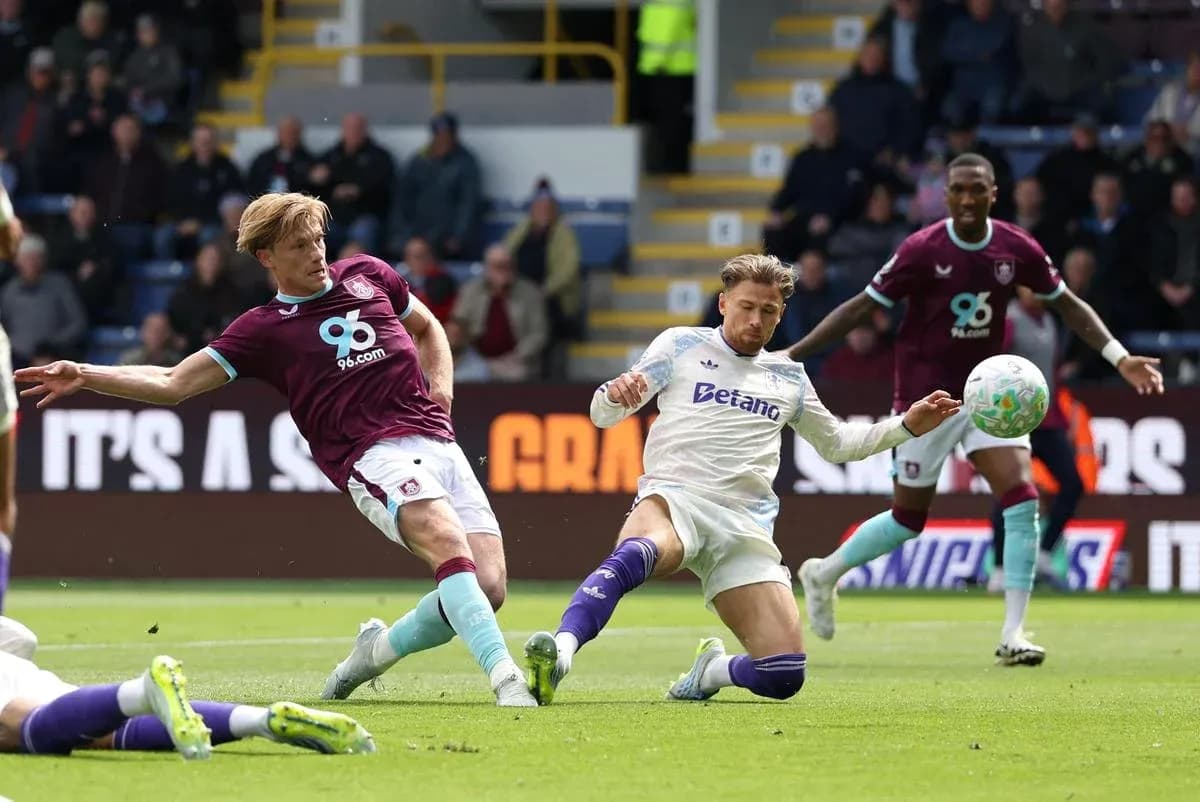
Burnley and Aston Villa shared a 2-2 draw at Turf Moor in Round 36 of the Premier League, a match that split neatly between Burnley’s vertical, transition-heavy approach and Villa’s territorial dominance. The scoreline mirrored the underlying numbers: Burnley’s 1.77 xG against Villa’s 1.42 suggested the hosts carved out slightly higher-quality chances despite having only 34% possession, while Villa’s control of the ball and territory never fully translated into a decisive attacking edge.
Executive Summary
Burnley, under Mike Jackson in a 4-2-3-1, built their game around compactness, quick counters and the creative influence of their three attacking midfielders behind Zian Flemming. Aston Villa, also in a 4-2-3-1 under Unai Emery, leaned on a heavy-possession structure with Youri Tielemans and Victor Lindelöf as the double pivot and Ross Barkley as the central link. The match narrative was defined by Villa’s methodical occupation of Burnley’s half versus Burnley’s direct exploitation of space behind Villa’s full-backs. Both goalkeepers finished with negative goals-prevented (-0.16 each), underscoring that the finishing slightly outstripped the shot-stopping on the day.
Scoring Sequence & Disciplinary Log
The events unfolded as follows, in strict chronological order.
Goals and VAR:
- 8' Jaidon Anthony (Burnley) — Normal Goal. Anthony struck early, capitalising on Burnley’s aggressive use of their wide midfielders.
- 40' A potential goal by Ollie Watkins (Aston Villa) was disallowed by VAR. This incident underlined Burnley’s vulnerability to direct runs but spared them on the scoreboard.
- 42' Ross Barkley (Aston Villa) — Normal Goal, assisted by John McGinn. Barkley’s late-arriving run from midfield punished Burnley’s block just before the break.
- 56' Ollie Watkins (Aston Villa) — Normal Goal, assisted by Emiliano Martínez. A direct connection from goalkeeper to striker exposed Burnley’s high defensive line.
- 58' Zian Flemming (Burnley) — Normal Goal, assisted by Hannibal Mejbri. Burnley hit back almost immediately through a vertical combination between the No. 10 and the advanced midfielder.
Disciplinary log (card verification: Burnley 1, Aston Villa 1, Total 2):
- 49' Tyrone Mings (Aston Villa) — Foul
- 60' Zian Flemming (Burnley) — Persistent fouling
Substitutions followed as both coaches adjusted:
- 69' Lyle Foster (IN) came on for Hannibal Mejbri (OUT) for Burnley.
- 74' Lucas Digne (IN) came on for Ian Maatsen (OUT) for Aston Villa.
- 74' Emiliano Buendía (IN) came on for Victor Lindelöf (OUT) for Aston Villa.
- 79' Josh Laurent (IN) came on for Lesley Ugochukwu (OUT) for Burnley.
- 79' Zeki Amdouni (IN) came on for Zian Flemming (OUT) for Burnley.
- 80' Douglas Luiz (IN) came on for Ross Barkley (OUT) for Aston Villa.
- 80' Lamare Bogarde (IN) came on for Matty Cash (OUT) for Aston Villa.
- 85' Leon Bailey (IN) came on for John McGinn (OUT) for Aston Villa.
- 87' James Ward-Prowse (IN) came on for Florentino Luís (OUT) for Burnley.
- 87' Jacob Bruun Larsen (IN) came on for Jaidon Anthony (OUT) for Burnley.
At half-time, the score was Burnley 1-1 Aston Villa, reflecting Anthony’s opener and Barkley’s equaliser.
Tactical Breakdown & Personnel
Burnley’s 4-2-3-1 was clearly built to compress space centrally and spring forward. The back four of Kyle Walker, Axel Tuanzebe, Maxime Estève and Lucas Pires sat relatively narrow, inviting Villa to play in front of them. In front, Florentino Luís and Lesley Ugochukwu formed a double pivot tasked with screening Barkley and McGinn’s half-space movements. The attacking trio of Loum Tchaouna, Hannibal Mejbri and Jaidon Anthony operated aggressively between the lines, with Anthony in particular driving at Ian Maatsen and exploiting the left channel, as evidenced by his early goal.
Zian Flemming, as the lone forward, played more as a second striker/10 hybrid, dropping to link and then surging into the box late — his 58' goal, assisted by Mejbri, was a textbook example of Burnley’s plan: win second balls, find the advanced midfielder quickly, and then exploit the disorganised Villa back line.
Aston Villa’s 4-2-3-1 was more orthodox in possession. Matty Cash and Maatsen pushed high, with Lindelöf and Tielemans responsible for rest defence and circulation. Villa’s 66% possession, 510 passes and 439 accurate (86%) show how effectively they recycled the ball, especially via Tielemans’ metronomic role. Barkley, positioned between Burnley’s lines, repeatedly sought overloads with McGinn on the right and Morgan Rogers on the left, dragging Burnley’s pivots out of shape. The 42' goal came from precisely this: McGinn finding Barkley breaking beyond the midfield shield.
Ollie Watkins was central to Villa’s vertical threat. His disallowed effort at 40' and his 56' goal both came from direct, aggressive runs into the space behind Burnley’s defence. The assist from Emiliano Martínez for the 56' strike highlighted Villa’s willingness to bypass the build-up entirely when Burnley’s line crept too high.
Defensively, Burnley’s foul count (17 vs Villa’s 8) and Flemming’s yellow card for “Persistent fouling” reflected a strategy of tactical disruption. Flemming worked back to harry Villa’s build-up, and his repeated infringements eventually drew the booking. Mings’ yellow card for “Foul” at 49' was symptomatic of Villa’s occasional difficulty dealing with Burnley’s quick counters, especially when the hosts transitioned through Anthony or Mejbri.
The substitution pattern reinforced the tactical themes. Jackson’s introduction of Lyle Foster and later Zeki Amdouni and Jacob Bruun Larsen refreshed Burnley’s front line to maintain a counter-attacking threat. James Ward-Prowse for Florentino Luís at 87' added a more progressive passer in the pivot, aiming for late control and set-piece quality. Emery’s changes — Digne for Maatsen, Buendía for Lindelöf, Douglas Luiz for Barkley, Bogarde for Cash, and Bailey for McGinn — gradually shifted Villa towards a more attacking, risk-tolerant shape, effectively morphing the double pivot and adding dribblers between the lines. Yet Burnley’s compact block and willingness to foul limited the payoff.
Goalkeeper reality was finely balanced. Max Weiss made 5 saves for Burnley; Emiliano Martínez made 4 for Villa. With both keepers posting -0.16 in goals prevented, the data suggests each conceded slightly more than an average keeper might from the shots faced. Weiss faced more on-target attempts (7 for Villa vs 6 for Burnley), consistent with Villa’s territorial dominance, while Martínez had to deal with fewer but often clearer Burnley chances, as reflected in Burnley’s higher xG.
The Statistical Verdict
The statistical profile underlines a classic stylistic clash. Villa’s 66% possession and 510 passes, 439 accurate (86%), speak to a side in control of the ball and tempo. Burnley’s 34% possession and 255 passes, 186 accurate (73%), show a team comfortable ceding control in favour of verticality and moments. Shot volume followed a similar pattern: Villa led in Total Shots (18 to 15) and Shots on Goal (7 to 6), and generated more corners (8 to 2), consistent with their sustained pressure.
Yet xG tilting slightly Burnley’s way (1.77 vs 1.42) suggests the hosts crafted the better-quality looks, especially in transition. The foul count — Burnley 17, Villa 8 — and the even card tally (1 and 1) show Burnley’s readiness to disrupt and Villa’s relatively clean defensive work outside of Mings’ isolated booking. With both goalkeepers marginally underperforming their expected shot-stopping, the 2-2 scoreline emerges as a fair equilibrium between Villa’s structural dominance and Burnley’s incisive counter-attacking execution.