Brighton Dominates Wolves 3–0 in Premier League Clash
Brighton dismantled Wolves 3–0 at the Amex Stadium in Premier League Round 36, a performance built on aggressive early pressing, wide overloads and secure ball circulation. Fabian Hurzeler’s side were 2–0 up inside five minutes through Jack Hinshelwood and Lewis Dunk, then controlled the rhythm with 72% possession and a 14–5 shot advantage. Wolves, under Rob Edwards, never solved Brighton’s structural dominance in midfield and wide areas, and a late Yankuba Minteh strike sealed a win that was far more comfortable tactically than the xG (1.62 vs 0.49) might suggest.
First Half
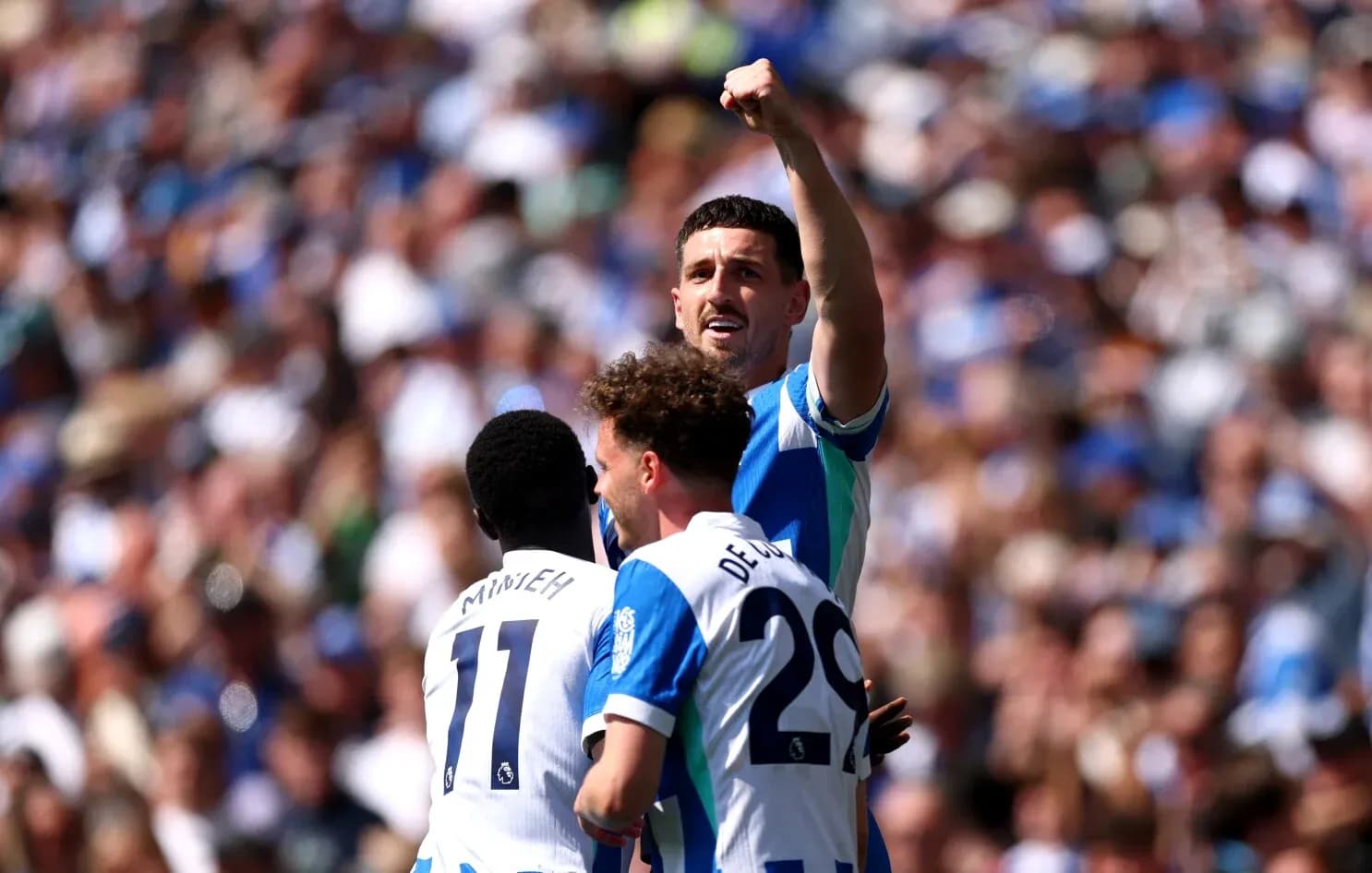
The scoring opened at 1' when Jack Hinshelwood arrived from midfield to finish a move created by left-back Maxim De Cuyper, immediately signalling Brighton’s intent to attack through advanced full-backs and underlapping runners. At 5', Lewis Dunk doubled the lead, again from a De Cuyper delivery, underlining how Wolves struggled to defend Brighton’s set patterns from the left side and their aerial threat from the back.
Discipline
Discipline was limited but clear in pattern. The full card log, in chronological order:
- 24' Kaoru Mitoma (Brighton) — Foul
- 49' Hwang Hee-chan (Wolves) — Foul
- 68' André (Wolves) — Foul
Brighton: 1, Wolves: 2, Total: 3.
Mitoma’s booking at 24' came as Wolves tried to counter into the space behind Brighton’s advanced line, highlighting the risk in Hurzeler’s high-possession approach. Hwang’s yellow at 49' and André’s at 68' reflected Wolves’ increasing frustration as they chased the ball and arrived late into duels.
Substitutions
Substitutions followed the game’s tactical arc. At 46', David Møller Wolfe (IN) came on for Hugo Bueno (OUT), giving Wolves more defensive stability on the flank. Brighton’s first change at 58' was structurally significant: Joël Veltman (IN) for Kaoru Mitoma (OUT), shifting Brighton towards a more conservative right side while maintaining control. Wolves then doubled up their attacking refresh on 67' with Rodrigo Gomes (IN) for Pedro Lima (OUT) and Jean-Ricner Bellegarde (IN) for Mateus Mané (OUT), seeking more direct running and ball-carrying between the lines.
Brighton responded on 76' with a double switch to maintain midfield energy and pressing height: Yasin Ayari (IN) for Carlos Baleba (OUT) and Georginio Rutter (IN) for Danny Welbeck (OUT). The third goal on 86' came from Yankuba Minteh, finishing a move that typified Brighton’s late-game threat in transition and their ability to exploit tiring legs. In the closing minutes, Hurzeler rotated further: Charalampos Kostoulas (IN) for Jack Hinshelwood (OUT) and Solly March (IN) for Maxim De Cuyper (OUT) at 88', preserving structure while resting key contributors. Wolves’ final adjustments at 89' — Angel Gomes (IN) for Hwang Hee-chan (OUT) and Tolu Arokodare (IN) for João Gomes (OUT) — came too late to alter the tactical narrative.
Structural Analysis
Structurally, Brighton operated as a dominant possession side, even with the formation not explicitly listed. The passing numbers — 578 total passes at 86% accuracy versus Wolves’ 225 at 68% — show a clear positional-play model. De Cuyper’s two early assists illustrate how Hurzeler used the left-back as a high, creative outlet, with Mitoma occupying half-spaces to drag markers inside and open the flank. On the opposite side, Hinshelwood and Minteh alternated between wide and interior positions, creating a box around Wolves’ central midfield that they could not match numerically.
Carlos Baleba and Pascal Groß controlled the central corridor, recycling possession and locking Wolves into their own third. With Brighton taking 10 of their 14 shots from inside the box, their positional structure consistently generated high-quality zones, even if the raw xG (1.62) suggests some overperformance in finishing. Dunk and Jan Paul van Hecke were rarely stretched; Wolves managed just one shot on target and only four inside the box, indicating that Brighton’s rest-defense — the positions they held behind the ball when attacking — was well calibrated.
Pressing and Defensive Strategy
Out of possession, Brighton’s press was organised rather than frantic. Welbeck led the line, screening passes into André and João Gomes, while the wingers jumped to Wolves’ full-backs. The 9–11 foul count shows Brighton did not need to foul aggressively to regain the ball; their structure and counter-pressing traps sufficed. Mitoma’s solitary booking was more an individual correction than a systemic flaw.
For Wolves, the 28% possession and 5 total shots reflect a game spent largely in a mid-to-low block, unable to progress cleanly. Their 3 offsides point to attempts at direct runs in behind rather than sustained build-up. Daniel Bentley’s 3 saves versus Bart Verbruggen’s 1 underline how much more frequently Wolves’ defensive line was exposed to final actions. The fact that both goalkeepers are credited with 0.25 goals prevented suggests that while each made at least one important intervention, the broader difference lay in volume of threat rather than shot-stopping heroics.
Statistical Overview
Statistically, Brighton’s 7 corners to Wolves’ 1 further confirm territorial dominance. The shot profile — 6 on target from 14 attempts versus Wolves’ 1 from 5 — aligns tightly with the xG gap (1.62 vs 0.49): Brighton created more and better chances, and their early execution forced Wolves into a reactive game state from which they never recovered.
In season-context terms, this performance would rate highly on both Overall Form and Defensive Index for Brighton: a clean sheet with minimal chances conceded, strong possession control, and efficient finishing. Wolves’ numbers, by contrast, resemble an away side overrun by a superior structure: low pass accuracy, limited box entries, and growing disciplinary strain as they chased shadows. The data and the flow of events align: this was a tactically one-sided 3–0, driven by Brighton’s control of width, rest-defense, and tempo from the opening minute.