
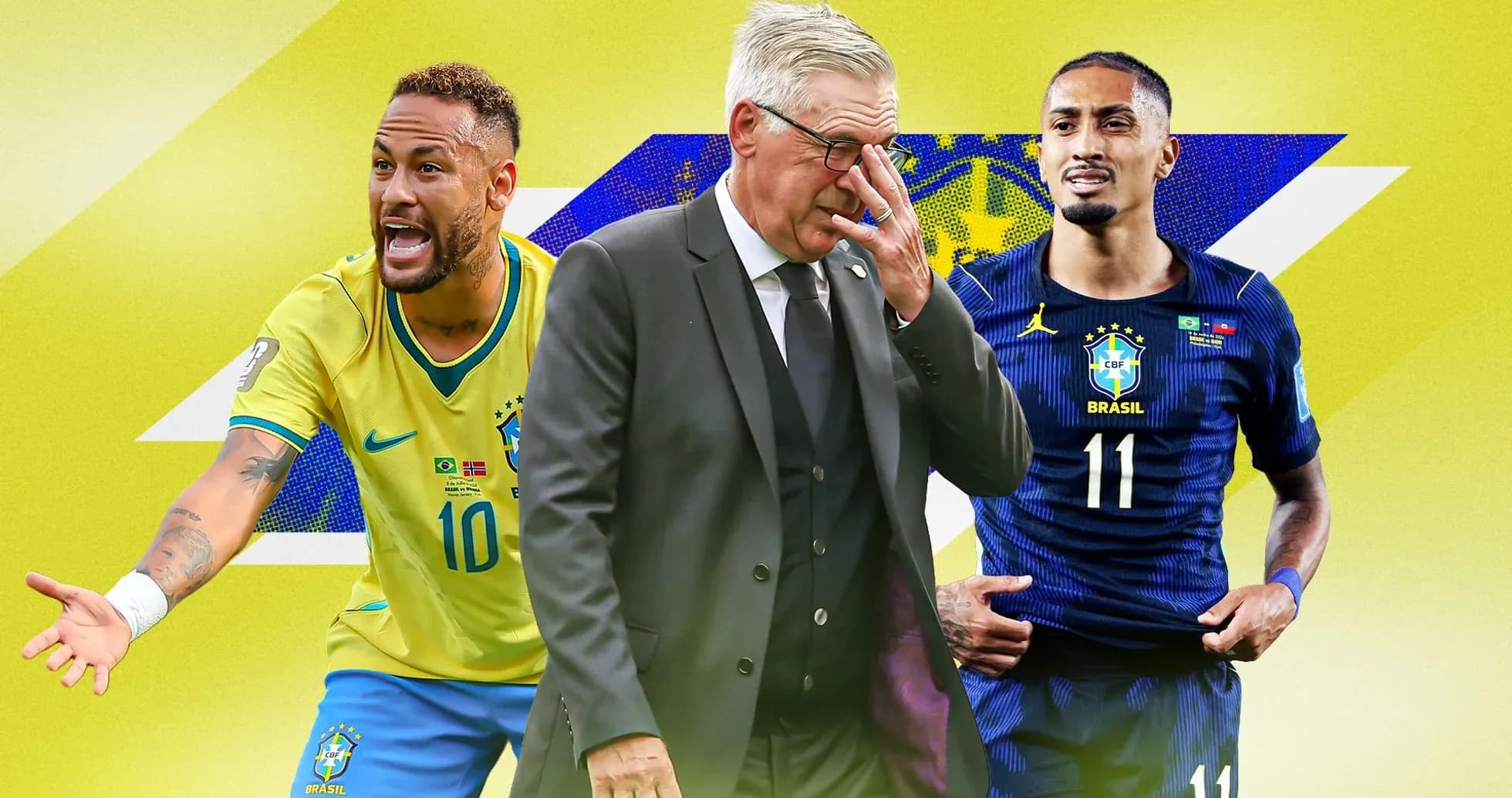
Brazil’s World Cup Collapse: Ancelotti’s Choices and Neymar’s Impact
For Brazil, this World Cup was supposed to be a bridge between eras. Instead, it became a grim snapshot of a giant stuck between the past and a future that still hasn’t properly arrived.
Carlo Ancelotti walked into the tournament with a squad that looked more like a testimonial guest list than the backbone of a modern contender. The warning signs were there in the call-ups alone.
An ageing core, a tired idea
Brazil arrived with three goalkeepers aged 33, 32 and 38. The defenders? An average age of 31, anchored by Danilo and Alex Sandro – names that once carried the weight of Juventus but now feel like echoes from a different cycle of elite football.
In midfield, Ancelotti leaned again on 34-year-old Casemiro and 32-year-old Fabinho. Trusted lieutenants, yes. But also clear symbols of a coach clinging to familiarity in a landscape crying out for renewal.
There were glimmers of tomorrow. Bournemouth’s 19-year-old Rayan, Botafogo’s 25-year-old Danilo. Brief flashes, nothing more. Ancelotti admitted as much when the dust settled.
“We need some young talent, we need some high-level players coming into Brazilian football,” he said, insisting the core remained “very solid” but openly calling for “new players that can come in.”
The message was clear: this was a squad patched together from what he trusted, not what the future demanded.
Neymar: the recalled idol who never really returned
Hovering over everything was Neymar. His selection dominated the build-up, his presence shaping the entire narrative long before a ball was kicked.
At 34, with his last cap in October 2023 and a body that has taken more punishment than most, his recall was a gamble fuelled by public pressure and nostalgia. Ancelotti bowed to it.
The outcome was painfully predictable.
On the eve of the World Cup, Neymar suffered a calf injury. Two to three weeks out, the medical bulletin said. He missed Brazil’s first two group games, then appeared for just 14 minutes against Scotland in Miami – a cameo that felt more like a farewell lap than the rebirth of a national icon.
He was off the pace, off the rhythm, and off the plan.
Ancelotti didn’t turn to him at all in the dramatic last-32 win over Japan. Chasing the game against Norway in the round of 16, he finally sent Neymar on, and the forward did what he has always done: he scored. A late penalty, a consolation. A goal that changed nothing and yet underlined everything. This was almost certainly his international swansong, reduced to a footnote.
In that context, one decision becomes even harder to defend.
The Joao Pedro omission that won’t go away
Neymar’s fragility and lack of impact cast a harsh light on the decision to leave Joao Pedro at home. The Chelsea forward, 24, had just delivered 29 combined goals and assists in his debut season at Stamford Bridge. Versatile, sharp, and in form, he looked tailor-made for a tournament that was always going to demand fresh legs and variety in attack.
It had reached the stage where most observers simply assumed Pedro would not only travel but potentially start as Brazil’s No.9. Ancelotti himself admitted the striker “probably deserved to be on this list.”
He wasn’t.
As Brazil crashed out and the inquest began, the omission quickly became one of the central charges against the coach.
“I have to be honest, I think this elimination begins with the decisions from the bench,” Ronaldo Nazario said pointedly. “I still don’t understand why Joao Pedro was not part of this squad. He has had an exceptional season, he is in form, and Brazil needed a striker who could offer something different.”
In a tournament where Neymar limped, literally and figuratively, through the margins, the absence of a fit, in-form forward like Pedro will be revisited again and again.
A midfield asked to do everything – and left alone
The flaws in selection were most brutally exposed in midfield. Brazil’s engine room simply didn’t have enough fuel.
Ancelotti initially named just five central midfielders, one of them Lucas Paqueta, who is more of a No.10 than a traditional central presence. Only later, when right-back Wesley was injured, did Manchester United-bound Ederson join the group.
The burden fell heavily on Bruno Guimaraes. The Newcastle captain was asked to create, to cover ground, to lead. He responded with four assists and an immense workload, but he couldn’t do it all. Not at this level. Not alone.
Ederson and Danilo were largely spectators, trusted only for scraps of minutes from the bench. The message from the dugout was unmistakable: Ancelotti didn’t truly believe in his alternatives.
After the defeat to Norway, the Italian didn’t hide where he thought the structural weakness lay.
“We have to think about the future, but it is very evident that in the midfield, I think that we have to move some players,” he said. A polite way of saying the current mix isn’t good enough.
One moment in particular will haunt this group.
The penalty that changed everything
Against Norway, with the game still balanced and Brazil seemingly in control, they earned a first-half penalty. This was the kind of moment that defines tournaments, the kind of moment that usually finds its way to a superstar.
Vinicius, the country’s leading scorer at the tournament and their most dangerous player, seemed the natural choice. The stadium, the watching world, expected him to step forward.
He didn’t.
Instead, Bruno Guimaraes placed the ball on the spot. His effort was saved. Brazil later fell behind and never recovered.
The decision wasn’t about instinct or hierarchy. It was about numbers.
“We did statistics for the players and according to that, Raphinha was the best option,” Ancelotti explained afterwards. “The best person would be Raphinha and then Neymar [who weren’t on the pitch], and after that, Bruno Guimaraes. After Bruno, it would be [Gabriel] Martinelli, so we chose Bruno Guimaraes as we felt he would be the best.”
Cold data in a hot moment. A process-driven call in a sport that still often belongs to the bravest, not the most efficient. The miss didn’t lose Brazil the World Cup on its own, but it crystallised the feeling that this team was being steered by a logic that didn’t quite fit the chaos of knockout football.
Injuries and excuses – and where they stop
Ancelotti is entitled to point to the context. Brazil’s squad was badly hit before a ball was kicked.
Eder Militao was out. Rodrygo was out. Estevao Willian, a teenage sensation tipped as a potential game-changer, was also unavailable. That meant no first-choice right-back and two missing wide players who could have transformed tight games.
The blows kept coming once the tournament started.
Neymar’s calf problem was the headline, but two more key figures followed him onto the treatment table. Raphinha pulled up with a hamstring injury in the first half against Haiti in the second group game and never returned. Paqueta, so often the creative connector, was forced off at half-time in the knockout tie with Japan.
By the time Norway arrived, Brazil were short of ideas, short of legs, and short of high-level options. Ancelotti can argue that no coach in the world could lose that many difference-makers and emerge unscathed.
He is right to a point. But only to a point.
Because the age profile, the conservative squad, the reliance on veterans, the omission of Joao Pedro, the limited trust in midfield depth – those were choices, not misfortunes.
Ancelotti’s “new cycle” and Brazil’s hard questions
For Ancelotti, this failure is being framed as a beginning rather than an end.
“A defeat is the beginning of a new adventure,” he said. “We have to keep improving, to find new ideas. It is not an end, it is the start of a new cycle.
“We will manage this defeat by bringing a fresh impetus to our work and the assessment of the players. We will try to improve and look for new ideas. The same as we did this year.
“I think the work we've done has been good. Football is like this; sometimes you have to manage the sadness of a defeat. I am used to this.”
He is right about one thing: this is the start of a long road back. But Brazil can’t afford for that road to be paved with the same caution that defined this campaign.
The next cycle will demand exactly what this World Cup exposed: younger legs, braver selections, a midfield rebuilt around energy and invention, and a willingness to trust the next Joao Pedro before it’s too late.
The question now is not whether Brazil can rise again. History says they always do.
The question is whether Ancelotti will truly let go of the past to get them there.



