
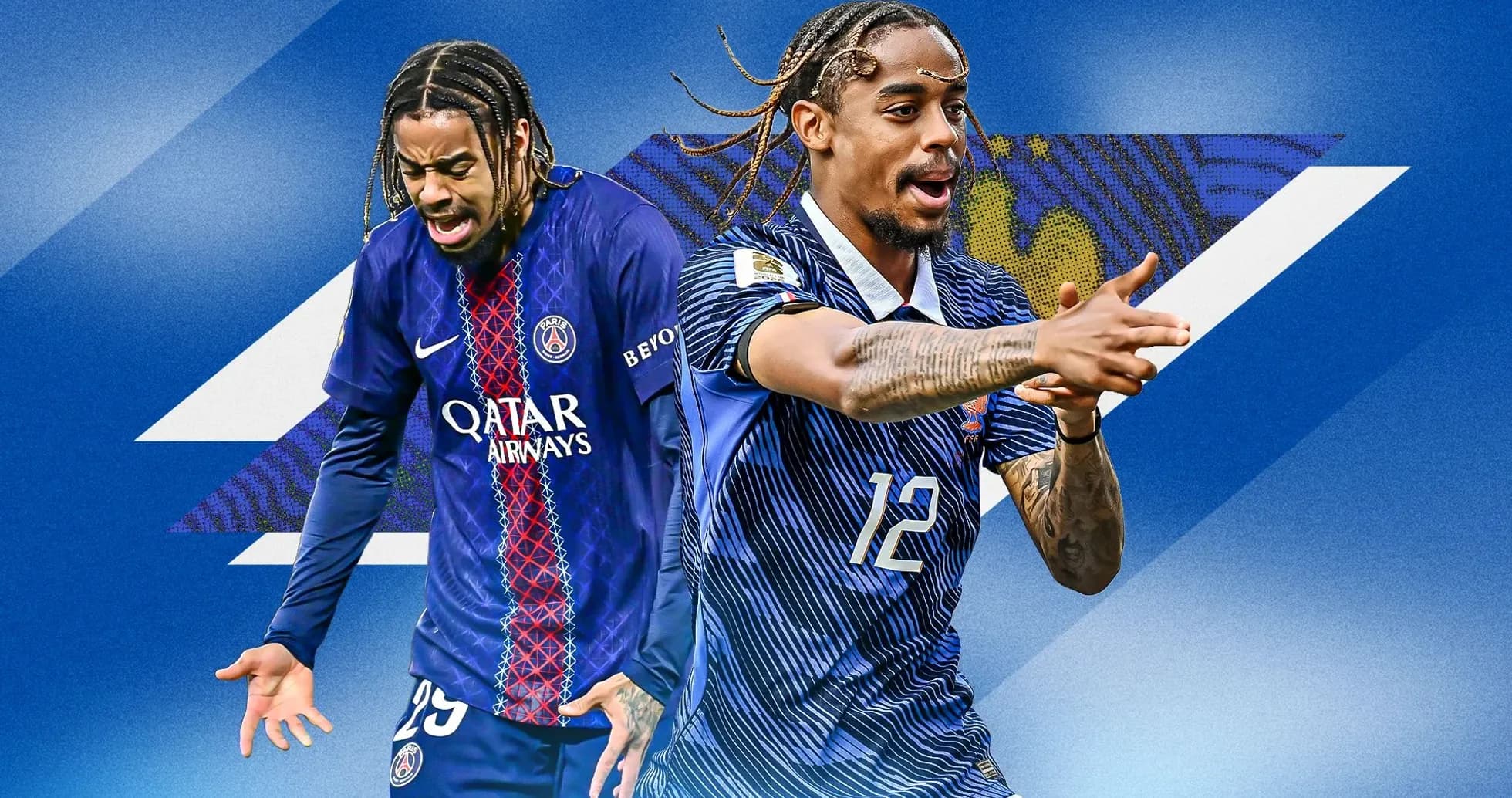
Bradley Barcola's PSG Future in Question Amidst Rising Competition
Bradley Barcola was supposed to be past this stage by now.
Three years on from swapping Lyon for the Parisian spotlight, the expectation was clear: nailed-on starter, poster boy of the post-Kylian Mbappé era, a winger around whom PSG would build. Instead, he finds himself glancing over his shoulder at the Parc des Princes, fighting for minutes, and wondering if his future lies somewhere very far from the French capital.
From rising star to rotation piece
On paper, Barcola’s rise has been anything but slow. His first season in Paris brought 14 goal contributions and the sense that PSG had unearthed another gem. Then came the summer of 2024, Mbappé walked out, and the left flank became the most scrutinised piece of real estate in European football.
PSG’s response was ruthless. Desire Doué arrived to add more youth and flair. Then, in January 2025, the club dropped a bomb on Barcola’s ambitions: Khvicha Kvaratskhelia, one of the most devastating wide forwards in the game, walked through the door.
Barcola didn’t shrink. He exploded.
The 2024-25 campaign was statistically outrageous: 21 goals and 21 assists. Those are superstar numbers. Yet when the season reached its sharp end, he kept finding himself on the wrong side of Luis Enrique’s big-game decisions. The Champions League final against Inter? Overlooked. Across the campaign, he rarely saw out 90 minutes when he did start. The message was subtle but unmistakable: productive, yes. Indispensable, no.
The following season hit harder. In 2025-26, his output dipped to 13 goals and seven assists. Luis Enrique rotated heavily in Ligue 1 to protect his core for Europe, and Barcola discovered he wasn’t in that inner circle. He did not start in the quarter-finals, semi-finals or final of another Champions League-winning run. In the league, he watched the marquee fixtures against Lyon and Monaco from the bench, unused.
For a player who believed he was climbing towards elite status, the ceiling suddenly felt a lot lower.
A World Cup in flashes, not full glare
The same pattern has followed him onto the international stage.
At 23, Barcola might have imagined himself as France’s undisputed first choice on the left. Instead, his national-team career has been a patchwork of cameos and auditions, and this World Cup has done little to change that.
He did not start the opener against Senegal, one of Africa’s heavyweights. He came on, though, and within two minutes delivered: a decisive goal, a game turned by a substitute who refused to treat the occasion like a consolation prize. That impact earned him a start against Iraq. This was the chance to seize the shirt. He didn’t. The performance lacked edge, and Didier Deschamps sent him back to the bench for the final group game against Norway.
Again, he came alive as a substitute. With 25 minutes left, he stepped on and swung in a precise cross for Doué’s late header, adding a sheen to the scoreline and another line to his case file as a game-changer rather than a game-owner.
Deschamps handed him another start in the last-32 tie against Sweden. Barcola responded with a sharp second-half finish, capitalising on a virtuoso display from Michael Olise. He finally kept his place for the round of 16 against Paraguay, a snarling, ill-tempered 1-0 win. This time, he vanished. Anonymous in a game that cried out for someone to grab it, he may once again pay the price when Deschamps selects his XI for the quarter-final against Morocco.
He is present, decisive in moments, but never quite secure. The story of his PSG life, retold on the global stage.
Contract standstill and a shifting PSG stance
All of this is unfolding while his club future hangs in the air.
Barcola’s deal runs until 2028, yet talks over an extension have stalled. The issue is not money; it’s hierarchy. He wants clarity on his role, on whether he is central to PSG’s plans or just another high-value asset in a squad of stars. Right now, the answer feels uncomfortably close to the latter.
Earlier this summer, PSG’s line was uncompromising. He was not for sale. The club valued him at a figure “much higher” than the £116 million Manchester City paid Nottingham Forest for Elliot Anderson, according to The Athletic. The message: this is not a player you can simply pick off.
Then the mood changed.
On his YouTube channel, transfer specialist Fabrizio Romano captured the shift: “Until last week, Barcola was untouchable; now I see him linked to several clubs. The reality is that Barcola is not untouchable. Barcola has serious possibilities to leave Paris in the summer transfer window.”
What changed? The market did.
Diomande, the new obsession
PSG have locked onto one of the breakout stars of 2025-26: Diomande of RB Leipzig and Ivory Coast. Liverpool had been widely reported as frontrunners for the 19-year-old, with a deal around €100m on the table. But the teenager’s preference has tilted the axis. He wants Paris. He believes Luis Enrique’s project offers his best shot at trophies and, potentially, the Ballon d’Or.
Leipzig, sensing the demand, have set a brutal price: around €130m. Even for PSG, that number bites. They have already moved Gonçalo Ramos to AC Milan and are set to send Lee Kang-in to Atletico Madrid. To go all-in on Diomande, they may need another significant outgoing. Barcola, watching yet another left-sided star being lined up, can see where this is heading.
If Diomande arrives, the queue for minutes grows longer. The risk of becoming a luxury substitute grows with it. For a 23-year-old who has already spent too long in that role, the idea of staying put becomes harder to justify.
Liverpool’s opening
Ironically, Liverpool missing out on Diomande could end up suiting everyone.
With Mohamed Salah gone, Anfield needs a new attacking reference point, a player with both star wattage and Champions League pedigree. The club has already brought in Victor Muñoz and must carefully manage the development of prodigy Rio Ngumoha, who does not turn 18 until the end of August. They need someone who can step in immediately, absorb pressure, and carry responsibility.
Barcola fits that profile. In Merseyside, he would not be the third option on a flank or a tactical luxury. He would walk into a dressing room expecting him to start. Andoni Iraola’s high-energy, front-foot football looks tailored to his skill set: aggressive running, direct dribbling, and an eye for the final ball.
Liverpool also need a statement. A superstar signing to ease the sting of Salah’s departure and signal that this is evolution, not decline. Compared to Diomande, Barcola brings something vital: proof. He has been in the Champions League for years, contributing at the sharp end of the competition. The leap to Anfield would be significant, but not speculative.
For PSG, a big fee for a player who no longer feels central could unlock Diomande and refresh their attack. For Barcola, it would be a reset, not a step down.
“Honestly, I don’t know”
If there was any doubt that a move is on his mind, Barcola removed it with a few simple words at the World Cup.
“Right now, I’m really focused on the World Cup,” he said before France faced Paraguay. “But regarding what happens afterward, honestly, I don’t know at the moment.”
No declarations of loyalty. No insistence that Paris is home. Just uncertainty, laid bare.
The equation is stark. Diomande’s likely arrival threatens to nudge him even further towards the periphery at PSG. His status with France remains fragile, dependent on bursts from the bench rather than guaranteed starts. His contract clock is ticking, and his value is peaking.
Barcola does not just need minutes. He needs a team willing to build around him, not over him. Whether that stage is Anfield or somewhere else, the time for waiting his turn in Paris is over.



