Bournemouth vs Manchester City: A Tactical Analysis of the 1–1 Draw
The Vitality Stadium under late‑season floodlights can make even giants feel small. Following this result, a 1–1 draw that felt like a statement, Bournemouth walk off level on the night but with their season’s story subtly rewritten: from plucky survivors to a Europa League contender capable of going toe‑to‑toe with a title challenger.
Heading into this game, the table said enough about the mismatch. Bournemouth sat 6th on 56 points, Manchester City 2nd on 78. Overall, Bournemouth’s goal difference of 4 (57 scored, 53 conceded) hinted at balance edged by chaos; City’s 43 (76 for, 33 against) spoke of domination. Yet over 90 minutes, the gap narrowed to the width of a single goal and a series of small tactical wins.
I. The Big Picture – Structures and Season DNA
Andoni Iraola stayed faithful to his seasonal blueprint, rolling out Bournemouth in a 4‑2‑3‑1 – the shape they have used in 35 of 37 league matches. The back four of A. Smith, J. Hill, M. Senesi and A. Truffert protected D. Petrovic, with T. Adams and A. Scott as the double pivot. Ahead of them, the fluid line of three – Rayan, E. J. Kroupi and M. Tavernier – worked around lone forward Evanilson.
This mirrored Bournemouth’s broader identity: at home this season they have played 19 times, winning 7, drawing 10 and losing only 2. They average 1.5 goals for and concede 1.1 at the Vitality Stadium, a profile of a side that rarely gets blown away and almost always finds a foothold.
Pep Guardiola answered with a familiar but subtly tweaked 4‑1‑4‑1, one of City’s most‑used structures this campaign. G. Donnarumma started behind a back four of M. Nunes, A. Khusanov, M. Guehi and N. O’Reilly, with Rodri as the single pivot. The advanced line of four – A. Semenyo, Bernardo Silva, M. Kovacic and J. Doku – orbited around E. Haaland.
City’s season numbers underpinned their authority: overall they average 2.1 goals for and 0.9 against, with their away profile still imposing at 1.7 scored and 1.1 conceded. But Bournemouth’s home resilience and City’s occasional away flatness (4 defeats on their travels) set the stage for a more even contest than the league table alone suggested.
II. Tactical Voids – Suspensions and Discipline
Bournemouth entered this fixture with a notable hole in their rotation. R. Christie, one of the league’s leading red‑card recipients, was out through suspension after his dismissal. Álex Jiménez, another disciplinary hotspot with 10 yellow cards this season, was also suspended. For a side that leans into intensity, losing two of its most combative profiles forced Iraola to adjust the emotional temperature of his midfield and right flank.
That absence elevated the importance of T. Adams and A. Scott as the primary screeners. Without Jiménez’s aggressive front‑foot defending on the flank, Smith and Hill had to be more conservative in their duels, focusing on positional discipline rather than constant pressure.
Discipline has been a season‑long subplot for both clubs. Bournemouth’s yellow‑card distribution shows a late‑game spike: 26.44% of their bookings arrive between 76–90 minutes, with another 21.84% in added time (91–105). City, too, see a surge in the 46–60 and 76–90 windows (both 19.70%). That shared tendency towards late‑game cards shaped the closing stages, where caution and game management edged out chaos.
III. Key Matchups – Hunter vs Shield, Engine Room Battles
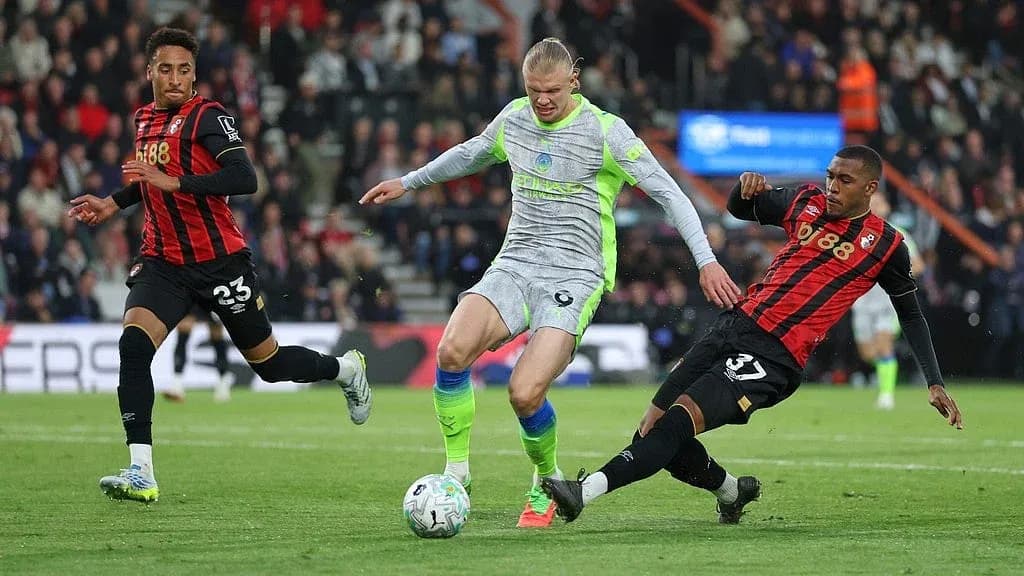
The headline duel was always going to be E. Haaland against Bournemouth’s defensive shield. Haaland arrived as the league’s most ruthless finisher: 27 goals and 8 assists in 35 appearances, backed by 102 shots (59 on target). He is not just a penalty‑box predator; he has also scored 3 penalties but missed 1, a reminder that even his ruthlessness has a human edge.
For Bournemouth, the central pairing of J. Hill and M. Senesi was tasked with compressing the space Haaland thrives in. Their job was helped by the double pivot in front of them. Adams, with his defensive instincts, and Scott, with his reading of passing lanes, formed a compact box around the Norwegian. The plan was clear: deny early service, force Haaland to receive with his back to goal and into traffic.
On the other side, Bournemouth’s own cutting edge came through E. J. Kroupi. Heading into this game, he had 13 league goals from 32 appearances, with 31 shots and 21 on target – a profile of a forward who shoots selectively but accurately. Operating as the central playmaker behind Evanilson, Kroupi tried to exploit the half‑spaces between City’s centre‑backs and full‑backs, especially when M. Nunes and N. O’Reilly stepped high.
The “engine room” confrontation was equally compelling. Rodri, City’s metronome, had to navigate the pressing triggers of Rayan and Tavernier, who curved their runs to block passing lanes into Kovacic and Bernardo Silva. Bernardo, one of the league’s leading yellow‑card recipients with 10 bookings, walked the tightrope between control and over‑commitment. His willingness to tackle – 49 tackles and 6 blocked shots this season – is both a tactical asset and a disciplinary risk, especially against a Bournemouth side that thrives in transition.
For City, the creative threat of R. Cherki and P. Foden waited on the bench, ready to reshape the narrative if Guardiola chose to alter the game’s rhythm. That depth contrasted with Bournemouth’s more linear bench options like J. Kluivert and E. Unal, who offered directness rather than structural reinvention.
IV. Statistical Prognosis – xG, Solidity and What the Draw Tells Us
While the raw xG numbers are not provided, the season‑long patterns offer a lens on this 1–1. Bournemouth’s overall scoring rate of 1.5 goals per match and concession rate of 1.4 suggest that holding City to a single goal is a defensive over‑performance relative to their norm. City, who average 2.1 goals overall and 1.7 away, were dragged down into Bournemouth’s tempo and shot profile.
Clean‑sheet data reinforces the point. Bournemouth have 11 clean sheets overall, 6 at home, but rarely against the very top. Limiting City to one goal sits at the upper end of their defensive capabilities. City, with 16 clean sheets (7 away), usually suffocate opponents; conceding here fits Bournemouth’s home scoring average almost perfectly.
Following this result, the numbers and the narrative converge: Bournemouth’s 4‑2‑3‑1, even shorn of Christie and Jiménez, proved structurally sound enough to blunt the league’s most feared striker and fluid enough to threaten on the break through Kroupi and Tavernier. City remain the more complete machine over 38 games, but on this night, under these lights, the gap shrank to a single goal and a shared point – and a reminder that tactical clarity can bend even the heaviest of statistical odds.