Bournemouth vs Manchester City Tactical Analysis: Draw Highlights
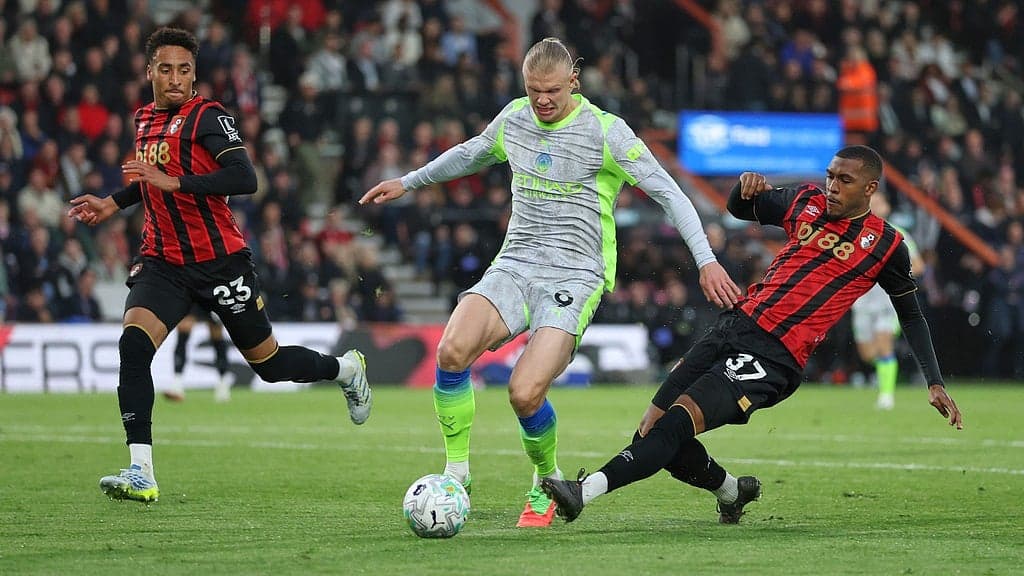
Bournemouth’s 1-1 draw with Manchester City at Vitality Stadium was a high-level tactical arm-wrestle in which Andoni Iraola’s 4-2-3-1 outperformed expectations against Pep Guardiola’s 4-1-4-1, both in chance quality and in defensive control for long stretches. Bournemouth led 1-0 at half-time and were within seconds of a statement win before Erling Haaland’s 90' equaliser salvaged a point for City. Underlying numbers underline how finely balanced it was: Bournemouth generated 1.99 xG to City’s 1.68, despite having only 45% possession and fewer total shots (10 vs 14). The game became increasingly fractious late on, with Bournemouth collecting four yellow cards to City’s one.
I. Executive Summary
Bournemouth set up in a compact 4-2-3-1, with D. Petrovic behind a back four of A. Smith, James Hill, M. Senesi and A. Truffert, screening double pivot T. Adams and A. Scott. Their plan was clear: mid-block, protect central spaces against Rodri and the City interior midfielders, then break quickly through E. J. Kroupi, Rayan, M. Tavernier and lone forward Evanilson. City’s 4-1-4-1 had Rodri anchoring behind a line of A. Semenyo, B. Silva, M. Kovacic and J. Doku, supporting Haaland.
Bournemouth’s structure proved immediately effective. They conceded territory but limited City’s clean central progress, forcing much of the visitors’ play into wide or crowded zones. Petrovic faced only five shots on target, making three saves, while Bournemouth blocked three efforts and allowed just 10 shots inside the box from City’s 14 total. On the ball, Bournemouth were tidy and deliberate: 431 passes, 346 accurate (80%), using Adams and Scott to play through City’s first line and then switching quickly to the flanks.
II. Scoring Sequence & Disciplinary Log
The discipline narrative started early. At 37', Tyler Adams (Bournemouth) received a yellow card — Argument — reflecting the competitive edge in midfield as Bournemouth tried to disrupt City’s rhythm. Two minutes later, they landed the first major tactical blow: at 39', E. J. Kroupi (Bournemouth) scored for the home side, assisted by A. Truffert. The goal encapsulated Bournemouth’s plan: win the ball, progress quickly down the left, and exploit the spaces behind City’s advanced full-backs and midfield line. Truffert’s involvement from left-back underlined Bournemouth’s willingness to commit their wide defenders in transition.
That 1-0 advantage held to half-time, with the score 1-0 at the break (Bournemouth 1-0 Manchester City).
In the second half, City sought to adjust their attacking structure and tempo. At 56', Pep Guardiola made a triple substitution to change the dynamics between the lines: P. Foden (IN) came on for M. Kovacic (OUT), R. Cherki (IN) came on for B. Silva (OUT), and Savinho (IN) came on for A. Semenyo (OUT). The intent was clear: more direct dribbling and creativity around the box, with Foden and Cherki offering sharper movements between Bournemouth’s lines.
Bournemouth’s defensive commitment ramped up, and it began to show in the card count. At 59', James Hill (Bournemouth) was booked — Foul — a product of aggressive defending as City tried to attack more directly through central channels.
As the game entered its final phase, both coaches leaned into their benches. At 76', J. Kluivert (IN) came on for E. J. Kroupi (OUT), a like-for-like swap intended to refresh Bournemouth’s counter-attacking threat. Simultaneously, O. Marmoush (IN) came on for J. Doku (OUT) for City, adding a different profile of forward movement from the left.
At 84', D. Brooks (IN) came on for Rayan (OUT), and at 89', E. Unal (IN) came on for Evanilson (OUT), signalling Bournemouth’s desire to hold the ball higher up and relieve pressure with fresh legs in attack. City’s pressure and the game’s intensity increased, and tempers flared in added time.
The late disciplinary sequence was dense. At 90+3', Justin Kluivert (Bournemouth) was shown a yellow card — Argument — reflecting the emotional stakes as Bournemouth tried to protect their lead. In the same minute, Rodri (Manchester City) was booked — Argument — as confrontations spread into midfield. At 90', L. Cook (IN) came on for A. Smith (OUT), a defensive-minded substitution to reinforce Bournemouth’s structure on the right side. Finally, at 90+6', Adrien Truffert (Bournemouth) received a yellow card — Foul — as Bournemouth continued to commit to last-ditch defending.
Crucially, the equaliser arrived just before that last card: at 90', Erling Haaland (Manchester City) scored, unassisted, to make it Bournemouth 1-1 Manchester City. The timing underscores how close Bournemouth came to closing out a near-perfect defensive display.
Card totals, locked to the event log, were: Bournemouth 4, Manchester City 1, Total 5.
III. Tactical Breakdown & Personnel
Bournemouth’s 4-2-3-1 was built on compactness and intelligent pressing triggers. Adams and Scott screened passing lanes into Haaland and City’s advanced midfielders, often allowing Rodri to have the ball but cutting off his vertical options. This forced City into more lateral circulation and crosses, which suited Bournemouth’s central defenders, Senesi and Hill, who could defend the box with numbers.
On the flanks, A. Smith and Truffert balanced aggression with restraint. Truffert’s assist for Kroupi’s goal highlighted his licence to advance when Bournemouth broke the first press, but his late yellow for Foul also showed the physical demands of repeatedly stepping out to meet wide attacks. Bournemouth’s wingers, Rayan and Tavernier, worked back diligently to create a 4-4-1-1 shape without the ball, squeezing space between lines and protecting full-backs.
In possession, Bournemouth were more than just reactive. Their 431 passes, 346 accurate (80%), indicate a willingness to play through City rather than simply clear long. Adams’ early yellow for Argument did not deter him from remaining central to their build-up, dropping between centre-backs at times to create a back three in possession and open passing lanes to Scott and the attacking midfield trio. With 7 corner kicks to City’s 6, Bournemouth also created a steady stream of set-piece situations, a key part of their attacking plan given City’s usual dominance in open play.
City’s 4-1-4-1 had Rodri as the single pivot, but Bournemouth’s mid-block often left him as the free man, trusting their second line to screen passes into B. Silva and Kovacic. Haaland, isolated for stretches, depended heavily on wide service and late midfield runs. City’s 527 passes, 458 accurate (87%), and 55% possession reflected their territorial control, but Bournemouth’s shape ensured much of that circulation was in less dangerous zones.
Guardiola’s triple change on 56' was a major tactical pivot. Introducing Foden and Cherki for Kovacic and B. Silva shifted City towards a more dribble-heavy, half-space focused attack, with Savinho’s arrival for Semenyo adding verticality and 1v1 threat on the flank. This increased the volume of attacks around Bournemouth’s box, but Petrovic, who recorded 3 saves and 0.29 goals prevented, held firm until Haaland’s late strike.
Iraola’s response through substitutions was primarily about energy and defensive focus. Kluivert for Kroupi and Brooks for Rayan kept Bournemouth’s wide defensive work-rate high, while Unal for Evanilson and later L. Cook for A. Smith suggested a shift towards holding the ball in safer areas and shoring up the right side. The cluster of Bournemouth yellows in the final minutes shows how much strain the defensive unit was under as City pushed for the equaliser.
IV. The Statistical Verdict
The statistical profile reinforces that this was not a smash-and-grab by Bournemouth. Their 1.99 xG slightly exceeded City’s 1.68, indicating that the quality of chances they created, particularly around Kroupi’s goal and subsequent transitions, was at least on par with the champions’ opportunities. Bournemouth’s 10 shots (2 on target) from 6 inside the box and 4 outside show a measured approach: they did not shoot on sight, but worked for higher-value situations.
City’s 14 shots, 5 on target, with 10 inside the box, reflect sustained territorial pressure, especially after the 56' substitutions. However, Bournemouth’s 3 blocked shots and compact box defending meant that many of City’s efforts were contested. The identical goals prevented figures for both goalkeepers (0.29 each) underline that neither side was bailed out by extraordinary keeping; rather, the defensive structures in front of them did much of the work.
Discipline was a clear differentiator: Bournemouth’s 16 Fouls and 4 yellow cards versus City’s 7 Fouls and 1 yellow card show the cost of their high-intensity, reactive defending. Yet tactically, Bournemouth will view this as validation of their game plan: against a City side with more possession, higher passing accuracy, and a deeper bench, they produced the better xG and came within a single 90th-minute action of a landmark win. For City, the late Haaland equaliser salvaged a point, but the match exposed how a well-drilled mid-block and quick transitional threat can still disrupt their rhythm, even when they control the ball.