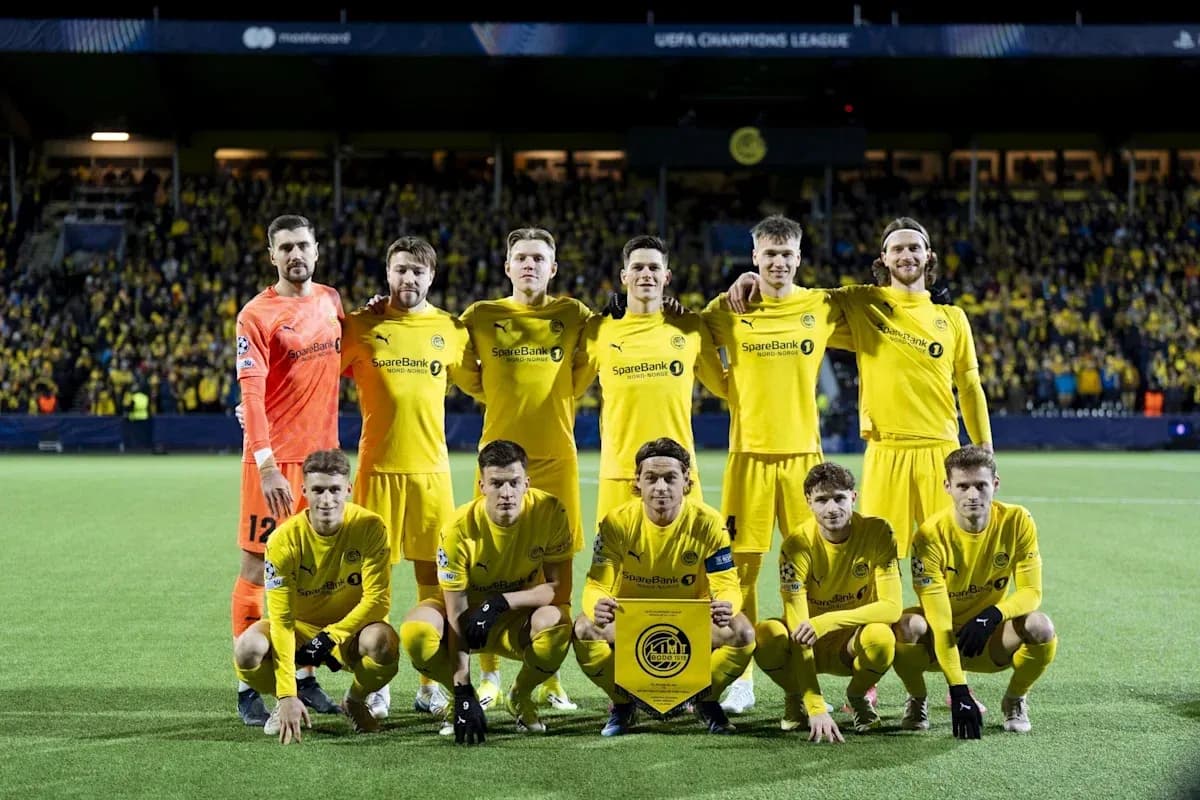
Bodo/Glimt’s Tactical Mastery in 3-2 Extra-Time Victory Over Union St. Gilloise
Bodo/Glimt’s 3-2 extra-time win over Union St. Gilloise at Aspmyra Stadion was a clinic in territorial dominance, structural patience and late-game management, eventually breaking a stubborn 10-man opponent that defended deep and countered selectively. Over 120 minutes, Bodo/Glimt’s 4-3-3, orchestrated by Kjetil Knutsen, imposed a 70% share of the ball, 23 total shots and 10 corners, slowly stretching Union’s 3-5-2 until the Belgian side’s resistance and numerical balance finally gave way.
From the outset, Bodo/Glimt’s positional play was clear: full-backs F. Bjorkan and F. Sjovold pushed high and wide, pinning Union’s wing-backs L. Patris and Guilherme Smith into a back five. The midfield trio of S. Auklend, P. Berg and S. Fet circulated the ball with remarkable security, reflected in the team’s 999 total passes, 889 of them accurate at 89%. Berg acted as the central pivot, dropping between centre-backs O. L. Bjortuft and J. Gundersen to initiate build-up, while Auklend and Fet advanced into the half-spaces to overload Union’s compact central block.
Union St. Gilloise, in contrast, built their game plan around defensive density and rapid transitions. With only 30% possession and 427 passes (335 accurate at 78%), they accepted long stretches without the ball, keeping their 3-5-2 narrow and vertically compact. K. Van De Perre and A. Zorgane were key in screening the back three of N. Havenaar, M. Sylla and K. Mac Allister, while the front pair of P. David and D. Olaru looked to spring counters into the channels once possession was turned over.
First Half
The first half, which ended 0-0, reflected this tactical tension. Bodo/Glimt probed methodically, but Union’s back line defended the box with discipline. The Norwegians’ shot profile already hinted at their approach: heavy volume in and around the penalty area rather than speculative efforts from range, ultimately finishing with 17 shots inside the box. Union, for their part, were content to survive without conceding big spaces between the lines, committing 10 fouls to break rhythm but staying largely organized.
Second Half
The game opened up after the break. In the 51st minute, Bodo/Glimt’s structural superiority finally translated into a breakthrough: O. Blomberg, operating from the right of the front three, finished after a contribution from J. Hauge. The pattern was emblematic of Bodo/Glimt’s plan—wingers starting wide, then attacking the half-spaces behind Union’s wing-backs once circulation had shifted the block laterally.
Union’s response was immediate and tactical. At 61', P. David (OUT) made way for M. Fuseini (IN), adding more direct running and vertical threat up front. The change paid off instantly as Guilherme Smith, arriving from midfield, equalized in the same minute after a contribution from Olaru. It underlined Union’s capacity to punch back in transition even while under sustained pressure.
Knutsen then adjusted his own midfield and attack to regain control of the central lanes and refresh the pressing. At 70', S. Auklend (OUT) was replaced by J. Kitolano (IN), and centre-forward O. Brynhildsen (OUT) gave way to A. Helmersen (IN). Kitolano brought fresh energy to counter Union’s counters, while Helmersen offered more penalty-box presence and combination play with Hauge and Blomberg. Union responded by introducing R. Schoofs (IN) for A. Zorgane (OUT) at 70', and later M. Biondic (IN) for D. Olaru (OUT) at 74', trying to maintain legs and decision-making in midfield and attack.
Bodo/Glimt’s second goal in the 76th minute encapsulated the impact of these tweaks. Hauge, who had been a constant threat cutting inside from the left, struck after a contribution from Helmersen, whose introduction had sharpened Bodo/Glimt’s movements between Union’s centre-backs. By then, the home side’s shot count and box entries were overwhelming; Union’s back line was forced ever deeper, and transitions became rarer.
Yet Union refused to fold. With their only corner of the match and a handful of direct attacks, they maintained enough threat to punish any lapse. In the 88th minute, Fuseini, the earlier substitute, finished after a contribution from Patris to make it 2-2. That goal, despite Bodo/Glimt’s control, showed Union’s efficiency: 19 total shots, 15 inside the box and five on target, a respectable attacking output given their limited possession.
Disciplinary Turning Point
The disciplinary turning point arrived in added time at the end of regulation. Union’s compact aggression boiled over: Kamiel Van de Perre picked up a first Yellow Card for Foul at 81', then at 90+6' received a second Yellow Card for Foul followed immediately by a Red Card for Foul. In the same 90+6' window, Guilherme Smith was booked for Argument, reflecting rising tension as Union clung to the draw. Reduced to 10 men, Union were forced into deeper, more desperate defending for extra time.
Extra Time
Extra time became a siege. Bodo/Glimt, still in their 4-3-3 but now with fresher legs, rotated intelligently. H. Aleesami had already come on for J. Gundersen at 41' (J. Gundersen (OUT), H. Aleesami (IN)), adding left-footed balance at the back. In the first extra-time period, I. Maatta (IN) replaced F. Bjorkan (OUT) at 103', and U. Saltnes (IN) came on for S. Fet (OUT) at 104', giving Bodo/Glimt renewed thrust down the left and an extra creative presence between the lines. Union, meanwhile, tried to inject pace and fresh energy with R. Mofokeng (IN) for B. Zeneli (OUT) at 91', and later R. Florucz (IN) for L. Patris (OUT) and O. Niang (IN) for Guilherme Smith (OUT) both at 120+1', but the numerical inferiority and accumulated fatigue were decisive.
The decisive moment came in the 117th minute, when Helmersen, who had already influenced the second goal, struck to make it 3-2. With Union’s block now a back four-plus-midfield scrambling laterally, Bodo/Glimt’s patience in circulation and relentless occupation of the half-spaces finally carved out the winning chance. Immediately after, Knutsen protected the lead by withdrawing Hauge (OUT) for V. Nielsen (IN) at 120+1', reinforcing the defensive line and adding aerial security for the final moments.
Defensively, both sides’ goalkeepers had contrasting workloads shaped by their team’s tactical choices. N. Haikin (Bodo/Glimt) faced fewer direct transitions than might be expected given Union’s counter-attacking intent, but still had to manage five shots on target against his side; his statistical line shows three Goalkeeper Saves, meaning Union’s finishing accounted for their two goals. At the other end, V. Chambaere (Union St. Gilloise) was under constant pressure from Bodo/Glimt’s 23 shots, nine of them on goal, and made five Goalkeeper Saves. The disparity in possession and shot volume meant Chambaere’s positioning and reflexes were repeatedly tested as Bodo/Glimt flooded the box with runners.
In terms of discipline and control, Bodo/Glimt balanced aggression with structure. They committed 11 fouls and received two Yellow Cards: Sondre Auklend for Foul at 16' and Haitam Aleesami for Foul at 92'. Union, by contrast, ended with four Yellow Cards and one Red Card: Van De Perre’s two Yellows for Foul (81' and 90+6') leading to his dismissal, Guilherme Smith’s Yellow Card for Argument at 90+6', and Kevin Mac Allister’s Yellow Card for Argument at 117'. The pattern fits the tactical story: a defending, increasingly stretched side resorting to more disruptive interventions as the match wore on.
Statistically, Bodo/Glimt’s dominance was comprehensive. Their 70% possession, 999 passes at 89% accuracy, 23 shots (nine on target, eight off target, six blocked) and 10 corners illustrate a team controlling territory and tempo, recycling the ball until space opened in and around the box. Union’s 30% possession, 427 passes at 78% accuracy and 19 shots (five on target, 10 off target, four blocked) highlight a more direct, risk-accepting approach that still produced two goals and several dangerous moments.
In synthesis, this was a match where structure and volume eventually overcame resistance and opportunism. Bodo/Glimt’s 4-3-3, with its high full-backs, rotating midfield and flexible front line, systematically dismantled Union’s 3-5-2 over 120 minutes. Union St. Gilloise’s game plan—deep block, compact central lanes, rapid counters—was executed well enough to force extra time and nearly steal progression, but the red card to Van De Perre and the relentless pressure on their back line tipped the balance. The final 3-2 after extra time accurately reflects a contest where Bodo/Glimt were tactically superior for long stretches, yet had to show resilience and late-game clarity to finally break Union’s resistance.