Australia vs Egypt: Tactical Clash in the Round of 32
The lights have already gone out at AT&T Stadium, but the Round of 32 tie between Australia and Egypt will live long as a study in contrasting structures, missing anchors, and one superstar’s gravity. After 120 minutes ended 1–1, Egypt walked away on penalties, 4–2, yet the real story lay in how these two squads were built and bent across the evening.
I. The Big Picture – Shapes, context, and tournament DNA
Both sides arrived in Dallas with group-stage profiles that foreshadowed the script. Australia had been functional rather than fluent: in total this campaign they had played 4 matches, winning 1, drawing 2 and losing 1. At home they had scored 3 goals and conceded 1; on their travels they had yet to score, conceding 2. Overall, that left them with 3 goals for and 3 against, a perfectly balanced goal difference of 0 and a cautious attacking average of 0.8 goals per game in total.
Egypt, by contrast, carried a more assertive attacking identity. In total they had played 4 matches as well, with 1 win and 3 draws and no defeats. On their travels they had scored 5 goals and conceded 3; at home they had 1 goal for and 1 against. Overall, 6 scored and 4 conceded gave them a goal difference of +2 and a total scoring rate of 1.5 goals per game, with 1.0 conceded.
Those numbers framed the tactical clash. Australia, second in Group D with 4 points and a group goal difference of 0 (2 scored, 2 conceded), leaned into structural discipline. Egypt, second in Group G with 5 points and a group goal difference of +2 (5 scored, 3 conceded), looked like a side comfortable in chaos, trusting their forwards to tilt the margins.
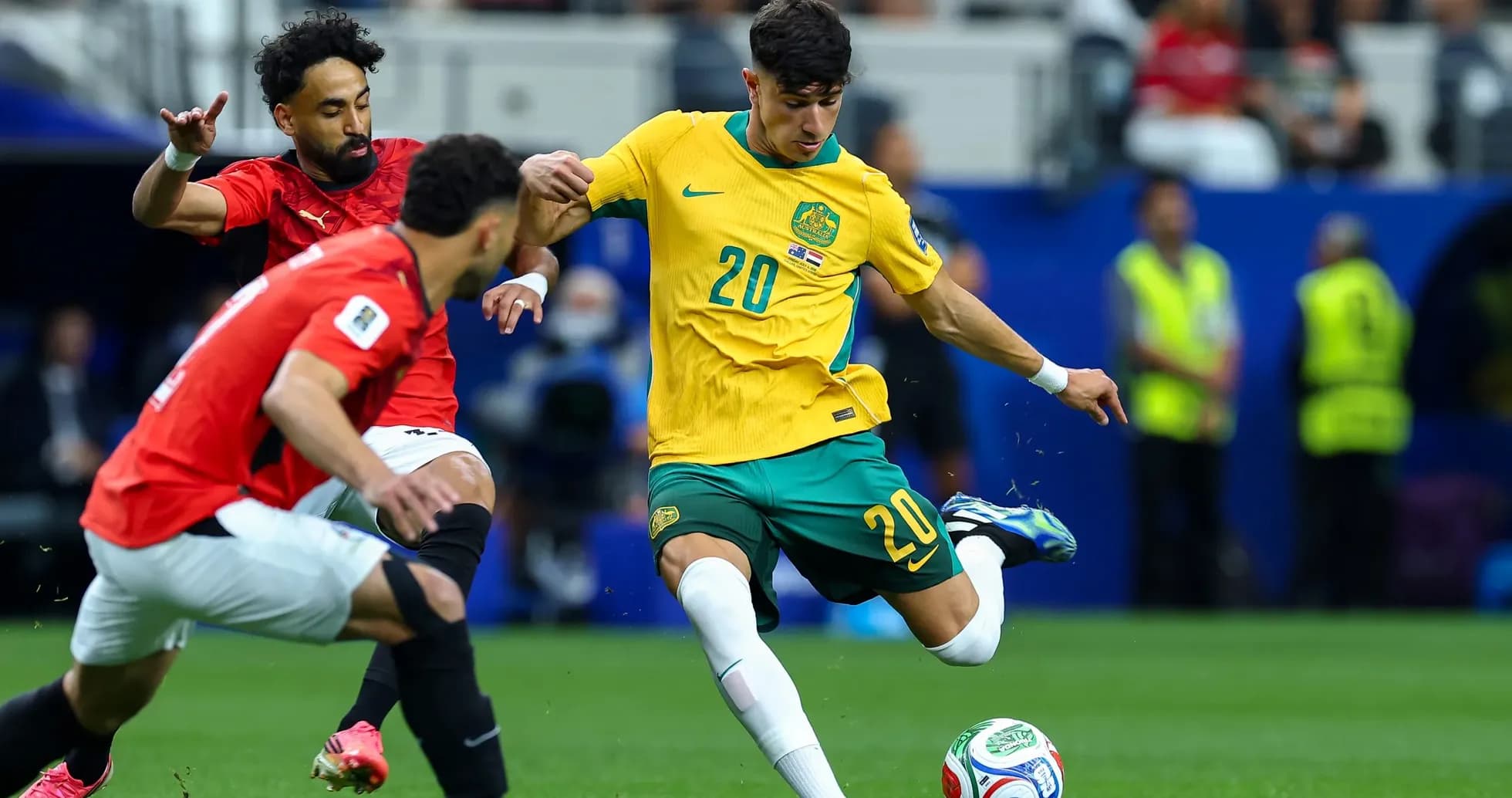
On the night, Tony Popovic doubled down on control with a 3‑4‑2‑1: P. Beach behind a back three of A. Circati, H. Souttar and L. Herrington, with a wide four of J. Bos, J. Irvine, A. O’Neill and A. Behich, and a fluid attacking trio of C. Volpato, C. Metcalfe and N. Irankunda. Hossam Hassan’s Egypt answered with a 4‑4‑2 that was really a 4‑2‑3‑1 in disguise: O. Shobeir in goal, a back line of M. Hany, Y. Ibrahim, R. Rabia and K. Hafez; a central pair with E. Ashour and the listed H. Fathy; O. Marmoush drifting from the left, M. Salah nominally up front but often dropping, with M. Ziko as the second striker.
II. Tactical Voids – Who wasn’t there, and what it changed
Both squads were quietly reshaped by absences. For Australia, the loss of M. Leckie to a hamstring injury removed a proven big‑tournament runner from the front line, while J. Italiano’s ankle problems limited goalkeeping options and likely reinforced the decision to trust Beach from the start. Without Leckie’s direct, channel‑running threat, Popovic’s front line leaned more on the unpredictability of N. Irankunda and the combination play of Volpato and Metcalfe than on stretching Egypt vertically.
Egypt’s absences cut closer to the spine. Hossam Abdelmaguid was unavailable through suspension, while Mohamed Abdelmonem’s ankle problems and Ahmed Abou El Fotouh’s hamstring injury stripped depth and continuity from the defensive unit. Perhaps most crucially, Mohanad Lasheen — one of the tournament’s standout enforcers with 13 tackles, 4 blocks and 4 interceptions in 270 minutes — was missing through suspension. His two yellow cards had underlined his combative edge, but his absence here robbed Egypt of a ball‑winning shield in front of the defence.
The irony was stark: Egypt’s statistical profile showed no clean sheets in total, with 4 goals conceded overall and yellow cards spread aggressively across the first hour and into extra time. Australia, by contrast, had kept 2 clean sheets in total and conceded just 1 goal at home and 2 away. Yet it was the side missing its premier destroyer that ultimately survived.
III. Key Matchups – Hunter vs Shield, and the battle for the middle
The headline duel was always going to orbit Mohamed Salah. Across the tournament he had already delivered 1 goal and 2 assists in 4 appearances, with 16 key passes, 6 successful dribbles and 37 duels contested, winning 19. Here, he floated between the lines, forcing Australia’s back three to constantly hand him off between Souttar’s aerial dominance, Circati’s aggression and Herrington’s cover.
Australia’s “shield” was collective. J. Irvine and A. O’Neill formed a double pivot that had to both screen Salah and Marmoush and initiate transitions. Irvine’s engine and O’Neill’s positional discipline allowed the wing‑backs, Bos and Behich, to push high in the 3‑4‑2‑1, trying to pin Egypt’s full‑backs and prevent them from doubling up on Irankunda and Volpato.
On Egypt’s side, the defensive leader was Yasser Ibrahim. His tournament numbers told a clear story: 7 tackles, 3 blocked shots, 2 interceptions and a 91% passing accuracy across 376 minutes. Against Australia’s lone striker, he marshalled the line, stepping out confidently when Volpato or Metcalfe drifted into half‑spaces. The absence of Lasheen meant more responsibility for E. Ashour and the listed H. Fathy to plug gaps; both had to shuffle laterally to track Australia’s inside forwards, occasionally leaving space for Irvine to advance.
The “engine room” duel thus became a three‑layered contest: Irvine and O’Neill vs Ashour and Fathy in the first phase; Bos and Behich vs Marmoush and Hafez in the wide channels; and, above it all, Salah’s freedom against the collective intelligence of Australia’s back three. Time and again, Salah’s gravity pulled markers out of line, creating pockets for Ziko and Marmoush to attack.
IV. Statistical Prognosis and the penalty epilogue
Heading into this game, the numbers suggested a narrow edge for Egypt. On their travels they had averaged 1.7 goals scored and 1.0 conceded, compared to Australia’s total scoring average of 0.8 and conceding 0.8 overall. Egypt’s lack of clean sheets hinted at vulnerability, but their unbeaten run and higher scoring ceiling made them slight favourites in an open contest.
Discipline patterns added another layer. Australia’s yellow cards were heavily back‑loaded, with 40.00% of their cautions in the 76‑90 minute window, pointing to late‑game strain when chasing or protecting results. Egypt, meanwhile, spread their bookings more evenly, with 25.00% of yellows between 16‑30 minutes, another 25.00% between 31‑45, and a further 25.00% in the 91‑105 period, plus 12.50% in 106‑120. This painted a picture of a team willing to foul early to break rhythm and again in extra time to manage transitions.
Over 120 minutes, those tendencies played out in miniature. Australia’s structure limited Egypt’s volume, but they struggled to consistently turn territory into high‑quality chances, in line with their modest total scoring record. Egypt, even without Lasheen and key defensive pieces, generated enough threat through Salah’s creativity and Marmoush’s movement to keep Beach busy and the back three honest.
When the match finally tipped into penalties after a 1–1 stalemate, the underlying storylines converged. Egypt, unbeaten in total and accustomed to navigating tight margins, held their nerve from the spot, converting 4 to Australia’s 2. For Popovic’s side, the campaign’s statistical arc — solid defensively, limited offensively — ultimately caught up with them in the most brutal of lotteries.
For Egypt, the shootout win felt less like fortune and more like the logical extension of their tournament identity: imperfect at the back, but driven forward by a world‑class talisman in Salah, a hardened back‑line leader in Ibrahim, and a collective comfort with living on the edge.