Atletico Madrid Questions VAR Decisions After Loss to Barcelona
The tension inside the Wanda Metropolitano has stopped being a mood and started to feel like a permanent fixture. Atletico Madrid are not just angry about a defeat to Barcelona; they are furious about what they see as a pattern, a sequence of decisions in big games against Real Madrid and Barça that has pushed the club to openly question the system itself.
This is no longer the usual grumbling about referees. This is about trust.
The tackle that lit the fuse
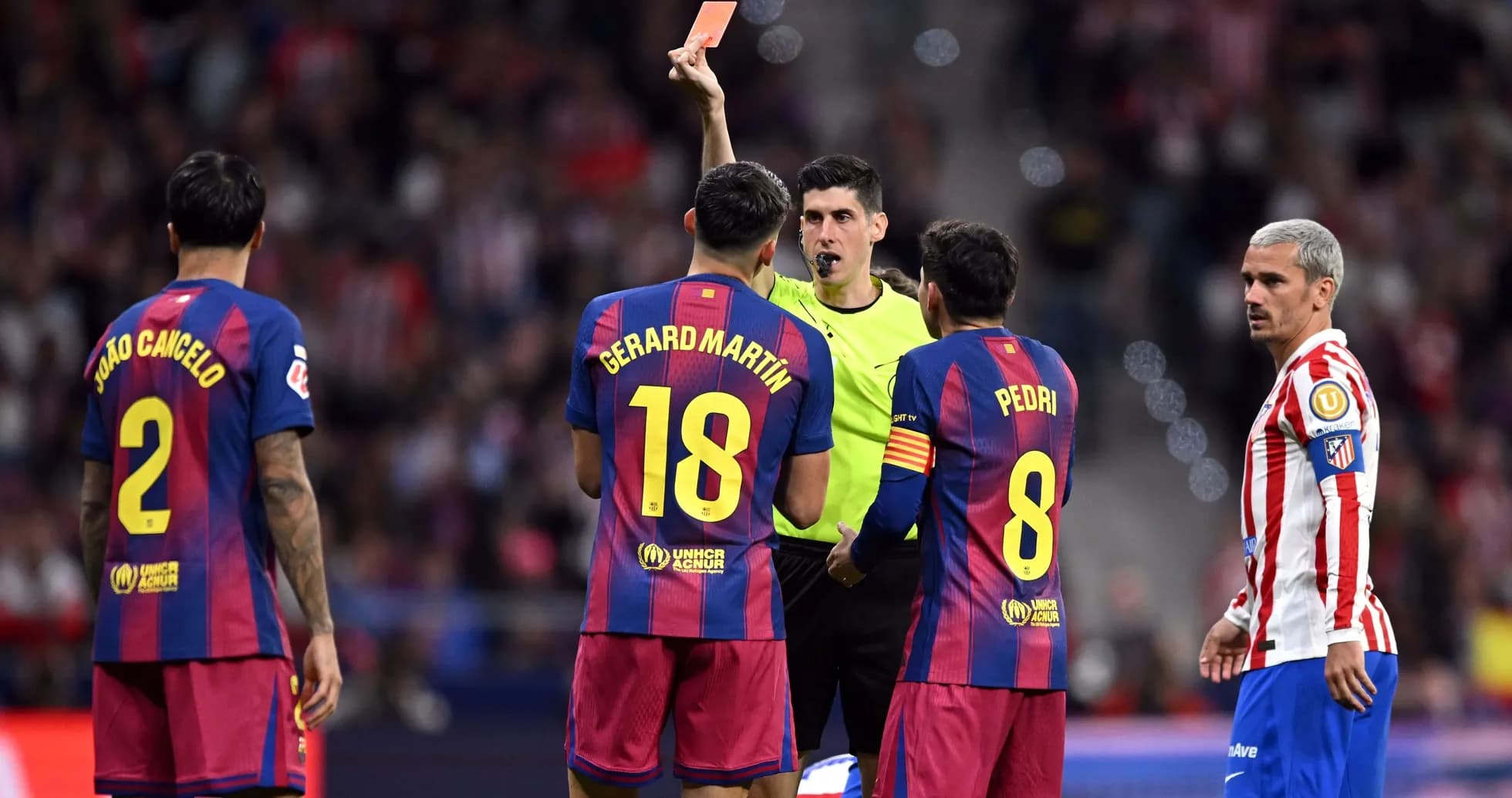
The flashpoint came on Saturday in a 2-1 loss to Barcelona. Early in the second half, Gerard Martin flew into a high challenge on Thiago Almada. Referee Busquets Ferrer went straight to his pocket and produced a red card. The Wanda roared. Justice, it seemed, had been done.
Then VAR stepped in.
From the booth, Melero Lopez advised a review. After consulting the monitor, Busquets Ferrer downgraded the decision to a yellow. The mood in the stadium flipped in an instant. What had looked like a turning point for Atletico became, in their eyes, another chapter in a familiar story.
Los Rojiblancos went on to lose, and the sense of injustice hardened.
Marin tears into VAR audio
When the audio from the VAR room was later released by the Federation, Atletico chief executive Miguel Ángel Gil Marín did not hold back. For him, the problem is not just one incident, but how the technology is being used.
He argued that VAR is no longer a tool to correct “uninterpretable errors” but a mechanism that shapes, even steers, the on-field referee’s judgment. In his view, the authority of the referee on the pitch is being eroded, replaced by the voice in his ear.
“When we see the images and hear the audio shared by the Federation, all we can do is feel ashamed,” Marin said, as quoted by Marca. He condemned what he described as comments from the VAR room that run completely against how the system is supposed to function, and he railed at the lack of consequences when that happens.
For Marin, there is a clear line. Referees, like players and coaches, are allowed to make mistakes in real time. That is part of the game. It is something else entirely, he argued, when an official in the booth actively influences a colleague who is trying to interpret a challenge on the pitch.
The message from Atletico’s hierarchy is blunt: the referee on the grass must own the decision, not simply rubber-stamp a verdict delivered from a screen.
“Different decisions for identical plays”
Marin’s anger runs deeper than one tackle. He pointed directly at what Atletico see as shifting standards, especially in recent matchdays.
He highlighted the inconsistency of “different decisions for identical plays,” a constant change in criteria that leaves clubs unsure of what to expect from one game to the next. For Atletico, the last two league fixtures have crystallised that feeling. Similar incidents, they argue, have produced very different outcomes, and always at a cost to them.
“It makes no sense,” he concluded. In his eyes, the system has stopped being transparent and started to feel arbitrary.
Le Normand: “Everyone who understands football knows it was red”
Inside the dressing room, the mood matched the boardroom.
Robin Le Normand spoke with the same edge after the final whistle. The defender did not dress his words up. For him, Martin’s challenge on Almada was a straight red, pure and simple.
“Now they're going to say it wasn't a red card, but everyone who understands football knows it was,” he said. He drew a direct comparison with a recent incident in the Betis–Rayo Vallecano match, where the CTA (Technical Committee of Referees) had ruled a similar challenge a sending-off. Same type of action, different punishment. Le Normand admitted he had no explanation for what changed between that match and this one.
He also painted a picture of a game that felt out of control in another sense. Players, he said, could not speak to the referee, not even the captain. Every protest, every question, seemed to be met with a yellow card. Instead of cooling things down, the official “raised the bar for the game,” as Le Normand put it, escalating tension rather than managing it.
“Everyone can make mistakes,” he accepted, but he was clear: in his view, the referee made one here, and “everyone saw it.” What stung most, he said, were “the little things” – the accumulation of marginal calls and small decisions that, over 90 minutes, tilt a match.
A club at war with the system
Atletico have never been shy about embracing the role of outsiders in Spanish football’s established order. This, though, feels different. The criticism is not wrapped in rivalry or theatre; it is directed squarely at the mechanisms meant to guarantee fairness.
When club executives are talking about shame after listening to VAR audio, when senior players openly question whether identical incidents are being judged on the same scale, it points to a deeper fracture.
The Wanda Metropolitano will move on to the next match, the next fight, because it always does. But until those in charge of Spanish officiating convince Atletico that the criteria are clear, consistent, and applied without fear or favour, every whistle in a big game will carry an extra weight – and every VAR check will be heard in Madrid with suspicion rather than relief.